You should do this …
https://www.howtogeek.com/things-you-should-do-after-purchasing-a-new-windows-laptop

… for Cardiff u3a
You should do this …
https://www.howtogeek.com/things-you-should-do-after-purchasing-a-new-windows-laptop
As hardware/software has developed, has enough consideration been paid to redundancy (ie failsafe solutions). This article, whilst bemoaning the underlying architecture of Microsoft’s Windows operating systems (since Windows 3.1), points more widely to the way that modern systems don’t really address the issue of … “What if this happens, then what?”
Again, this is a difficult decision on which Forum to post, but I settled on this one. You should read and consider whether the security issues it raises concerns you, or not, and take appropriate action …
I hear it rather too often, and have commented on strategies to delay upgrades until Microsoft get the bugs out of a release, but here’s an article that might help you improve performance if your machine seems to be running slower after an upgrade …
https://www.howtogeek.com/windows-pc-sluggish-after-an-update-try-these-fixes-to-speed-it-up

It was less than 12 months ago that we had a session looking at the emerging technology of Large Learning Models (LLM) and in particular Chat-GPT and Dall-E from Open AI. In fact it was the meeting we had on the 23rd March, and this was the article I created for that meeting; I also put a slightly different version of it on the public Cardiff u3a website. Sianed and I also debated the topic in September, an experience neither of us would willingly go through again!!!! So with so much having happened in such a short period of time, it certainly seemed right to revisit the topic and see what’s happened.
First some background, some developments and some resources for you to follow-up, then some notes and content from three member contributions. We have Jonathan, Iain and Phil to thank for these.
What do we mean by Artificial Intelligence. Well, nothing that’s really appeared in the past 15 months it would have to be said. Some articles for you to consider …
Race to AI: the origins of artificial intelligence, from Turing to ChatGPT – in this article from The Guardian the background to what is, and what is not, artificial intelligence is explored and whilst recognising that a step-change has occurred, we have not yet reached the “nirvana” of artificial intelligence.
A simple guide to help you understand AI – in this animated webpage from the BBC, you have the “Janet and John” introduction to artificial intelligence. That’s not meant as an insult in any way, it’s a very straightforward introduction to the subject and if you switch the animations on you will get a full-experience.
It is however the Royal Institution’s Christmas Series of Lectures fronted by Mike Wooldridge that perhaps best defines the scope, the possibilities and the future of artificial intelligence. I seriously recommend that you watch all three lectures on BBC’s iPlayer.
Much of the attention in the past year or so has been focussed on LLM and Chat-GPT. Which? attempts to answer the question – “is it safe to use” in this article, but comes up with more questions than answers, but it does a bit of explaining along the way, but actually the best way to find out what Chat-GPT can do, is to try it yourself, which you can do here, after signing-up for an account on the Open AI servers.
Some experiments and experiences. We kicked-off here with Jonathan telling us about his experience of using Microsoft Copilot.
Microsoft Copilot
Microsoft has released several AI “Copilots” that can complete different tasks for different purposes.
https://www.zdnet.com/article/what-is-microsoft-copilot-heres-everything-you-need-to-know/
https://www.tomsguide.com/how-to/how-to-use-copilot-to-control-windows
Of all the commercial developments in the past year it’s Microsoft that’s led the way, but Google’s working hard to keep-up, first with it’s Bard model, and latterly with it’s Gemini software.
Iain led us through some of the features of Bard and this article indicates the differences between Bard and Chat-GPT. Iain was particularly struck by the way the system seemed to learn from one day to another. An inappropriate response to a question of taking your grandchildren somewhere in Cardiff, had been replaced by a much more acceptable answer. How does this happen? Has it learnt something? Or, is it’s previous answer become part of the resource that it uses to find responses. I guess we’ll never know!!
Since the meeting Iain has also shared with us in the Artificial Intelligence Forum a really interesting and potentially useful use of AI in interpreting scrolls recovered from the eruption of Vesuvius. There are many really useful uses of AI, as the Royal Institution lectures showed us. I aim to add Topics to that Forum over the next few weeks (and months) as they emerge, and I encourage you to do the same.
We then had an illuminating presentation from Phil, that I encourage you to look at.
It starts off with Phil’s interest in Family History and his ancestor’s death from cholera which prompted him to enquire about that epidemic.
He then asked Chat-GPT to write an essay (which he’d had to do in an earlier life) on the topic “Liberal and Utilitarian Educational Thinking in 19th Century Great Britain: A Comprehensive Analysis with Reference to Cardinal Newman”
He felt that the attempt was worth at least a B+
He then shared with us some images created by Image2Go.com not all of which totally hit the brief he’d requested.
In conclusion, I shared a few issues …
Volkswagen says it’s putting ChatGPT in its cars for ‘enriching conversations’ – really? The first recording of a Tesla driver wearing Apple’s Vision Pro headset has already been posted to the internet. Where’s the common sense, in common sense?
A frankly rather surprising Judges in England and Wales are given cautious approval to use AI in writing legal opinions.
A totally unsurprising Britain’s MI6 chief says his spies are using AI to disrupt flow of weapons to Russia.
3 reasons why AIs like Microsoft Copilot and ChatGPT will only get worse — and why it doesn’t have to be this way – a suggestion that as more and more AI-generated content floods the internet, and as more and more reliable content providers stop the “bots” from trawling their sites, that the quality of information on the web will decrease. AI eating itself is a phrase that might come to mind.
Finally a very thought-proking article – AI Needs to Be Both Trusted and Trustworthy – a theme picked-up by Ian (not Iain) on Signal with his reference to the fact that Chinese academics wary of their reputations have moved towards implementing new guidelines to protect the quality of their research.
I’ve put quite a few articles up on Flipboard in the past couple of months. I aim now to move some of them into the Artificial Intelligence Forum on Thought grazing with a brief commentary, and I invite your replies/comments. I think this move indicates that I will be using the Forum more for reference, and Flipboard more for news. I think that makes sense.
[A short series of posts that I aim to also put up on the Digital Matters page of the Cardiff u3a website]
If you watched Rip Off Britain on January 15th [Episode 35 of Series 15 at c. 29mins 45secs into the programme] you will see an expert describe the Scam that one of our members has experienced recently and which has led me to write this post which may well be the first of a number on the subject of Scams.
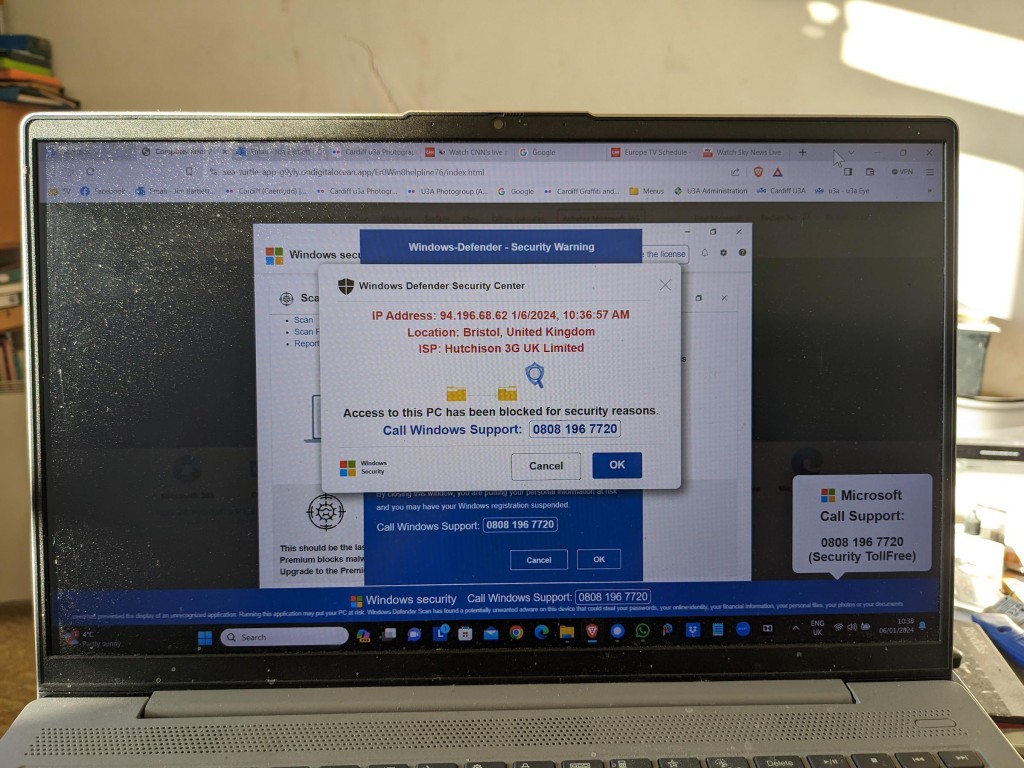
This scam manifests itself by your computer screen being taken over by a popup which also freezes your screen. You are instructed by a voice-over not to turn off your machine but instead to ring a telephone number where you will be “assisted” to unlock your computer which has been locked – in this case supposedly by Microsoft, but it could be any large tech company – for your protection.
This alarming message plus the fact that your screen has frozen may lead you into thinking you better click on the button to seemingly connect to Microsoft. This will lead to a telephone conversation where you will be requested to supply information that will undoubtedly lead to fraud.
Do nothing!
Note well: No tech company will approach you in this way. They will not be doing this form of online monitoring of your devices. In this case the scam is preying on the fact that you are being led to think that your Windows Defender Security package is not working properly. No tech company would readily admit to its users of a deficiency in their programs in this way – that could lead potentially to legal action being taken against them. For a genuine issue they might issue an alert on their webpages and a request to upgrade (or whatever), or they might be forced to send an email to registered users, but they would not send unsolicited messages in this way.
It is important to realise that with this scam, at this stage, the scammers know NOTHING about you. The scam works by malicious code having been added to a website you are visiting, or to an advert on the website you are visiting. The simple solution is to press F11 to unlock your screen, note the website address and make a note not to go to that site again. [I would probably also recommend clearing your internet cache and history from your browser before closing down your computer; waiting a few moments; and then re-booting it.]
The more long-term solution is to install an Ad Blocker such as AdBlock Plus as an extension to your browser. This would act in conjunction with your standard security software which on a Windows machine could well be Windows Defender.
Happy, safer surfing.
If you want to see the recording of the message that our Digital Matters member made of the scam, watch the video below …


First, an overview
This article from Norton is as good as any at summarising what you should do by way of maintenance – regular tasks that will make your machine run smoother, and possibly faster.
Backups
There are built-in options supplied for both Windows and MacOS – there’s no real reason to look beyond these. This table (for Windows 10) shows the different methods you might consider. I’ve also included this article that might help you understand what your need to do. However, with Windows (it’s never straightforward) you have another option File History, which maybe a better option, as it focuses on saving files to an external hard disk.
For the Mac, I wouldn’t bother going further than TimeMachine. You’ve heard me rave on about the Mac, but it’s true. You may do things differently on a Mac, but they’re just easier.
The most important thing is to do Backups, and do them regularly. My TimeMachine does an incremental backup every hour to an external hard disk. So the most I can lose should the machine crash, is the last 59 minutes. Some items will be excluded from this backup (eg photos) as they are backed-up automatically to iCloud when I import them on to my machine.
Windows 10 and 11 Maintenance
Let’s start by looking at this short video. You’ll want to go back and watch it more than once. Although it is aimed at Windows 10, I think all the utilities mentioned are available from Windows 11 too.
If you prefer reading to watching, and you’re a Windows 11 user, you will possibly find this article useful. If you don’t trust yourself to do the maintenance regularly, then Windows 10 users might find this article useful as it tells you how to schedule automatic maintenance and what it will do, but if you prefer your instruction to be visual you could watch this video instead, or as well.
If it’s just a speed-up you want from your Windows 11 system, you could work your way through the list in this article, but I’d be tempted to do the more comprehensive list of tasks mentioned in the videos above.
MacOs Housekeeping
Here it’s more housekeeping than maintenance, there are some things you can do to improve performance on your Mac, regular maintenance (as mentioned above) is not really required. This article aims to make your machine run better and faster – I’ll have to read it!!
The software I use on my Mac is CleanMyMac X – this article describes what you should do to automatically do some decluttering, which is probably a good thing and which I run once in a while; it obviously recommends that you use CleanMyMac to do it. Quelle surprise!
Operating system updates and upgrades
These are usually well announced by Microsoft and Apple. Generally, if the update is described as a Security Update, you should do it immediately; if it’s described as a bug-fix, or a point release with new features, I would counsel waiting a while … perhaps a couple of weeks, before installing it. Of course you can leave your operating system to do these automatically, so check your settings (as described in the videos) and select the time that your updates will be done.
More substantial upgrades are less frequent and my advice is to wait a while before installing these as it’s always challenging to go back to a previous release, and sometimes the upgrade will affect the running of one of your applications. All serious software developers will apply to get advance access to operating system upgrades to test their software on the new platform; but even with this access some bugs may not appear until the operating system is “out-in-the-wild”.
Internet history, cache and cookie cleaning
These were covered in the earlier videos but you should probably do these quite regularly anyway. You might have noticed that cookies weren’t “cleaned-out”. That’s probably because the majority of them will be re-installed the next time you go to a website, and cleaning them will also mean you have to re-enter information again. Generally, with good anti-virus software these days, cookie cleaning is not essential, as the malware threat has been reduced before they’re added to the browser.
Anti-virus and malware checking
For the Mac I have MalwareBytes (supplied by my bank). For the PC/Windows you know that I recommend Widows Defender, as it’s more than adequate for the “ordinary” user who’s not surfing the dark web! It’s evident that Microsoft have upped their game in this area and you can also deploy other tools to protect your machine. Take a look!

Hardware upgrades – memory, batteries
You might wonder whether you’re up to upgrading memory or batteries on your laptop or desktop, but actually this is a relatively easy job. You can use components from Crucial for memory and hard disk upgrades, and they describe how to do it for specific machines, or you can search for compatible components on the internet. Search for the instructions on how to fit for the specific DIY task. You’ll feel a sense of pride when you’ve completed the task too! A triumph for “person kind” over the machine
A really good upgrade is to replace an old Hard Disk Drive (HDD) with a Solid State Drive (SSD). The performance enhancement you will experience will be noticeable. You can always deploy the old HDD as an external disk and maybe use it for your backups when you place it in an appropriate caddy.
If you’ve not got the courage to do it yourself, you can always ask We will fix your PC to do it for you.

Cleaning screens and keyboards
Often overlooked, your screen and keyboard can always do with a clean, and you’ll be surprised at the difference it makes – to your mood if nothing else. I recently purchased this kit from Amazon to clean screens, keyboards and TV.
Application housekeeping
Another often overlooked consideration. You should look at whether your software should be upgraded. If it was purchased through an AppStore then you should be able to find out if there’s an upgrade available – you may have to purchase it, but often the upgrade will be free. Often the software provider – if you’ve registered your ownership – will inform/advise you of an upgrade to a new version, or release. Generally bug-fixes are not chargeable, but you may have to pay for feature-enhancements.
Please be aware that it’s impossible to expect that a software developer will keep their software compatible with every release of operating system software, so if advised that this is the case you should seriously consider an Upgrade, or finding a replacement if the software passes “out-of-support”.
You should also look to see whether (as was mentioned in the videos) you actually need the software anymore. At best it might just be taking up disk space you might need, at worst (as it becomes more outdated) it might provide a “backdoor” for malware to enter your system and upset your life!
Some applications (as was mentioned in the videos) also have local data caches and backups (genealogy database software is notorious for this). As you exit your session you are prompted to save a backup – the question is … how many backups do you actually need!!
All-in-one solutions
For the PC/Windows you could look at CCleaner (free version) – I love this quote from the article “Macs don’t need standard cleaning” but I do have MacPaw’s CleanMyMac X on my machine, and I bought it! However if you’re a Windows user there’s a lot to be said to doing the cleanup manually following the suggestions mentioned in the videos, I have shown.
Miscellaneous – eMail, Contacts, Calendars, Reminders, Notes, Photos
Not strictly maintenance but something to bear in mind and perhaps make a regular task, is maintaining your “everyday” applications.
Do you need to keep all your eMails? It may be possible to Archive them outside the Mail application – thus making it run faster and more efficiently. You can also if you’re using a local mail client (recommended) occasionally rebuild, or optimise, the email storage. It’s just a database and it will run more efficiently if it doesn’t have a lot of redundant links to deleted messages, and the like, contained in it. You may be surprised at the large number of files (especially photos) that are stored in your email. Perhaps you should save them to a Photos app, or at least download them to a folder on your machine – they’d be more accessible there.
It’s surprising how many Contacts are duplicated, or how details and lists can get out-of-date. Always a good idea to review them and merge duplicates, edit changes and delete no longer needed entries.
Calendars are less needing of maintenance. If the day has passed, so what; it’s more important to know the forthcoming events are accurate and up-to-date. However recurring entries should be reviewed occasionally.
Again, like the above, it’s more important to keep Reminders up-to-date, and if you decide to use that utility, to stick to it. It’s an application that you shouldn’t use occasionally, you should commit to using it, and then be able to rely on it. As I demonstrated recently you can talk to it – as of course you can with a lot of utilities and applications.
Notes can become a bit of a dustbin, and I suppose you should be allowed to have somewhere you just dump stuff. However, they do have a very useful role in planning, and charting progress of a project, or a trip – especially when you can show completion with a bullet-point format. The functionality is always improving and now you can store website addresses, photos, maps, music and more in a note and then share it with someone else so that they can collaborate with you on the topic. It’s just a bit embarrassing when you look back at what you’ve “noted” and realise it never actually “turned-out-like-that”.
Finally Photos. Probably the biggest hard disk grabber of all. You need to plan a strategy for what you want to keep, the application you want to use to access them, or share them, and then – if at all possible – stick to your plan! Not always easy, but for your sanity, probably essential. The first task is to work out your duplicates. This is where DupeGuru comes in. Apiece of open source software that has proven to be a life-saver to me, and a tool that has allowed me to recover a lot of disk space. It works well with phoitos, but can also be used to find duplicates of other file types as well.
… and there’s probably more – over to you!!!
More reading
PC Maintenance Software: 6 Best to Use in 2023
Best free PC optimizer of 2023
In case you are wondering how I take a picture of our Zoom meetings, the answer depends on which operating system you are using. (I am using Windows 10.)
David has supplied these instructions for Apple users:
Taking a screen shot on a Mac …
support.apple.com/en-gb/HT201361
Alternatively from MacOS Mojave onwards there’s a tool called Screenshot – here’s a link to the Help file …
support.apple.com/en-gb/guide/mac-help/mh26782/mac
To do a screenshot of an iOS or iPadOS device, press the power-off button and then the Home button.
With a Windows computer, the simple answer involves the ‘PrtSc’ key, near the right hand end of the top row of the keypad. You might have to press the Alt key or the Fn key, on the bottom row, at the same time. You will have to experiment. A message might pop up, saying the screen shot has been saved somewhere. If that doesn’t happen, the image might have been saved to the clipboard, in which case you will have to choose somewhere to paste it.
The less simple Windows answer involves the Snip and Sketch program, which you access by pressing the Windows key + Shift + S. This gives you the opportunity to crop the picture on the screen, so you only save the area you want.
For Android tablets and phones, press the power and volume-down buttons at the same time. I couldn’t get that to work with my phone though. I did have success by holding the power and ‘home’ buttons together. The screen flashed to show the shot had been taken. The picture went to Google Photos and to the Gallery.
Good luck!
Jim
It’s often useful to be able to send an image of your screen, or part of your screen to someone. In fact I use this facility all the time when creating these blog posts.
On the Mac, it’s very easy …
Press Cmd-Alt-3 to capture a complete screen
Press Cmd-Alt-4 to draw a window that you want captured
To be guided through the options you can
Press Cmd-Alt-5 and from the Options screen decider where you want to save your Screen shots [I save them to a Dropbox folder so they’re available between my two machines], and also choose the option for the type of screen capture you want, or even to Record a series of actions.
On the iPad/iPhone, it’s straightforward too. You can capture a screen by Pressing the Power Button and the Home Button together [It works best if you press the former just before you press the latter].
To take a screen shot in Windows, I suggest you follow the advice in this post. Or alternatively watch this video …
Jim has sent me this note as well …
“It might be helpful for your notes if I run through my Windows 10 sequence. The relevant key on my laptop is labelled SYSRQ/PRTSC, so I have to press the ALT key at the same time to print the screen. This puts the image onto the clipboard, so I then have to save it somewhere. I usually go to Paint Shop Pro and paste it as a new image. One thing I am investigating is what happens if you have two pages at once on the screen. At the moment I can only print one of the pages, depending on which I click on.“
Try dupeGuru – it’s very good at finding direct matches of files on your machine even when they have different names. It also provides a matching score so that if it’s not exactly sure that it’s found a match it will score it and you can then make a decision after inspection. Otherwise you can delete or move it to an archive folder – just in case!