A short set of notes to mark the last meeting of the Computer Group before it rises like a phoenix from the ashes as “Digital matters” in September (14th September to be precise). It was great to see some returning faces – David Hughes, Jonathan Guest, Steven Jones and Rob Morris; extend the welcome I should have made to Elaine Millward – attending her second meeting; report that Fred Davies was on the mend and hoped to be with us in the autumn and to accept apologies from Sianed, Don, Margaret and Sue.
But we still managed to have an attendance of 17 which was magnificent and which means we ended the year on a high point in terms of numbers. It was accepted that we would start the year in September with a subscription of £2.50 a meeting but would reduce it through the year if we were building up a surplus. [I’d much prefer to reduce through the year than increase.] My guess is that we are quite close to breaking even this year, but I’ve not done the sums yet. We started last year at £1.50each with a room fee of £15 an hour – but this increased at Christmas to £20 an hour with reducing numbers.
I encouraged members to join the Signal group and I have 4 members to add – Elaine, Rob, Steven and Tony – I should have sent the invites before these notes are published. I must also check that I’ve added members who have joined us through the year to the Thought grazing community – I know I must add Elaine, but there maybe others who might have been overlooked. In which case they’ll have a lot of reading to do to catch up!!!
I also mentioned the Meet the Groups event which will take place on October 10th at URC at 2:00pm. Yvonne and Stella offered to help me with the stall to describe what we do to prospective members who might have to go on a waiting list as I’m limiting the group size to 25 max. I mentioned that I had to write a new description for the group which I’d circulate for comment before submitting our new description to the u3a website.
Finally in the introductory remarks I mentioned to members that I was taking part in the inaugural Debating Society meeting opposing the motion “The Use of Artificial Intelligence will be a bad thing for mankind”. This will take place at URC on 5th September at 2:00pm. I’m looking for a Seconder and hopefully can get support from someone in the group.
I then presented the talk on Smart TVs which sparked some lively discussion, particularly from Ralph who would appear to be very knowledgeable on the subject and who contributed a lot to our understanding of colour and the need to really try and get to the point where we could appreciate that what you wanted to see in your home was the same as what you were being shown in the sale room.
Following that we had a discussion on developments in the ChatGPT/Bard and Artificial Intelligence space since we discussed it earlier in the year.
Have a great summer everyone. I hope to see you in September but if you don’t want to join the new Digital matters group, please let me know. You’ll always be able to access Thought grazing and I’ve no reason to take you off the Signal group.
I last ran this topic in 2019 pre-Covid, so a lot of water (dare I say streams) will have gone under the bridge since then, but actually not much has changed either. Essentially screen technology has improved and some suppliers have adopted a standard LED technology across their range, which makes choice easier, and also they (particularly LG, but other main players too) now use the same operating system platform across their range – thus making it easier to use different TVs from the same manufacturer.
What hasn’t changed is the way they compete with each other for the “smartness” of their devices, so I will spend some time on that, without giving too much in the way of recommendations – that has to be a very personal choice, but hopefully if you’re undecided you may find something of use to make a choice.
So first the questions you need to ask yourself, with a guide to possible answers.
Do you need a Smart TV? Concerns about privacy; advertising; snooping [Reveal – you don’t need a Smart TV, it’s just terribly difficult to avoid getting/buying a new one – and I certainly wouldn’t recommend buying an older model second-hand!]
Links to non-Smart TVs (from Amazon UK) – one model from LG; Sharp quite possibly; Cello the major supplier in the UK market.
Finally a dated article from my last summary, but the findings are no less valid and do indicate that a streaming device might be worth considering.
Is the built-in Smart TV provided the best way forward? Well from a convenience point of view, quite probably yes; but if you’re concerned about obsolescence of the Apps on the platform; privacy etc – quite possibly not. An alternative is to buy a TV monitor (or a computer monitor) and pair it with a streaming box from Apple, Roku, Amazon or Google. [This is an option I’m carefully looking at for a new TV in the kitchen, because all the main suppliers don’t seem to supply an option smaller than about 29″ which would (I feel) be just too imposing in a relatively small space).]
Freeview or FreeSat? Both require an aerial or satellite dish, but there are ways of watching Freeview (Freeview Play) as a stream, or watch Freeview as an app on your mobile device and cast/play it to your TV. If you only want the main “terrestrial” services and don’t require streamed services (from the Internet) – these could be for you. There’s also YouView which is a packaged service combining terrestrial channels with some popular streamed services which is then available on certain platforms (ie BT TV, EE TV, TalkTalk TV and Sony TV) – a sort of semi-Smart TV service.
Do you need a TV at all, or could you just use your laptop/tablet instead? Well that’s certainly a possibility. For personal use I’d not discount it and all the major streaming services do have apps for laptops/tablets.
However as the reference to Youview (above) makes clear, if you choose to get your TV service from BT, or Virgin, or TalkTalk or EE, they will provide a box which could provide a lot of what you need for your TV viewing with out the need for Smart TV. These boxes will have replay, and recording as standard features.
Then there are the streaming service boxes – all of which have their own Smart TV features. I’ve mentioned Roku already, but there’s Google Chromecast, Now TV (which is built on the Roku platform) and of course Apple TV boxes, which can all run alongside your Smart TV apps, or add to your Dumb TV offerings. With a Roku device you can also use Apple’s Homekit and Airplay – useful for sending your Apple device’s screen to the TV – and control it with Amazon Alexa or Google Assistant.
Which neatly leads into Voice assistants and Sound.
Without much risk of contradiction I can say that the audio quality from all TVs is poor unless you are willing to pay mega-bucks. If you’re willing to pay a little bit extra, it’s worth investigating the Soundbar that pairs with your TV manufacturer, or alternatively to look at an offering such as Sonos – there are others, and I’m not going into this area.
What is worth considering when looking at a Smart TV is how it integrates into the rest of your Smart Home. It really is worth stopping and considering whether you’re a Alexa, Google Assistant or Siri home. You quite possibly have acquired devices from several manufacturers not realising that they all have different voice assistants and not all of them integrate easily (if at all) into your Smart Home Hub – Nest, HomeKit, Echo, or SmartThings – to name a few.
If we look at just the Voice assistants and TVs – Samsung supports its own Bixby (which integrates, I believe with it’s own SmartThings smart home platform), Google Assistant and Amazon Alexa and whilst it has a very good integration withe Apple through its Apple TV app, and through AirPlay doesn’t allow you to use Siri voice assistant, or integrate it into Apple’s Homekit ecosystem. Indeed it’s only LG that has a good integration with Apple Homekit enabling you to use Siri to control the TV. [Indeed LG is a good platform for voice assistants because it supports Google Assistant and Alexa as well as it’s own little known ThinQ system.]
What other alternatives are there to watching streamed digital content on your TV? Well the most obvious one is to use your PC/Mac as the TV and use software on the PC/Mac to record Free-to-Air content. You will need a digital tuner for the PC/Mac to get the content.
There are other companies in this field but I can only vouch for Hauppage. I once installed a card in my Windows PC, and I still use a USB Tuner with my MacBook Pro to watch TV. Postscript.
There also DIY streaming solutions. I have built a Plex server, but Plex as an app is also a possibility, streaming content across the internet from an app. My Plex server allows me to archive content I want to watch and watch it from anywhere in the world from a server running at home. That used to be useful for my family in Australia before they started using a VPN.
I’d known about Plex for quite a long time but had (prior to 2016) not done anything about it. I’d formally used iTunes essentially as a media server built around a MacMini that sat under the TV with all content that I could record from Get iPlayer Automator and my media that I’d digitised including my CD collection, as well as the streamed versions purchased and downloaded from iTunes/Amazon.
I set about a project to install Plex on the MacMini (which I’d upgraded with a new SSD drive, an extra 4Gb of RAM and an install of the latest MacOS (then High Sierra, it now runs Catalina). Here are a few links to show you my direction of travel.
I forgot to mention new display technologies from LG/Sony/Panasonic called OLED, and Samsung – QLED. This article explains what these are. It would appear that Samsung and Sony just lead the pack on their use of QLED technology, but it is a race that all will try and compete and try to win. WYSIWYG or what you like is what you buy (WYLIWYB).
I haven’t handled other screen technology – 4K, 8K, HD-Ready, Curve-screen 3D and more – notes from the last time I did this topic, here and here (two different links).
Other links (useful if you have an online Which? account) – not sure whether they’re open to everyone …
Just too much to mention!!!!! So in conclusion, some more links …
For the Samsung aficionados – their argument why their platform is the best for Smart TV; a persuasive argument (for me) from LG as to why their support for Apple Homekit maybe the best way forward for me; a review of HomeHubs which might be of use/interest in helping to come to a decision on what you might want to do in your house re. smart homes (a topic we will definitely study again in “Digital matters”); and finally a review of all the major Smart TV platforms for you to ponder over and consider whether anyone has a significant advantage over any of the others FOR YOU! I stress again, this is a very personal decision.
And finally, some more links from the previous presentation to maybe make you think and help your decision-making.
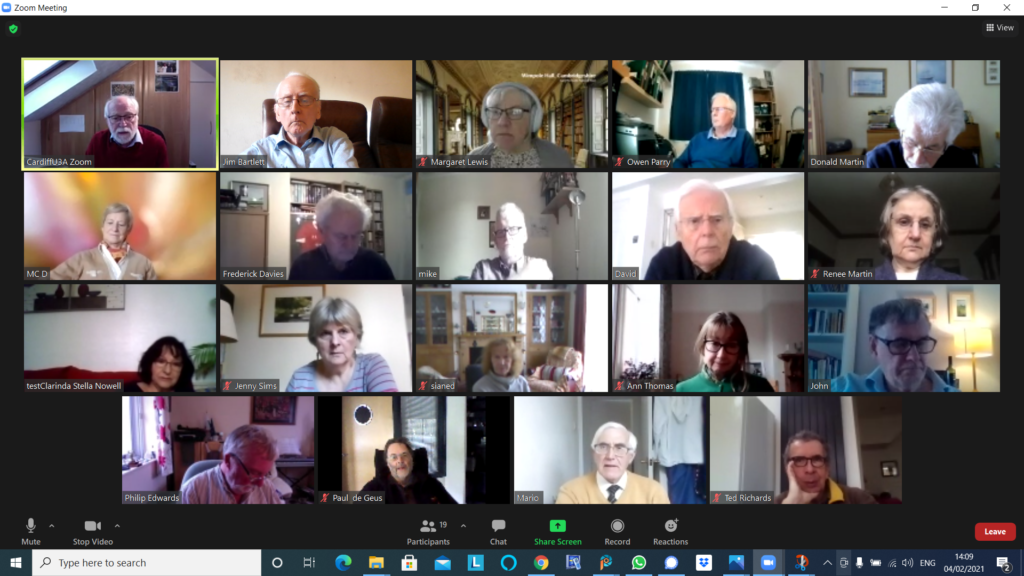
A large attendance yesterday, touching nineteen as shown above. We started with this – The Blue Ball – it’s mesmerising; the digital equivalent of those steel balls that swung on a cradle on execs desks in the seventies, remember them?
I mentioned the emojipedia which I referenced in the last notes and offered to help anyone who wanted to get onto Signal at the end of the meeting. Then it was “round the screen” to find out what members had been up to, or were having difficulties, or issues, with.
Margaret reported on two scams, one from Lloyds Bank (spelt Lloyd) and an “internet interruption” call/text which on traceback (which David H had done having received the same one) appeared to come from Caerphilly! On a more productive note she had been able to transfer a lot of treasured photos from her old laptop – which she’d been unable to upgrade to Windows 10 unfortunately (for a number of reasons, lapsed time, lack of memory) – to their desktop. I mentioned that Linux was still a possibility to revive the old laptop, we could look at that agin when we were all together in person. She also told us about a very pleasant experience attending virtually the Destinations Travel event, and informed us about the Stanfords Travel Writer Festival and the videos from the event which finished yesterday will be online from that site.
Owen reported that following the last meeting, he’d replaced his Powerline Adaptors with new ones and was now getting much improved wired connection speed for his study.
Don had been decorating for the past three weeks, that is when he wasn’t standing in the garden at a safe distance from the lead gas pipe he’d fractured in a wall, thinking it was redundant!
Jim had got himself into “trouble” with Flickr for displaying a photo of some aubergines – this caused much mirth. He reported to me today that Flickr had apologised for slapping an “unsafe” rating on the picture, and it was now visible to everyone. He had also upgraded (on his new laptop) his copies of Audacity (audio editing) and PaintShop Pro (photo editing).
Marie-Christine reported she was having a problem with her version of Lightroom and Windows. I offered to raise the matter on the Lightroom Queen Forum if she told me hat version of Lightroom, and the precise version of Windows she was having problems with.
Fred reported that a switch to Signal was not getting any traction with his friends, and that he’d had an instance of PayPal phishing to contend with.
David H added to Margaret’s description of the “internet will crash” scam. Someone asked where you should report such scams. The preferred method would appear to your ISP, in this case Sky, but Marie-Christine reminded us of Action Fraud (0300 123 2040) – is it a scam in itself? No it’s run by the police. Other tricks are to type the phone number of a caller into a browser and you’ll get an indication from Who Called Me? or Should I answer? Of course for an email you should look carefully at the email header address and type the domain into a browser to see if it’s genuine. David also asked whether it was possible to use WiFi for making telephone calls as the O2 signal in his apartment was so bad. The answer appears to be to activate WiFi calling for Android or iOS. David also reported that he was still not having any joy with his Times subscription on his iPad although it was working on his wife’s machine. I suggested that perhaps the subscription was limited to a fixed number of devices, and that perhaps deleting it from both machines and then re-installing it in order of preferences might solves the problem. Just a thought. Finally, he mentioned the possibility of adding people to a Netflix account and that his daughter had added them to her account and he was paying her £3 a month in gratitude – this being the cost of the extended subscription. It was pointed out that there was a similar option for Spotify, and the launch of Apple One scheme just recently was very similar. [NB The Spotify Family requires address verification; I’m not sure how this works but all members have to have “the same address” – work that one out yourself.]
Mike had nothing to report.
Renee reported some alarm issues ; problems with her satellite TV which required a factory reset eventually as the Italian channels had changed polarity (??) and just re-tuning didn’t solve the problem.
Stella had nothing to report.
John told us about the problems that have dogged them since he lost a bank card and the issues of not knowing whether a request to change details for a direct debit (because it use the former 16-digit number) was a scam or not. Just a nuisance. He wondered whether there were more scams at large currently because of Covid. Not sure. He reported with some delight success in transferring a SIM from an old phone to a new iPhone XR. There were some problems initially (with O2) but these were now resolved and he was getting the service he wanted at the reduced price of the service on the old phone. My standard advice is never to buy a phone on a plan, but to always save up for “the next one” when you purchase outright a new one. Also look at the plans that are available for SIM-only, or Pay as you Go. Measure up what you can get against the ones offered by GiffGaff (running on the O2 network and owned by them), which is my personal recommendation.
Paul had nothing to report, having been too sore to think of anything else but finding a comfortable place to sit since his accidental encounter with his loft.
Phil told us about a Facebook page – Strange things found in walls, including a safe and a gothic arch. He also told us about his experience (relating to Jim’s Flickr episode) of the poor performance of content-filtering for schools internet when he was working.
Ted told us about Just Watch – a really useful website that tells you which streaming service you should look on to find films, etc. He also mentioned how useful he was finding the Snipping Tool in Windows to cut-out an element from an image. I was able to say that the Screenshot Utility in MacOS did the same thing, but there were also short-key sequences for the Mac that did the same thing.
Sianed relayed the sad story of the Smart TV that had lost its smart functionality. For many of us that’s a cause for celebration as the smart functionality decreases with the age of a set as manufacturers don’t keep their apps up-to-date. So now she is in the happy position of using possibly an Amazon Firestick, a Google Chromecast (although Paul doesn’t rate it as there appears to a lot of US-content), a Now TV dongle, a Roku device or an Apple TV. Here’s a recent review of all of the ones available in the UK.
Finally Jenny described the National Pensioners Convention (Wales) event that she was participating in on Tuesday (9th February). You are encouraged to sign-up and take part in the webinar – I’ve circulated details by email earlier. She particularly noted the work of the Good Things Foundation and the Carnegie Trust in supporting digital inclusion activity and projects. She recommended looking at the former’s website.
I concluded the meeting with a gallop through home networking and router configuration which is all written up in this article which builds upon earlier ones.
Boot-up
Google’s apps to help the hard of hearing [Ted, Jim, Martin]. Unfortunately (and as I clarified at the meeting) – it’s not possible for me to check every link for accuracy or relevance. All I can do is point you in possible directions. I will only make recommendations when I actually use the software, or hardware, that I write or talk about. Thus it’s unfortunate that Ted wasn’t able to test the apps referred to in this piece from the previous meeting. One because it wasn’t in Google’s Play Store, the other because it required a more recent Android device than the one he had. Such is life! Martin however brought in some information that I found on the Internet as well, and I’m pleased to be able to provide the link here.
Jim, has also installed Live Transcribe on his Android device and states that it works surprisingly well …
Mesh networks [Paul]. Paul was so impressed in the process of doing his research he even ate his own dog food and purchased a system. He’s going to discuss it, and other ways of improving your home WiFi in the session he’s going to lead on March 28th.
Any other member issues?
Well … David Hughes’ impassioned plea for guidance on buying TV systems, was met with much agreement so I’m going to do a session on that next time, as well as a bit more on websites – following on from todays’ session.
Jim thought I’d not explained a couple of things particularly well last time, in particular I perhaps didn’t distinguish clearly enough the difference between the Internet and the World Wide Web. This is almost the same problem as distinguishing between a Search Engine and Google, or as I think you all know now – the difference between a Browser and Google. Such is their dominance of the use of the Internet. So as Jim has stated in his Comment under the notes of the last meeting – the Internet is just a wire, or a radio signal; it’s the medium of communication; it’s essentially hardware. However it’s useless without applications to run on it, and there’s a plethora of those, as you well know! These applications need protocols to transmit the information across the physical medium, ie the Internet. The most ubiquitous application is the World Wide Web which has made use of a number of protocols in its development, but which now is almost universally using HTML (with programming add-ons such as Javascript, Ruby on Rails, etc etc – don’t worry about these!).
I was negligent in not showing you what an HTML representation of the webpage looked like – I just showed you the Mark-up created by the application I was using – WordPress – an intermediate stage in creating the HTML. To rectify that, here’s an extract of HTML from the same page I showed you …
… we’ll pick-up the story later on! News Best Android Apps on the Google Play Store The world of USB changes to follow Apple’s lead – USB-C and Lightning
There’s another browser that doesn’t get mentioned a lot, but it’s been around for quite a while – Opera – here’s some tips and tricks, and here’s some more. Response from Google to Australian government’s thoughts on restricting their default browser use of their search engine in Chrome browser. Zuckerburg (Facebook) plans to create a ‘privacy-focussed’ world.
Adobe is finally killing Shockwave. What Google knows about you. Save the Web – help Tim Berners-Lee. Digital TV
I think it’s going to be best if we leave this as a discussion session, with each and all of you chipping-in and sharing experiences. I will lead-off with a few comments – some provocative maybe, and some guidance – hopefully not provocative! Then I’ll leave you with a plethora of articles and links which I researched for the last time I did this session about 12 months ago. What size of TV do you need? What is Smart TV?
Do you need a Smart TV?
Freeview or FreeSat?
Is the built-in Smart TV provided the best way forward?
Do you need a TV at all, or could you just use your laptop/tablet instead?
What do you need, do you really, really need? My notes from the last time I did this session … You don’t need a Smart TV – OK A couple of weeks ago I shared a link in our Flipboard magazine [NB you need a Flipboard account which you can create from this link – http://flip.it/3.ybs4] to a post which suggested that you don’t need Smart TVs … http://www.makeuseof.com/tag/buy-roku-not-smart-tv/ … and this article is even more troubled by Smart TVs and even suggests you should switch off their functionality because they might be spying on you … https://www.howtogeek.com/176392/smart-tvs-are-stupid-why-you-dont-really-want-a-smart-tv/ In preparing this session, I came across this article from The Guardian from last year … https://www.theguardian.com/technology/askjack/2016/sep/08/can-i-still-buy-a-dumb-tv … admittedly there are not many!! You can be assured however, if you go for one of these you won’t be buying something (Smart) that’s not better provided by a standalone set-top box from your Telecomms provider (Virgin, BT, etc etc), or the new range of add-on boxes which I’ll discuss later. So we’ll start with the three Free-to-Air services FreeView – https://www.freeview.co.uk/ FreeSat – https://freesat.co.uk/ YouView – https://www.youview.com/ – but not available from Virgin. All of these offer multiple channels and for the first two you might find your TV already has a tuner which supports one, or the other, or even both! Since their original launch these services when bought with a set-top box have other services added including recording and playback, and streaming of Internet content, eg Netflix. Streaming services The new one on the block so-to-speak is NowTV which starts with the offer of streaming Sky Channels without the need for a subscription, but for only a little more in cost can also add the FreeView channels, and more. Here’s a comparison of the NowTV offers – http://www.nowtv.com/best-tv-boxes – click through from Devices Tab to see their boxes rather than just sticks. And it comes with some really attractive introductory offers (which I’ve taken advantage of) But that’s not all, NowTV also comes as an app to add to other platforms as well, as we’ll see a little later, and just note that the Now TV devices are “powered by Roku” – that’s a name we’ll come back to! What are the alternatives to a NowTV box? Here are some reviews of media streamers that are worth reading … http://www.independent.co.uk/extras/indybest/gadgets-tech/tv-entertainment/best-tv-streaming-boxes-sticks-reviews-sky-sports-netflix-apple-amazon-fire-google-chromecast-a7185261.html http://www.techradar.com/news/television/best-streaming-video-player-1275853 http://www.techadvisor.co.uk/test-centre/digital-home/16-best-media-streamers-2017-uk-best-media-streamers-you-can-buy-3580569/ … and then there is … Amazon Firestick Google Chromecast but maybe not the Chromecast Ultra ??? … and if you choose Apple TV (4th generation) you can load Apps onto it to tailor your viewing options, including the NoWTV app, which also allows you to watch on up to four devices … … the list of devices supported by NowTV is quite impressive … http://www.nowtv.com/devices You want to record and playback as well as watch? These reviews are a good place to start … https://www.whathifi.com/best-buys/digital-tv-boxes/best-digital-tv-boxes https://www.cordbusters.co.uk/best-freeview-boxes-recorders-tv-2017/ Ending with this … http://www.expertreviews.co.uk/tvs-entertainment/1405950/best-freeview-box-2017-the-best-set-top-boxes-for-viewing-and-recording … which bring us back to NowTV boxes again, which are built on the Roku platform … https://www.roku.com/en-gb/index … and which should benefit from everything Roku do in the future. What other alternatives are there to watching streamed digital content on your TV? Well the most obvious one is to use your PC/Mac as the TV and use software on the PC/Mac to record Free-to-Air content. You will need a digital tuner for the PC/Mac to get the content. The best known company in this area is Hauppage and you can see a list of their products here … http://www.hauppauge.co.uk/site/products/prods.html There are other companies in this field but I can only vouch for Hauppage. I once installed a card in my Windows PC, and I still use a USB Tuner with my MacBook Pro to watch TV. Postscript. The DIY streaming solution – Plex server I’ve known about Plex for quite a long time but have never done anything about it. I’ve used iTunes essentially as a media server built around a MacMini that sits under the TV with all content that I can record from Get iPlayer Automator and my media that I’ve digitised including my CD collection, as well as the streamed versions downloaded from iTunes/Amazon. I hate iTunes with a vengeance. I spend countless hours sorting it out – admittedly I do have a rather complex way of sharing my iTunes media and libraries but I also just know there must be better way. Perhaps, now’s the time to try Plex. So I set about a project to install Plex on the MacMini (which I’ve just upgraded with a new SSD drive, an extra 4Gb of RAM and an install of the latest MacOS – High Sierra. Here are a few links to show you my direction of travel. Plex now lets you stream and record live TV—if you have an antenna and tuner How it works Working with my Apple TV and Sonos And I’ve signed-up for a lifetime subscription to Premium services so that I can … Record free-to-air content … I’ll let you know how it goes!! I forgot to mention new display technologies from LG/Sony/Panasonic called OLED, and Samsung – QLED. This article explains what these are. https://www.howtogeek.com/327047/whats-the-difference-between-oled-and-samsungs-qled-tvs/ I also didn’t touch upon curved screens, nor 3D. I’ll leave those up to you! Other links (useful if you have an online Which? account) http://www.which.co.uk/reviews/internet-tv-boxes/article/recommendations/which-best-buy-internet-tv-boxes http://www.which.co.uk/reviews/pvrs-and-set-top-boxes/article/recommendations/which-best-buy-pvrs-and-set-top-boxes Some more links to make you think and help your choices … maybe! Best TVs of 2019 ???? Watching Sky TV without signing-up to a long-term subscription service
If you’ve got a Mac you can download programmes from ITV Hub and BBC iPlayer and keep them forever using Get iPlayer Automator
Then there’s TVCatchUp – watching TV “on the go”
OLED, QLED, 4K, Curve-screen and more – notes from the last time I did this topic, here and here (two different links).
Postscript … And now (with a Roku device) you can also use Apple’s Airplay. as well as control it with your Amazon Echo (if you have one) …
https://www.makeuseof.com/tag/control-roku-using-amazon-echo/ Getting into the Web
Creating a website, the easiest way possible, using WordPress – Getting started tutorials.
Let’s setup a website in WordPress, that you can all play with. We’ll call it CFU3APlaySite, I’ll create a single user (who will be an administrator – so you’ll have all the powers to do anything and everything with the site – even delete it!) called DIHU3A, with the password Ca3rdyddU3A – that should be familiar. Let’s set it up and import some content from the old Google+ Community – which has now been imported into this site (hurrah!!!!).
Your mission (should you choose to accept it) … create a website in WordPress for four weeks time!