The right way to change Ts&Cs – Google learnt it’s lesson

It’s not long ago that Google was described as “the evil empire” because of its perceived intent on hoovering up all the data it could about us in the endeavour to “provide the best search experience for its users”. Baloney of course – they just wanted to drive the monetisation of their platform as far as they thought they could get away with, and by now you shouldn’t pay too much attention to the search results that appear at the top of a Google search – they’ve almost always been “paid-for”.

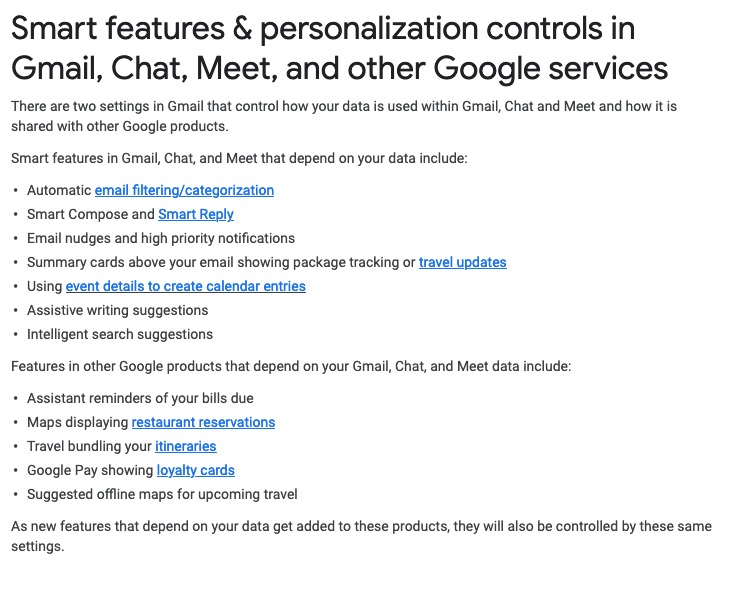
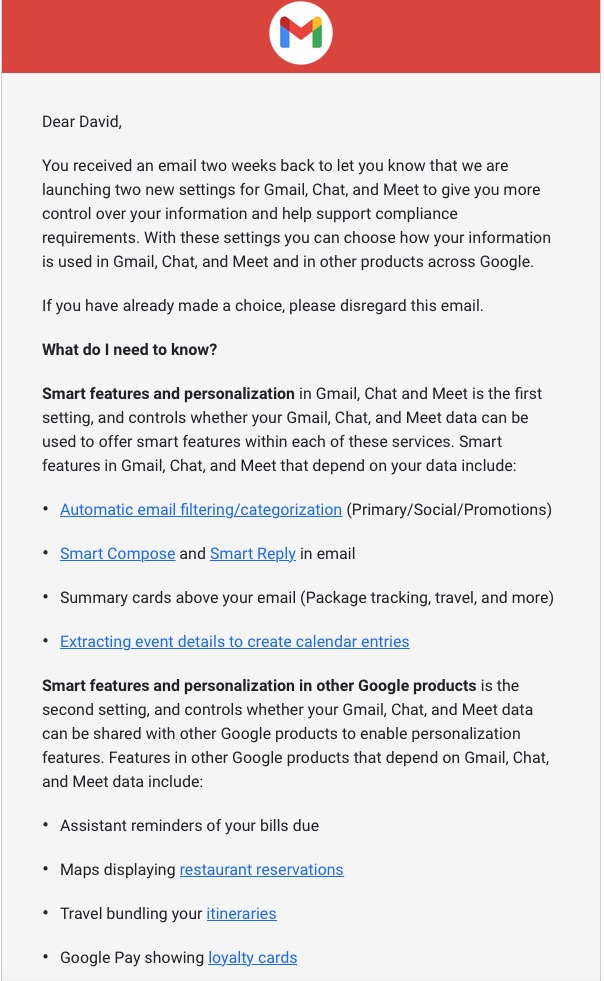
However, out of bad publicity they learned a lesson. When changing terms and conditions of use, or service, its best to explain clearly, and in advance, what they want, and expect, to do, and invite comment. That was most certainly missing from Facebook’s recent debacle with WhatsApp. So to show how it perhaps should be done, I’me including some recent screen shots from Google over the past few months …

A very recent change to Google services that is being proposed and communicated to users in an email. This was the first email sent …

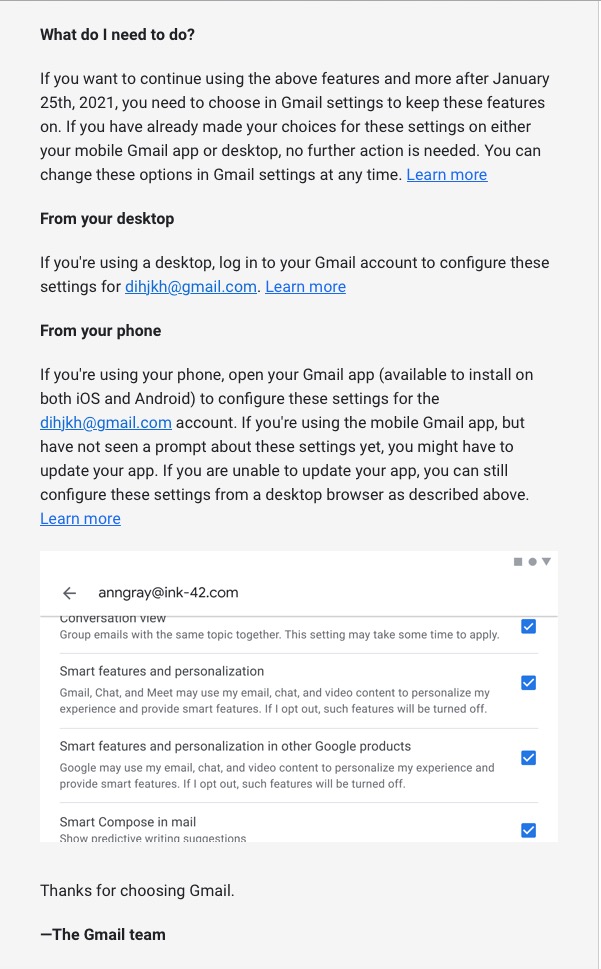
… which was followed up with this one, which prompted me to do something about it!!!

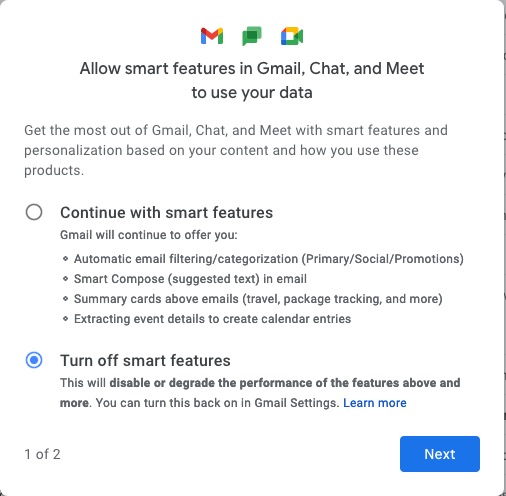
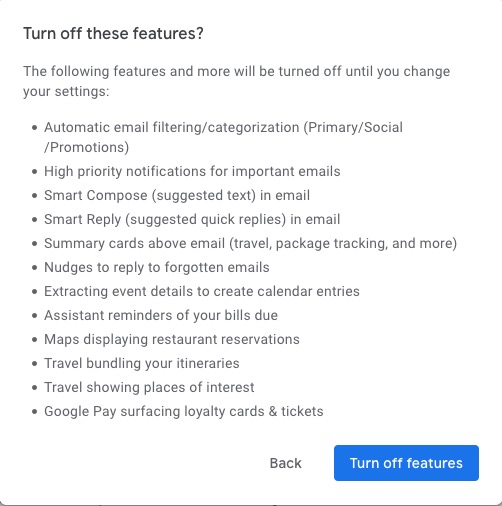
Once into the application, you receive a screen like this one …

I’ve now switched off these personalisations, but what I was doing was very clearly explained.

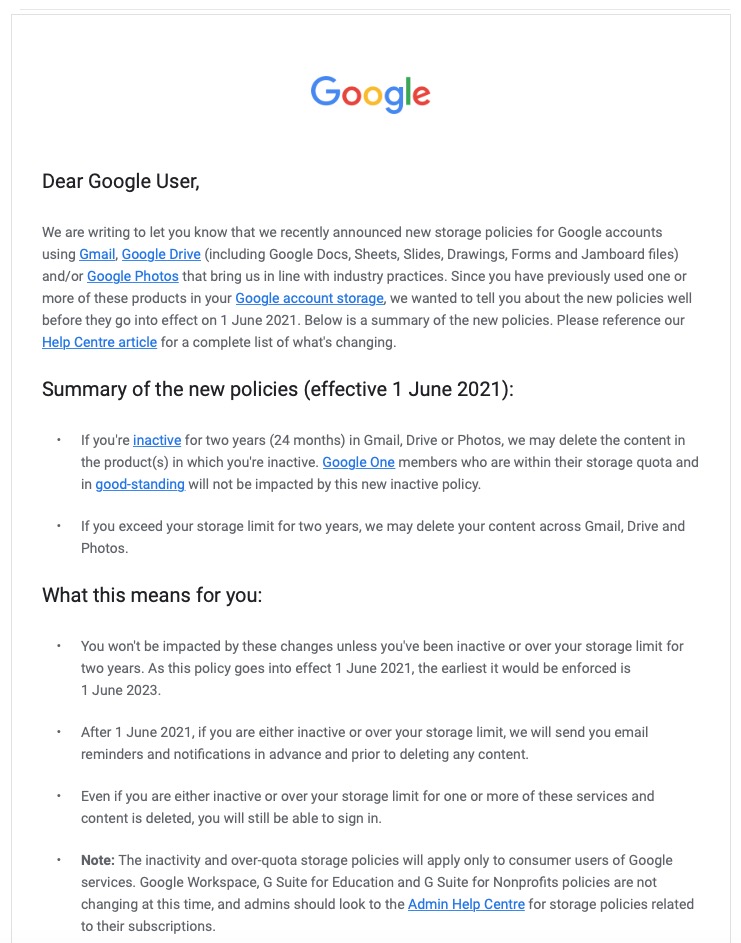
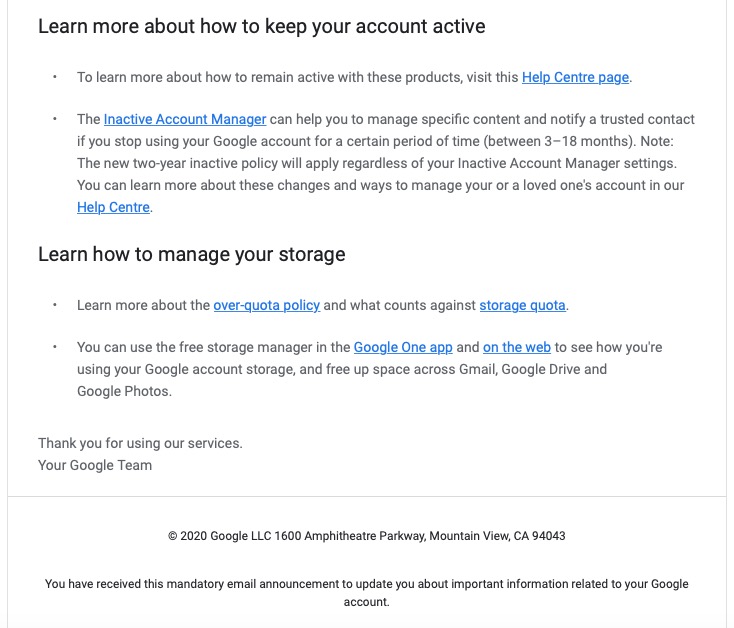
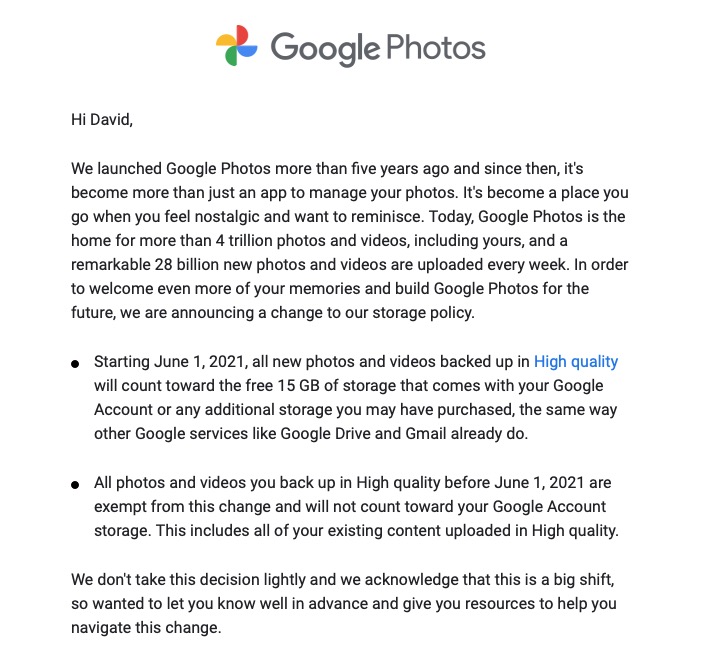
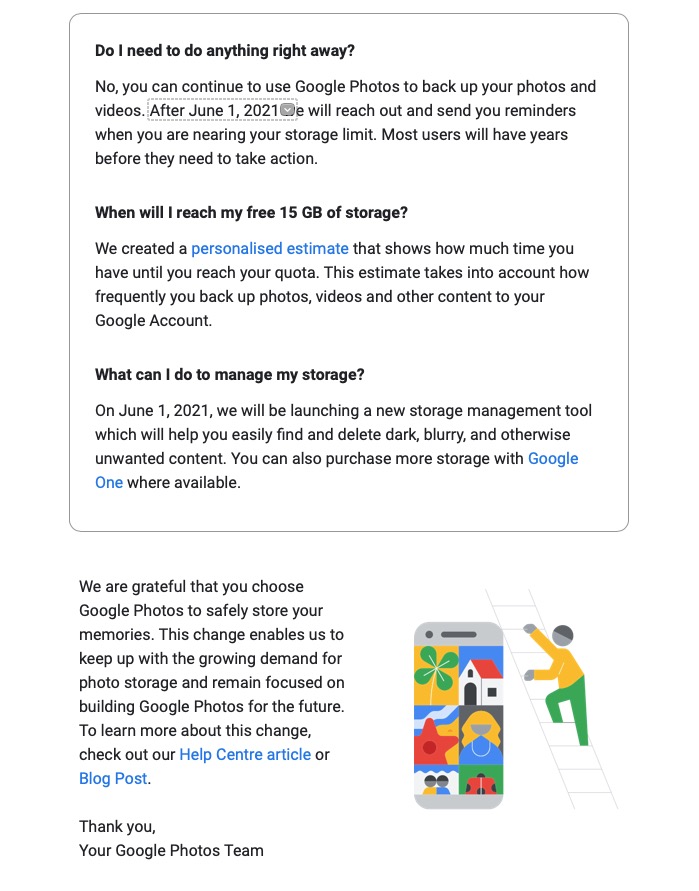
Then there is this advance warning of changes to the storage policy that covers your Drive and Photos accounts. [I must do something about this as I have a number of Google accounts knocking about.]

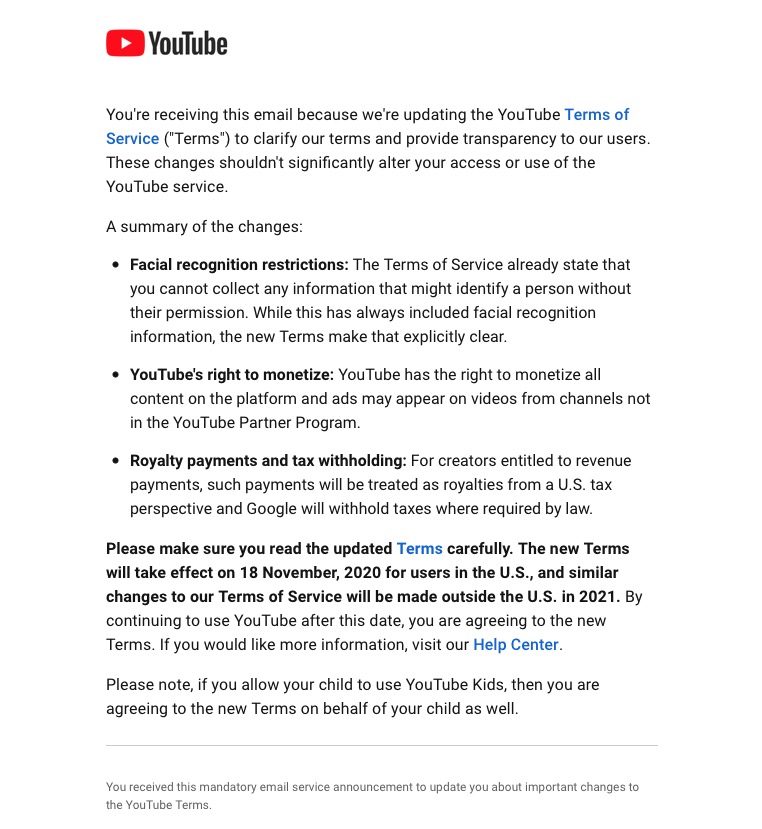
A clear explanation of changes to YouTube – not ones I like, but there’s no attempt to hide what they intend to do, and it provides a hint that they will apply to us later this year when Google leave Ireland for the US.

Changes to the Google Photos policy which is causing some distress, but is explained clearly and gives you a lot of time to work out how to use the service after June 1st 2021.

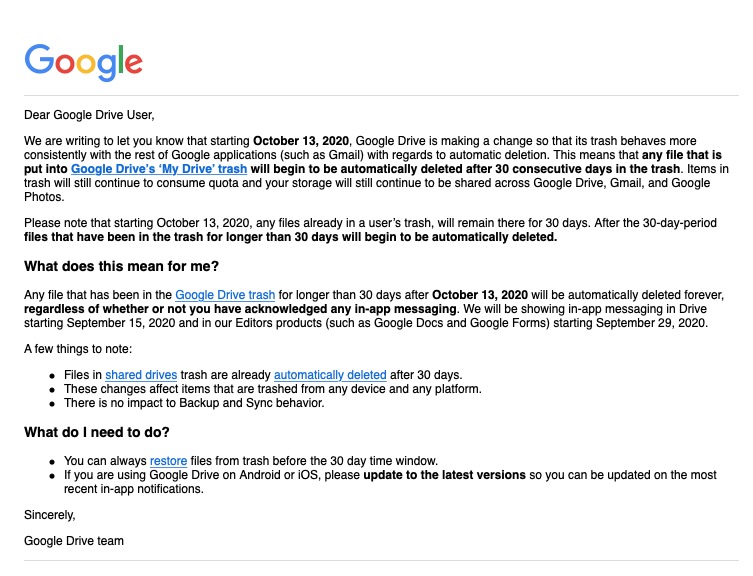
Early notice of the intended changes to Google Drive, and how files will be deleted.

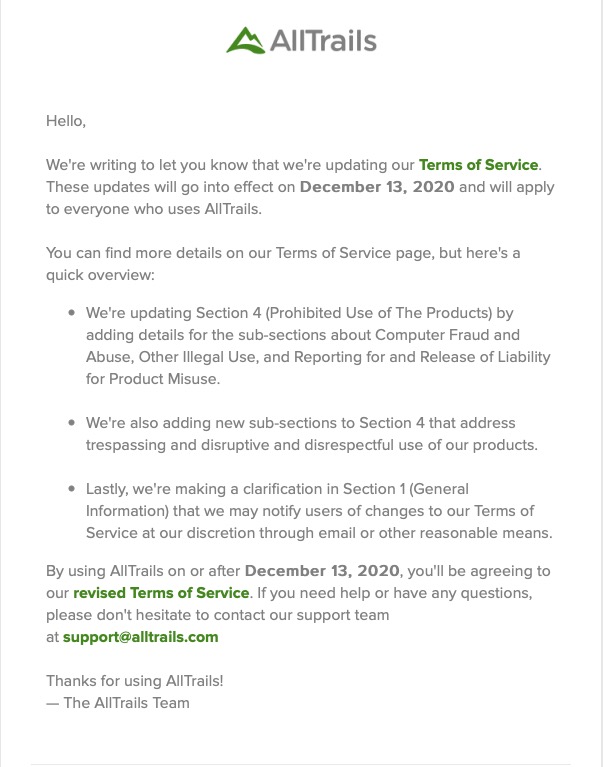
Finally, another company explains clearly how and why it’s changing it’s Terms and Conditions – not something WhatsApp did. Shame on them!

Moving to Signal [Updated – Jan 16th]

I hope you’ve managed to read the recent blog posts I’ve written earlier. One sets out my concerns about the Facebook ecosystem, the other on the changes to the WhatsApp Terms and Conditions of Service. I won’t go over the points I make in those posts. I do urge you to look at them however.

I’ve reflected on what might be the best way forward for me, and for us. I accept that for us in the short-term we could accept the new Ts&Cs and wait and see what transpires as we are still, apparently, in the European Region – but for how long! And once we’ve accepted those Ts&Cs what does it mean long-term, after our data is repatriated to the the US from Ireland.

But … we’ve been here before.

The demise of Google+ was a great shame and disappointment to me and I think the group as well. We’d just started to use it in some degree and when Google closed it down in April 2019, I started this private website, with the forums following last year, as the least worst immediately available alternative. We added the WhatsApp group for more instant communication in September 2019. However there is so much that WhatsApp doesn’t have, that we used to have in Google+ – threaded discussions, communities and close links to Google Photos to name but three.

This blog, with its Forums and Topics, addresses a lot of the shortcomings of WhatsApp but its’ main failing is its lack of notifications. I’ve tried to find ways round this limitation – using IFTTT, or installing the WordPress app to provide notifications – but neither of these are truly acceptable. So I cannot suggest we ditch WhatsApp and move to exclusively using this website.

I’ve reviewed the alternatives and have come to the conclusion that moving to using Signal would be the least painful transition if we were to make a move away from WhatsApp for instant messaging. The alternative in my opinion would have been an app called Telegram which has many virtues, but these are outweighed (again imho) by some of the people who have accounts on it – the Presidents of Brazil and Turkey to name but two!

The user interface of Signal is very similar to WhatsApp, so the learning curve should be relatively easy. The functionality is basically the same. The encryption method (end-to-end) is actually the same one that is used by WhatsApp – they adopted it because the code written by Signal’s developers is open-source – and indeed the founder of Signal was one of the founders of WhatsApp.

What makes Signal a really attractive proposition is that it is a publicly funded Foundation. As such, it cannot be taken over by another company, so this could be the last move we have to make. Furthermore, it is open-source which means that the software is supported by its users and its developers, in the same way as this platform (WordPress) is.

So I feel comfortable about making this move. I’m recommending to you that we move to use Signal instead of WhatsApp for instant messaging, but would encourage you also to look at the Forums and Topics on this site to use as a resource for problem-solving. The move is, and must be, a personal decision however.

I won’t abandon WhatsApp just yet, as some people I know won’t move immediately, so I’ll need to accept the Ts&Cs, but I will be on a clear path to move away and encourage others to move as well. To this end, I most certainly will not be “active” on WhatsApp, but just lurk in the same way as I use Facebook, Facebook Messenger and Instagram currently, and if this Group wants to continue using WhatsApp, it would seem sensible to seek someone to take over the administration of that WhatsApp group rather than me.

I will be setting up a U3A Computer Group on Signal later today that you are very welcome to join. I will post a link to the current WhatsApp members to enable them, or any other Group members, to join if they so wish, after they’ve first downloaded the app from this link and created an account – which is surprisingly easy. Once you’ve done that and allowed access to your Contacts – which will pick up others in your Contacts who are Signal users – you’ll probably see me. Please feel free to drop me a message to ask any questions about using Signal, and I suggest you also look at this useful article that explains how Signal works. I will be writing another article on a public blog later today which follows on from the earlier articles mentioned at the top of this article but will go into more detail of my reasons for moving away from WhatsApp.

In the course of time, probably at the time that Facebook data is moved from Ireland to the US, I will almost certainly cancel my accounts connected to Facebook Inc. That will be a hard decision to take as I will lose connections to many long-term friends who I dip in occasionally to see what they’re up to, and I will miss the annual “Happy Birthday” messages from many of them. Still the time is approaching when I should make that move.

Update

Further to this post yesterday it appears WhatsApp have realised they have not communicated the reasons for their proposed changes well enough citing “misinformation”, I would say poor communication. So read this …

https://blog.whatsapp.com/giving-more-time-for-our-recent-update

… you all have more time to make your own personal decisions. I would still advise not AGREEing just yet, you may not be able to change your mind! I will reflect and report back later. Meanwhile Signal is struggling under the pressure of a huge influx of new users – teething problems one hopes.

Home Broadband using 5G

I have for the years of my retirement chafed under the yoke of slower Internet access compared with when I was at work. Although I have had fibre from the cabinet as soon as it became available, I have rarely had more that 18-20 Mb/s download speed and commensurately slow upload speeds. I have also suffered with intermittent halts on the network where a succession of routers have decided to drop the connection back to the ISP, sometimes for several hours. And not just one ISP either. We have also had problems with Apple devices (iPad and iPhones) which frequently dislike the wireless network and have to have their lease renewed or their wireless function turned off and then on again.

As my most recent contract was coming to an end in January 2021, I took the opportunity to explore other options. Fibre to the premises was my hope but not available and no prospect in sight. I had signed up to receive an indication of when it might become available but OpenReach has lived up to its reputation for impenetrability and Virgin Media have no interest in cabling up my end of Penylan.

I did remember a member of the Computer Group had mentioned non-cabled access although my faulty memory suggested the word ‘radio’ and I couldn’t track that down. But the concept stuck and I looked at whether it was feasible to implement home broadband using mobile technology. The answer is of course, yes.

I spent some time looking at the three possible providers – 3, EE and Vodafone. They all had different offerings: 3 the cheapest, EE possibly the most flexible and Vodafone another option. They all provide useful ways of determining just what service you can get at your address. 3 quickly dropped out as they did not provide 5G cover in my area. Then I investigated volume usage and checked with my existing supplier (Vodafone) as to what sort of throughput I was currently using. It turned out that EE’s highest level contract was an allowance of 300Gb per month and that if, as my wife and I do, you watch a number of subscription services over the Internet and do a lot of Zooming, you can approach that level quite easily.

So there I was, Vodafone was the remaining option: the most expensive but offering unlimited usage. I struggled with their online system for investigating any further despite being a current customer but eventually came up trumps – I wonder if that’s a phrase that will fall out of favour now?? – using their chat system. A piece of advice : use the chat system from the sales page not the general or technical support page. The financial imperative means they give better answers and don’t want to send you to any other group!

I quickly gained an assurance (in writing) that their 5G service would reach my house and provide good and consistent connections and importantly, there is a 14 day trial period to check it all out. I placed my order and on hearing of the difficulties I had had with the existing connection from Vodafone, have a £10 per month discount for 2 years. It’s still twice what I was paying, though.

The Gigacube and SIM came the next day by courier. It took me 10 minutes to install, plug in my two Ethernet cable to the sockets; then 2 or 3 hours to visit every networked device and change it over to the new wireless network. My iPad is now downloading consistently at 170Mb/s and nothing in the whole set-up is slower than 45 Mb/s. Every room in the house has a good signal including the attic room two floors up.

Issues? Yes, one. I distribute a wired Ethernet connection via powerlink devices (you connect one to the router, plug it into the mains and then get a network connection from similar devices plugged in elsewhere in the house). The main one is to my study for my PC and laptop. The new network didn’t seem to like this at first but after a few hours of head scratching and for no apparent reason, it suddenly started working. I haven’t worked out why yet.

Verdict: well, it’s early days isn’t it? But I’m certainly very pleased so far. I’ll monitor usage and maybe ‘unlimited’ was a bit of a luxury.

The new WhatsApp Terms and Conditions of Use

Let’s start with this passage from the article in The Register referred to below where the founder of WhatsApp talks about his reasons for creating WhatsApp …

“When WhatsApp was acquired by Facebook in 2014, it promised netizens that its instant-messaging app would not collect names, addresses, internet searches, or location data. CEO Jan Koum wrote in a blog postAbove all else, I want to make sure you understand how deeply I value the principle of private communication. For me, this is very personal. I was born in Ukraine, and grew up in the USSR during the 1980s

One of my strongest memories from that time is a phrase I’d frequently hear when my mother was talking on the phone: ‘This is not a phone conversation; I’ll tell you in person.’ The fact that we couldn’t speak freely without the fear that our communications would be monitored by KGB is in part why we moved to the United States when I was a teenager.

Two years later, however, that vow was eroded by, well, capitalism, and WhatsApp revealed it would be “coordinating more with Facebook,” and gave people the opportunity to opt out of any data sharing. This time around, there is no opt-out for the sharing of data with Facebook and its tentacles. Koum left in 2018.”

So this all started 4 years ago, when WhatsApp announced a change to their Terms and Conditions (Ts&Cs) – the first change in many years, and the first since being taken over by Facebook. It was possible to opt out of this change which was announced as only to “improve the experience of Facebook users” (that’s kind of them – do I believe that?).

I don’t know whether I chose to opt out, I suspect I did, but I have no way of knowing!!! Whatever … I only had 30-days to opt out then, and I can’t go back and opt-out now.

I was alerted to the current impending change on February 8th, which is a take it, or leave it choice by this article in a well respected techie (UK-based) blog – The Register. It’s subsequently been updated, and may be updated again I suspect as more information is squeezed out of Facebook.

Before Christmas in a meeting of the Cardiff U3A Computer Group, I referred to the repatriation of UK-data to the US as a consequence of Brexit. So far Facebook and Google (and there could be more) have announced their attention to do just that, and others will undoubtedly follow. Free from Europe, our government has said we will follow GDPR (it had very little option), but the US tech companies see the wisdom of not having a European base for their (our) data and are hopeful of less stringent Federal privacy restrictions under a new Democratic Party controlled Senate committed to introducing legislation.

Once out of the European protection, we in Britain could in the course of time, and after the repatriation of Facebook data to California (read the article above), be deemed not to be part of the European area and so the protection offered by WhatsApp/Facebook suggested in this article in “The i“, would cease to apply. So the short-term acceptance of these Ts&Cs thinking they don’t apply to us, might be scuppered should the data-hosting move to the US.

No certainties, just doubts and that’s where mistrust comes in.

As of today, I’m at a loss to know what to advise or do. I’m hopeful of further clarification in the days to come, but I’ll leave acceptance of the new Ts&Cs to the last few days before February 8th.

Your comments and thoughts most welcome.

Why do I dislike Facebook (Fb)?

I was challenged with this question last Thursday when I told my family about the intended changes to the WhatsApp Terms and Conditions of Use. I didn’t reply to my IT-savvy son until this morning when I was first asked to agree to these new Ts&Cs. This is what I wrote …

“It starts with trust, and then you work away from that. It’s what a company does with information and whether you can then trust them to handle it properly. Google+ was a closed system that you opened up; Fb is an open system that even though it has Privacy Controls – which you need a degree to work out how to set them – essentially allows them to do anything with what appears on their platform.

You take a photo – you don’t retain copyright, you assign that right to them when you publish to the platform  – you lose some control over what is done with the photo. You can’t opt out of adverts (understandably – that’s how they make there money) – you are conned into thinking that in allowing them, you will get a better experience.

For whom? For you – no, they’re just an annoyance to me, but for others they just drive people to buy stuff they might not want/need. For them – yes, that’s how they drive income and more.

So it’s the more that’s more interesting and insidious because what they do with that information leads to targeting people with posts, hence my reference to Brexit and Trump. [I had said in my brief first reply – Cambridge Analytica, Brext and Trump.] The algorithms behind the scenes work the data and susceptible people get targeted with posts as well, not just adverts. I could go on, but as I said – it’s all about Trust, and Fb as a company is one that I just don’t trust.

Getting data from WhatsApp was something they committed at take-over they wouldn’t do. Now they are starting to do just that. Next step targeted adverts on a platform which is advert free; then “posts from others you might be interested in” – not the encrypted ones, but ones from Public Figures. Then “oh! dear” we have to drop encryption because of new privacy laws in the US. [Aside: is it a coincidence that Google, Twitter and Fb appear to be more privacy focussed since the Republicans lost control of the Senate and they just might want to be on the right side of the argument that’s going to come in the US in the next four years ].

So I always logout of Fb to stop them tracking me; I suspect that WhatsApp will have a mechanism that prevents a user from being disconnected so Fb with these new Ts&Cs will be tracking as well as getting the other personal info from users.

Please feel free to comment either on the post.

The new WhatsApp Terms and Conditions of Use [Clarification – Jan 21st]

Let’s start with this passage from the article in The Register referred to below where the founder of WhatsApp talks about his reasons for creating WhatsApp …

“When WhatsApp was acquired by Facebook in 2014, it promised netizens that its instant-messaging app would not collect names, addresses, internet searches, or location data. CEO Jan Koum wrote in a blog post: Above all else, I want to make sure you understand how deeply I value the principle of private communication. For me, this is very personal. I was born in Ukraine, and grew up in the USSR during the 1980s

One of my strongest memories from that time is a phrase I’d frequently hear when my mother was talking on the phone: ‘This is not a phone conversation; I’ll tell you in person.’ The fact that we couldn’t speak freely without the fear that our communications would be monitored by KGB is in part why we moved to the United States when I was a teenager.

Two years later, however, that vow was eroded by, well, capitalism, and WhatsApp revealed it would be “coordinating more with Facebook,” and gave people the opportunity to opt out of any data sharing. This time around, there is no opt-out for the sharing of data with Facebook and its tentacles. Koum left in 2018.”

So this all started 4 years ago, when WhatsApp announced a change to their Terms and Conditions (Ts&Cs) – the first change in many years, and the first since being taken over by Facebook. It was possible to opt out of this change which was announced as only to “improve the experience of Facebook users” (that’s kind of them – do I believe that?).

I don’t know whether I chose to opt out, I suspect I did, but I have no way of knowing!!! Whatever … I only had 30-days to opt out then, and I can’t go back and opt-out now.

I was alerted to the current impending change on February 8th, which is a take it, or leave it choice by this article in a well respected techie (UK-based) blog – The Register. It’s subsequently been updated, and may be updated again I suspect as more information is squeezed out of Facebook.

You may remember in a Group meeting before Christmas I referred to the repatriation of UK-data to the US as a consequence of Brexit. So far Facebook and Google (and there could be more) have announced their attention to do just that, and others will undoubtedly follow. Free from Europe, our government has said we will follow GDPR (it had very little option), but the US tech companies see the wisdom of not having a European base for their (our) data and are hopeful of less stringent Federal privacy restrictions under a new Democratic Party controlled Senate committed to introducing legislation.

Once out of the European protection, we in Britain could in the course of time, and after the repatriation of Facebook data to California (read the article above), be deemed not to be part of the European area and so the protection offered by WhatsApp/Facebook suggested in this article in “The i“, would cease to apply. So the short-term acceptance of these Ts&Cs thinking they don’t apply to us, might be scuppered should the data-hosting move to the US. [I think it’s clear to me that those in the EU will continue to be offered an opt-out – the market is too large for them to enforce a retrospective acceptance, but we in the UK …. !!!]

[Clarification] I should have made it clear that it is not the data that’s being repatriated as this could be held on many servers all around the world, but it is the legal ownership of our accounts that is being repatriated. The US Tech Corps have been “troubled” by the number of Anti-Trust, and Anti-Competitive legal cases that have been brought against them in the EU just recently. Being found guilty can subject those companies to very high levels of fines. In addition the tax haven which was Ireland has been challenged which provides another impetus to move their (that is Facebook and Google) offices back to the US. So far Twitter and Apple have stood alone as companies that have decided to stay in Ireland, whilst Amazon is based in Luxembourg. So it’s not just Privacy that is a driver to repatriate our accounts.]

No certainties, just doubts and that’s where mistrust comes in.

As of today, I’m at a loss to know what to advise. I’m hopeful of further clarification in the days to come, but I’ll leave acceptance of the new Ts&Cs to the last few days before February 8th.

[NB. I’m posting both these articles on the Public Thought grazing site as well.]

Please Comment below, or in the Topic on the Privacy and the Internet Forum.

Why do I dislike Facebook (Fb)? [Addendum – Jan 21st]

I was challenged with this question last Thursday when I told my family about the intended changes to the WhatsApp Terms and Conditions of Use. I didn’t reply to my IT-savvy son until this morning when I was first asked to agree to these new Ts&Cs. This is what I wrote …

“It starts with trust, and then you work away from that. It’s what a company does with information and whether you can then trust them to handle it properly. Google+ was a closed system that you opened up; Fb is an open system that even though it has Privacy Controls – which you need a degree to work out how to set them – essentially allows them to do anything with what appears on their platform.

You take a photo – you don’t retain copyright, you assign that right to them when you publish to the platform. You have to struggle to find a way to opt out of adverts (understandably – that’s how they make their money) – you are conned into thinking that in allowing them, you will get a better experience.

For whom? For you – no, they’re just an annoyance to me, but for others they just drive people to buy stuff they might not want/need. For them – yes, that’s how they drive income and more.

So it’s the more that’s more interesting and insidious because what they do with that information leads to targeting people with posts, hence my reference to Brexit and Trump. [I had said in my brief first reply – Cambridge Analytica, Brext and Trump.] The algorithms behind the scenes work the data and susceptible people get targeted with posts as well, not just adverts. I could go on, but as I said – it’s all about Trust, and Fb as a company is one that I just don’t trust. [Addendum: Fb would say that it’s not them that uses the data; but we now have plentiful evidence that Fb Service Users have found ways of manipulating the data they have access to as Fb Business Users.]

Getting data from WhatsApp was something they committed at take-over they wouldn’t do. Now they are starting to do just that. Next step targeted adverts on a platform which is advert free; then “posts from others you might be interested in” – not the encrypted ones, but ones from Public Figures. Then “oh! dear” we have to drop encryption because of new privacy laws in the US. [Aside: is it a coincidence that Google, Twitter and Fb appear to be more privacy focussed since the Republicans lost control of the Senate and they just might want to be on the right side of the argument that’s going to come in the US in the next four years ].

So I always logout of Fb to stop them tracking me; I suspect that WhatsApp will have a mechanism that prevents a user from being disconnected so Fb with these new Ts&Cs will be tracking as well as getting the other personal info from users. [However, see the addendum below which has caused me to change my views on that.]

Please feel free to comment either on the post, or in the Topic I’ve created to discuss the subject in the Privacy and the Internet Forum.

Addendum: After posting this article, a former colleague provided a link to a page on Facebook’s website. That article is included in the many posts to Flipboard I’ve added in the past three weeks. However, it’s worth looking at, particularly as it affects the advice I’ve given many times to Logout of your Fb account. It would appear that Fb’s reach is wider than I thought, and so I can only now recommend that you logout. Some salient passages from the article …

When does Facebook get data about people from other websites and apps?
Many websites and apps use Facebook services to make their content and ads more engaging and relevant. These services include:

Social plugins, such as our Like and Share buttons, which make other sites more social and help you share content on Facebook;

Facebook Loginwhich lets you use your Facebook account to log into another website or app;

Facebook Analytics, which helps websites and apps better understand how people use their services; and

Facebook ads and measurement toolswhich enable websites and apps to show ads from Facebook advertisers, to run their own ads on Facebook or elsewhere, and to understand the effectiveness of their ads.

When you visit a site or app that uses our services, we receive information even if you’re logged out or don’t have a Facebook account. This is because other apps and sites don’t know who is using Facebook.

I’ve added the emboldening to the last paragraph. So it means that if you do any of the above things on a site that uses Fb Services (ie pays to advertise on the Fb platform) personal information will be transferred to Fb.

Finally, if you’re just a bit more curious about Facebook’s Data Policy, take a read of this and be just a little gobsmacked at what’s going on behind the scenes and just consider it might be worthwhile reviewing your security settings. In particular look at the last section which explains how your information will be shared and especially look at the last part where they describe what they do with third-party partners (eg Cambridge Analytica ???).

Facebook have attempted to respond to the uproar about privacy with the announcement, and release of a Clear History Tool – and you should take a look at this page which explains What off-Facebook Activity means and describes how Fb’s third-party partners and business service providers may be interacting with Fb, and you.

Now you might realise why I dislike Facebook – they’ve lost my trust, and it’s just too much effort to make sure I’ve closed all the doors to protecting the personal information they hold on me.