This could be a long post as I record my “adventures” into re-building my Viglen Genie 920 Tower system as a Linux Server running Ubuntu 20.04. Along the way I’ll also describe how I refashioned an old Dell Inspiron 1545 laptop into a Ubuntu machine looking as if it was running MacOS, as well as showing how even a small msi Wind notebook can be re-born with a change from WinXP to Ubuntu. That’s the design brief.
I’ll describe what I did with the three systems separately, although I did a lot of this concurrently.
The Dell Inspiron 1545
I found that the Dell Inspiron 1545 had a 64-bit architecture (but was it a 64-bit processor), it had 3Gb RAM installed and was running Windows Vista – it was a good candidate for a Linux installation and re-birth as a usable system.
Before I started I did a flash upgrade of the BIOS as I was unsure whether I could still do that after I’d removed the Windows Vista from the machine. I then created Bootable installers using balenaEtcher to create disk images on the iMac, a great piece of software, and produced a number of bootable USB LiveDisk images so that I could trial varieties of Ubuntu without installing them on the Windows Vista machine. I found this article – which Ubuntu to install – very useful, and following reading it decided I’d try Mate and Budgie. I didn’t like Budgie – too flash; but then (having determined that the laptop indeed had a 64-bit processor) went on to create a 64-bit disk image of Gnome with Ubuntu 20.04 which loads on the machine but I’m concerned that it may not be very responsive, so am thinking I may revert to an earlier (i386) version (16.04) of Ubuntu, once this exercise has finished.
There are a number of articles written on making Ubuntu desktop look like a Mac – I will try this approach first, and then this one – “How to make Ubuntu look like Mac”, and add a Taskbar using Plank. [Links to be inserted]
I also shelled out £16.50 for a replacement for the 1Gb RAM in one slot to upgrade the RAM to 4Gb …
and I was amazed to find that theoretically I could upgrade the machine to 8Gb (if I could source the 2x4Gb DDR2 kit RAM – which is obsolete and very expensive, so I didn’t) but I could install a small SSD as well for about £20 …
This could turn out be a great little project to create an internet machine running a limited set of software like LibreOffice.
The Viglen Genie Tower was purchased in 2009, it has a 2.66GHz i7 Intel processor, 4Gb RAM and two HDDs – one 500Gb which has Win7 and XP installed on it; and the other a 1Tb removal HDD which will be the target for the Linux server installation. Configured this way I’d hoped to have a dual-boot into either a legacy Windows environment, or to the Linux server.
Why am I doing this? A good question. The answer … if I switched the machine on, it would work – I think it had Ubuntu 14.04 installed on it – but I’d forgotten the Linux admin passwords so couldn’t configure it – silly me!! So I think it’s about time I restored its capabilities as my back-up and development Linux server. Until I switched it on, I’d forgotten that it also had both Windows 7 and XP with software installed on it in a dual-boot configuration – so I was keen to keep that as well. It has Office 2007 installed on it – the last version of Office I could use easily and very similar to the Office 2011 I have on my iMac – still running MacOS 10.14 (Mojave) because of 32-bit compatibility issues. Having the Win installation means I can possibly upgrade the MacOS in the future – but I’m really not in a hurry to do that! [I do know about LibreOffice by the way!]
Why do I need a Linux server? Well, I could do more testing for the websites I run, I could also host websites on it – if I wanted to archive (retire) websites, and of course I could back-up my sites to it as well.
To create a server you need to install additional software to the Linux distro – I’ll be using Ubuntu – and you need to be mindful of the System Requirements. So you need to work backwards from what you want to do, to establish the minimum Ubuntu release you need to install. As essentially the machine was just going to serve files to another machine running browser software, and as there was only ever likely to be one user, the hardware requirements were going to be very low.
Ubuntu server itself has very frugal requirements, 500Mb RAM, 1GHz processor and 2.5Gb Hard Disk . It’s command-line driven, and has no Graphical User Interface (GUI). My problems with the current 14.04 installation came when I tried to create a dual-boot installation with a GUI and Server install and then forgot the passwords! So I couldn’t upgrade it, or do anything with it effectively!
The additional software I wanted to install was Samba – to allow me to transfer files from the other machines on the network to the Ubuntu server and LAMP, which stands for Linux, Apache, MySQL and PHP – all components needed to create a web-server. I will also be installing WordPress on it, which requires the LAMP components.
Building the Ubuntu 20.04 Server
This was straightforward in one sense. I just booted from the USB LiveDisk I’d created on the iMac using balenaEtcher and chose the Install option which is described in this article. Once I’d done that I had some problems with the GRUB loader which seemed to have been damaged by the installation of the server software, but eventually I got round these using an old 14.04 LTS LiveCD disk to Boot into Rescue mode and from there followed the instructions from this article, a real life-saver. Before reading this I had been tearing my hair out and thought I’d completely trashed the machine. I’d not anticipated that the Windows partitions would still be there – but they were!
By doing the Grub Rescue this way I found I still had the legacy installations of Windows 7 and Windows XP on the machine. A real bonus because I could try and restore some of my Windows knowledge. It was surprising just how much I could remember, as opposed to Windows 10 which I just can’t get my head around.
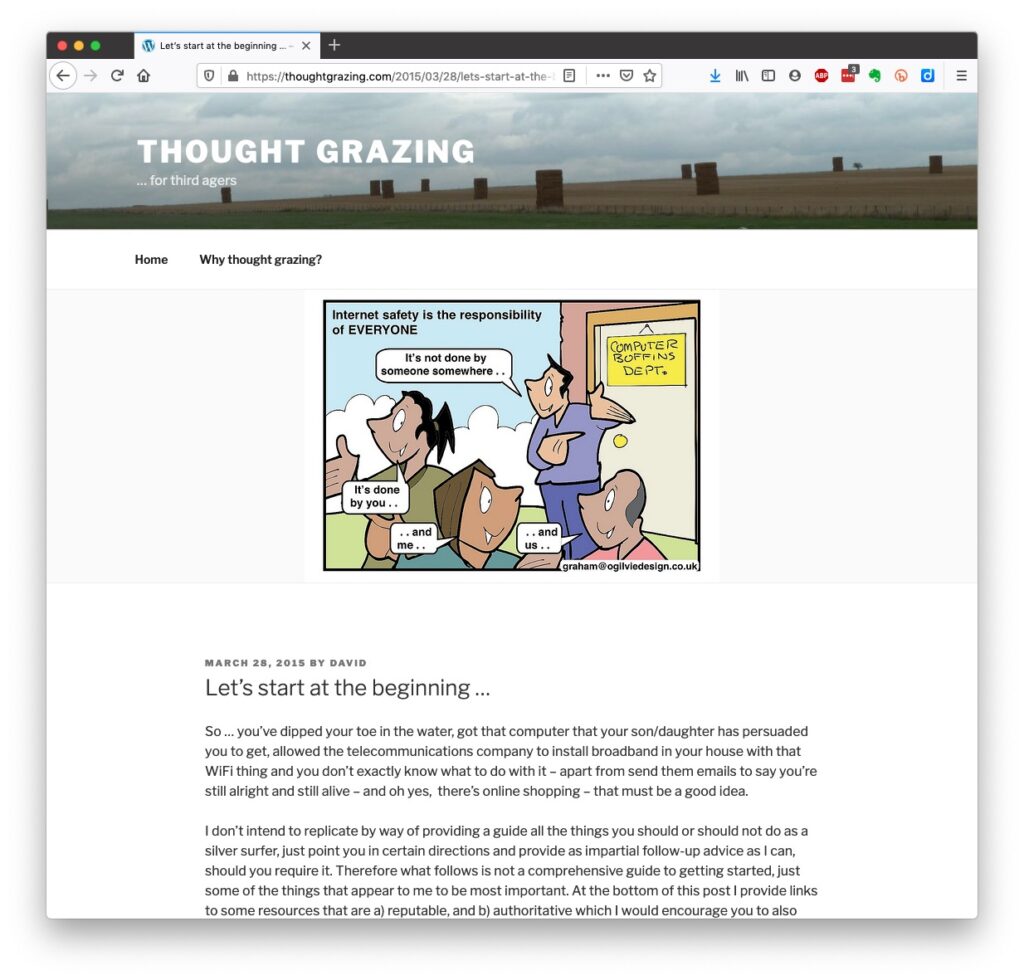
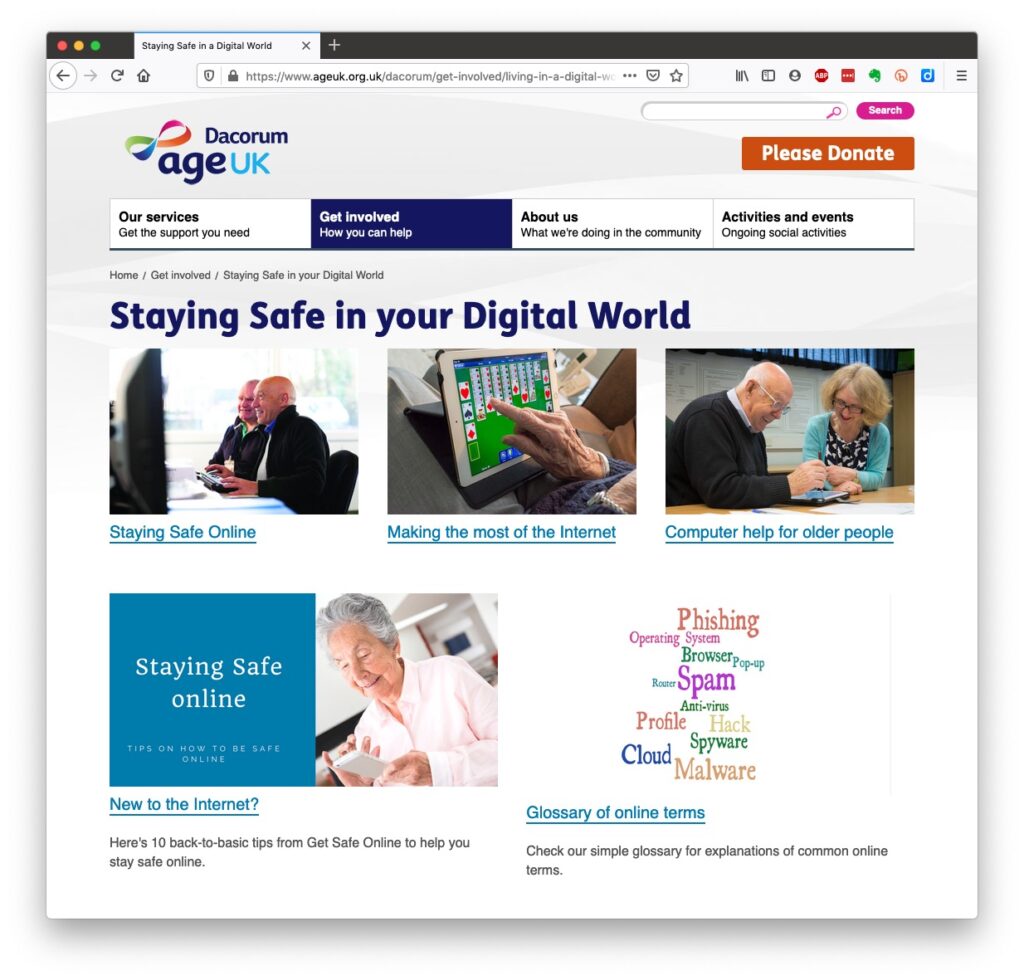
Luckily, there’s plenty of advice and guidance available – often slanted particularly towards our demographic (ie oldies) …
Those two sites are particularly easy to follow and understand, but others are equally informative and targeted.
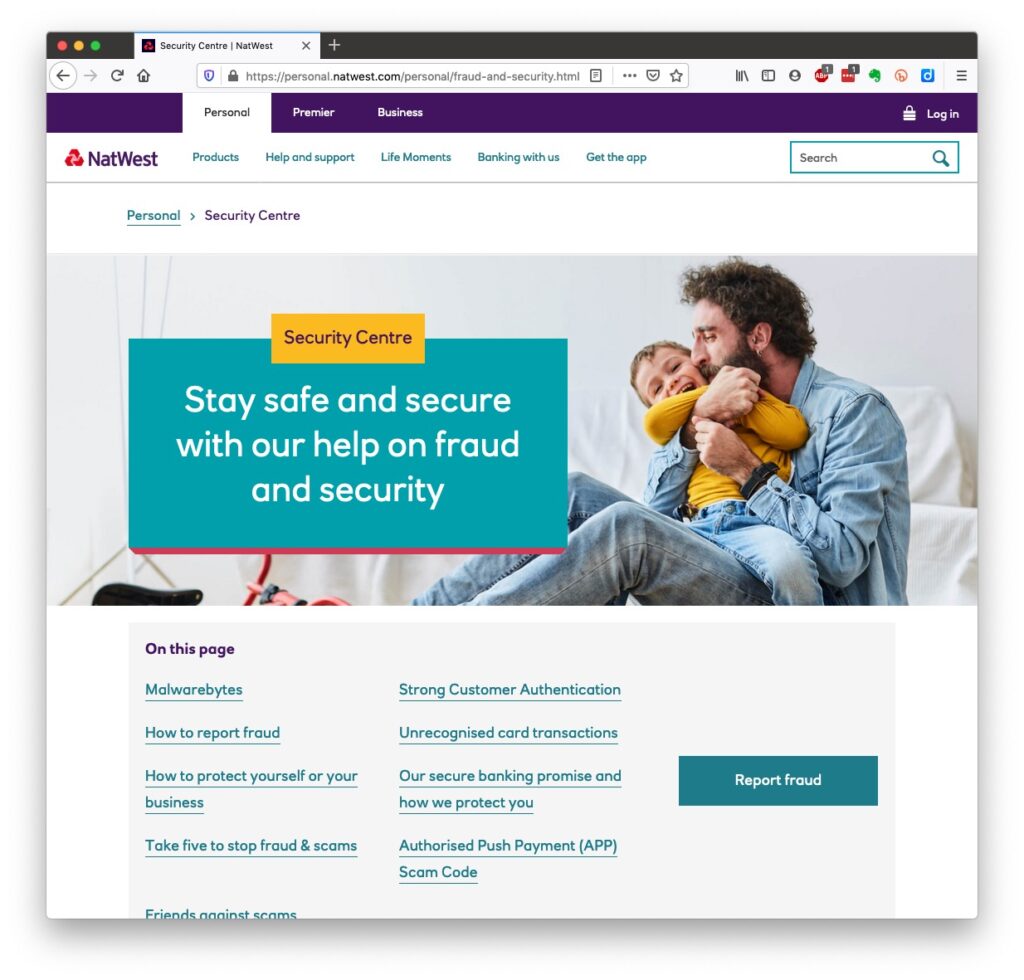
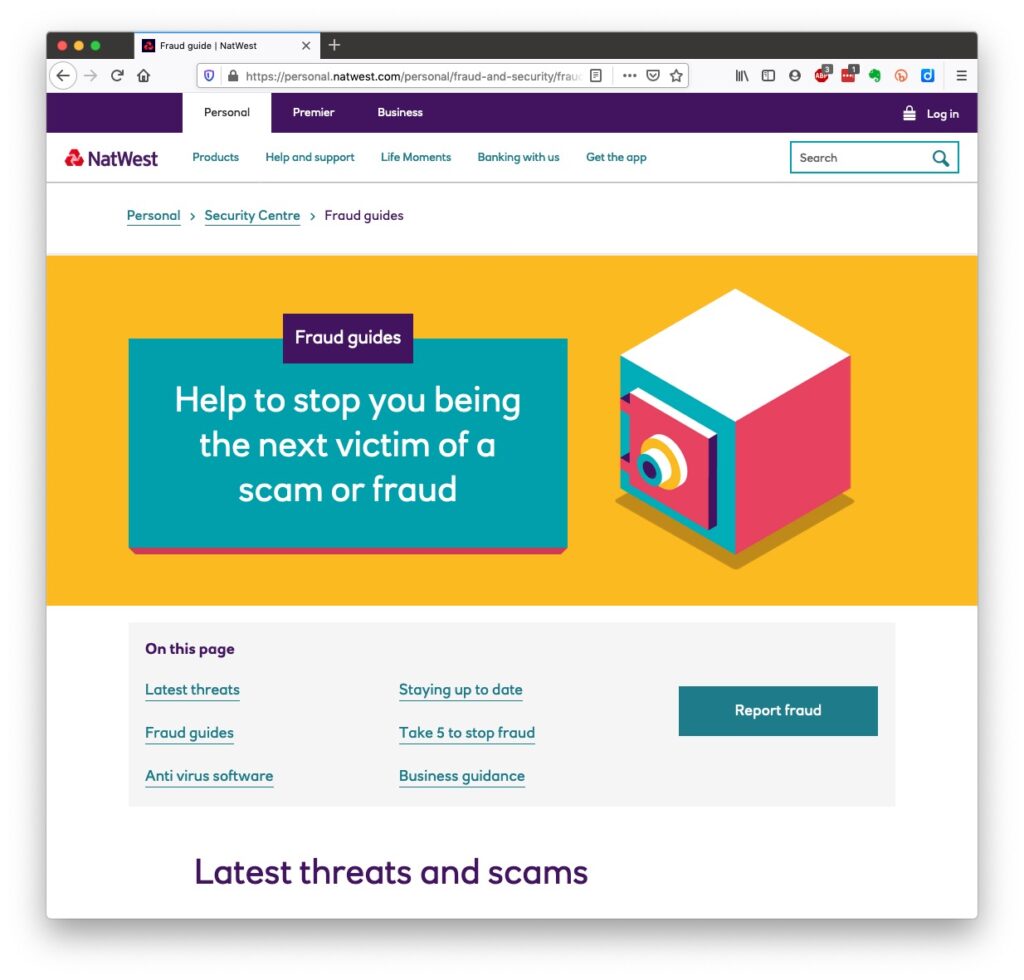
Your bank probably has guidance which it publishes online and which is accessible to everyone, not just their customers …
I’ll return to further information, guidance and references at the end of this post, but first we need to look at a few issues, discuss some terminology that’s widely used and try and tease out what’s really important, and what’s just an inconvenience and then it’s up to you to judge where you find yourself on the scale of …
First let’s distinguish the difference between online security and online privacy. These are two different issues which are however linked. Sometimes you have to relinquish some privacy to receive a service – unless you choose to pay for it (and I’ve long been an advocate of paying for services if they do a job that is necessary); exactly how much privacy are you prepared to relinquish?
Security on the other hand is an absolute – you should not be prepared to accept less than your very best efforts . We’ll deal with that in the third part of the post.
How do you relinquish your privacy, and how much of a loss of privacy is acceptable?
Some services could not be offered without income from adverts, or paid-for advertising – eg Facebook, Twitter and Instagram; and some eg Google and Amazon track and provide information to resellers if you don’t block them from doing so. As an example of how much value Google sees in getting knowledge of what you’re doing and where you’re doing it, they pay Apple up to $20bn annually to remain as the default search engine for any browser that’s running on an Apple device!
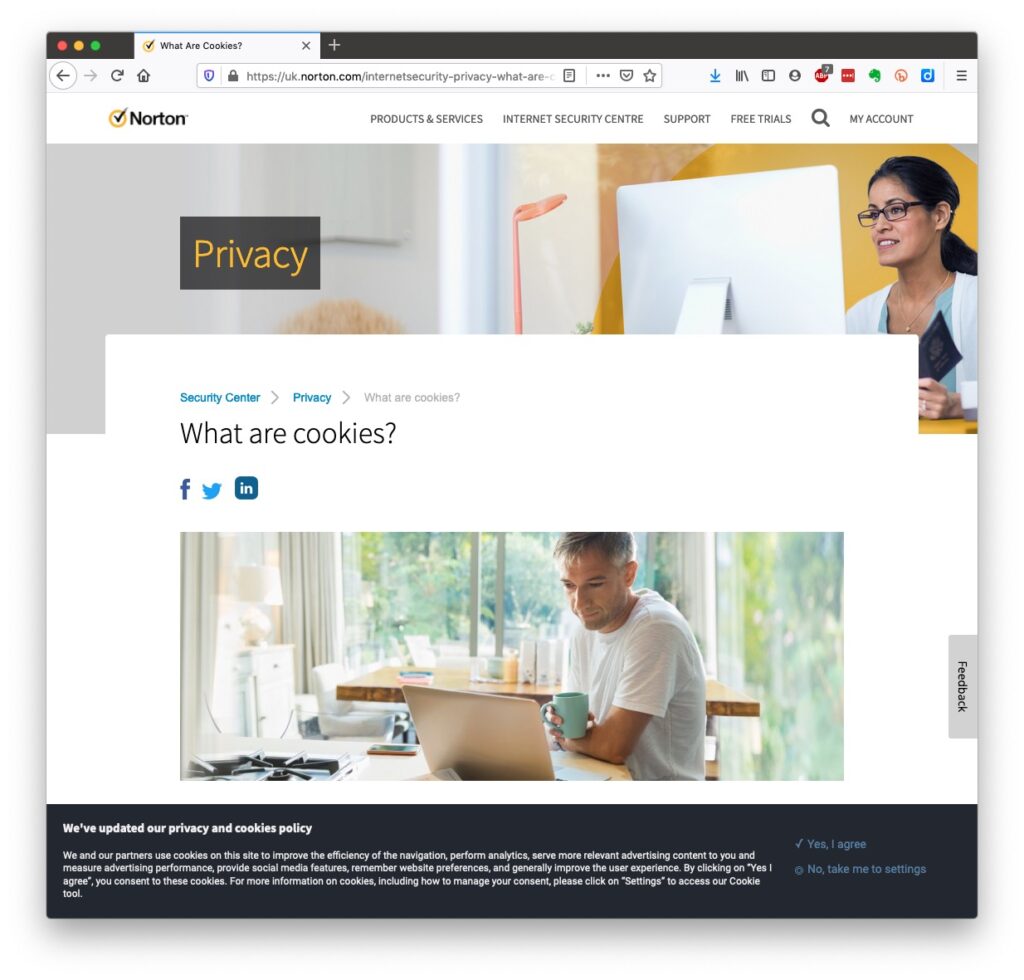
Sometimes you may click on a link and have been asked whether you wanted to accept cookies – what exactly are they, and what do they do. This article from Norton explains what they do quite well …
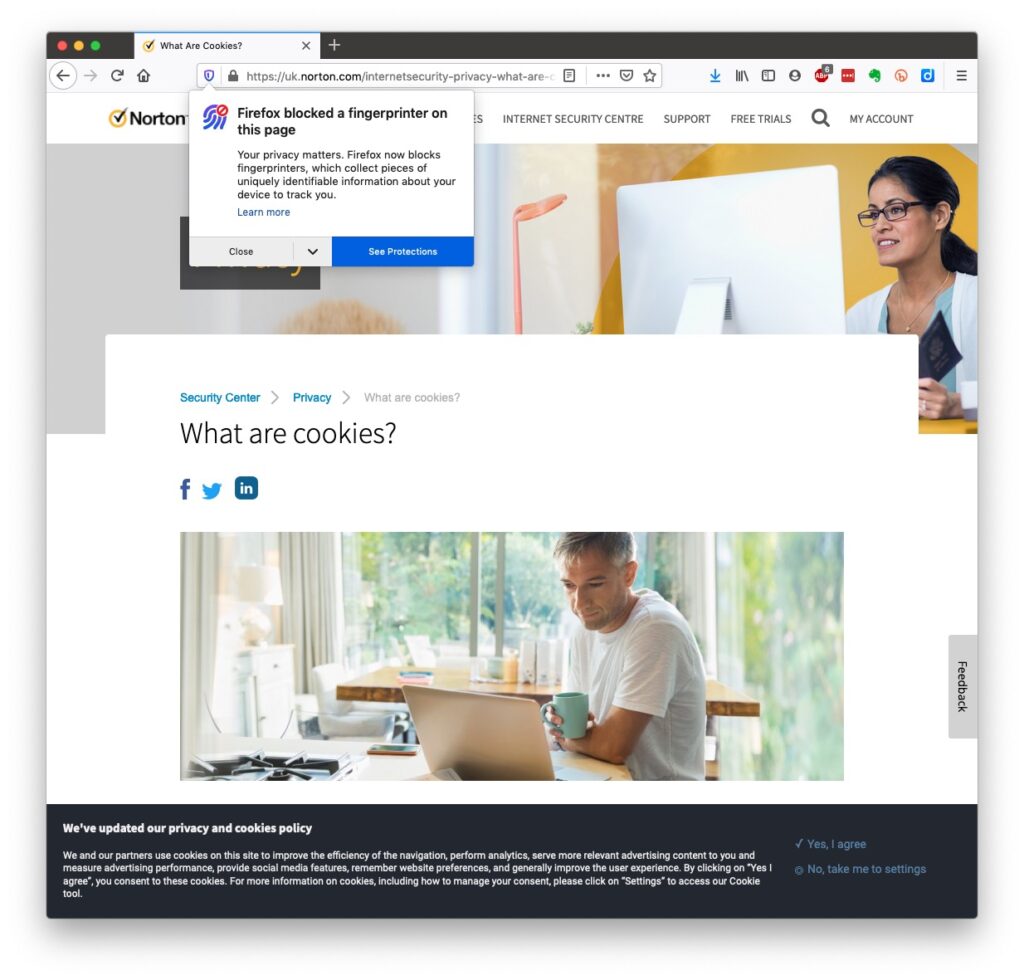
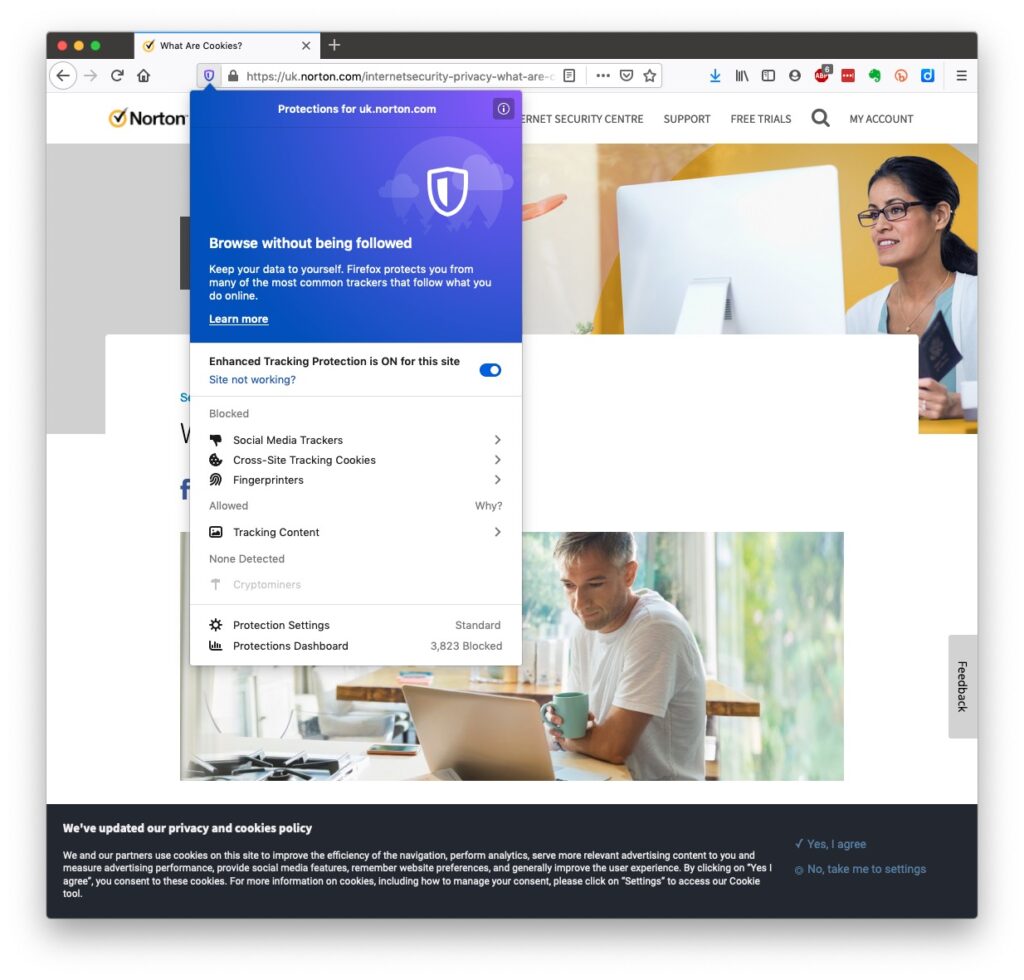
Essentially, they record what you do on a website so that when you return to it some of the settings are remembered and applied. Cookies do however also have a downside in that some can also act to track your activity once you’ve left the site. For that reason, you should disable in your browser the ability of third-parties to glean information from a cookie, and also to prevent them tracking your activity once you’ve left the site. You can at anytime, clear the cookies from your browser, and indeed on some internet browsers set them up to delete cookies when you leave (close the window) the site. If you use Firefox as your browser it will alert you the first time you go to a site that it is using a Fingerprinting cookie itself. For instance from the Norton site above …
… this is a nice feature, and should not be confused with the rather more annoying GDPR pop-ups which almost force you to accept because you can’t be bothered to check the detail that some sites force you to go to in selecting which cookies you want to store. I often just stop using that site rather than read through the options, or alternatively just click “Accept” and hope for the best!! Not exactly the privacy control that was envisaged when the legislation was enacted!
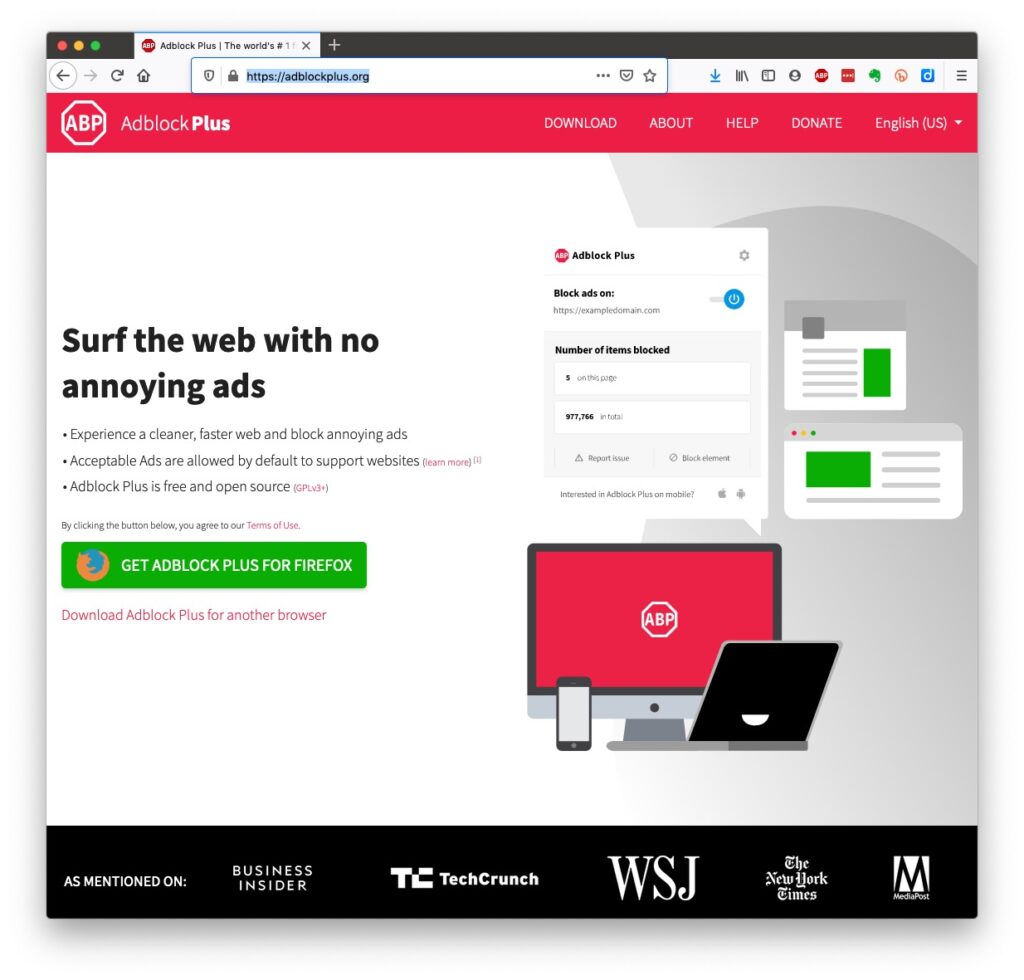
Another thing you should consider is whether you want adverts to be shown, or not. You might get a request to enable adverts when you visit a site, the answer you supply will be held in a cookie in the browser – that’s how cookies work. Firefox, Brave and Microsoft Edge, by default, block most, if not all, adverts. These are often annoying and having a browser that blocks adverts, or if you use Chrome – using an ad-blocker like AdBlock Plus often makes for a more “pleasurable browsing experience” by limiting the intrusion you might feel upon your privacy.
Which brings us to browsers and search engines
Search engines are not created equal! Whilst Google is often thought to be the same as the internet and is often mistaken to be an internet browser itself, it is in fact just one of a range of possible search engines that you can use to look for information on the internet. It uses a platform called Chromium to display the results of its searches to you through a browser called Chrome. However, other browsers – Microsoft’s Edge, Brave and Opera all use the same underlying Chromium technology – the difference being they don’t track what you’re doing “to present the content that most meets your needs” (Google’s philosophy) and in some cases (eg Brave) they can actually prevent tracking of your browsing history. I use Safari – which on Apple is my default browser choice, but otherwise I would use either Brave or Firefox as my internet browser.
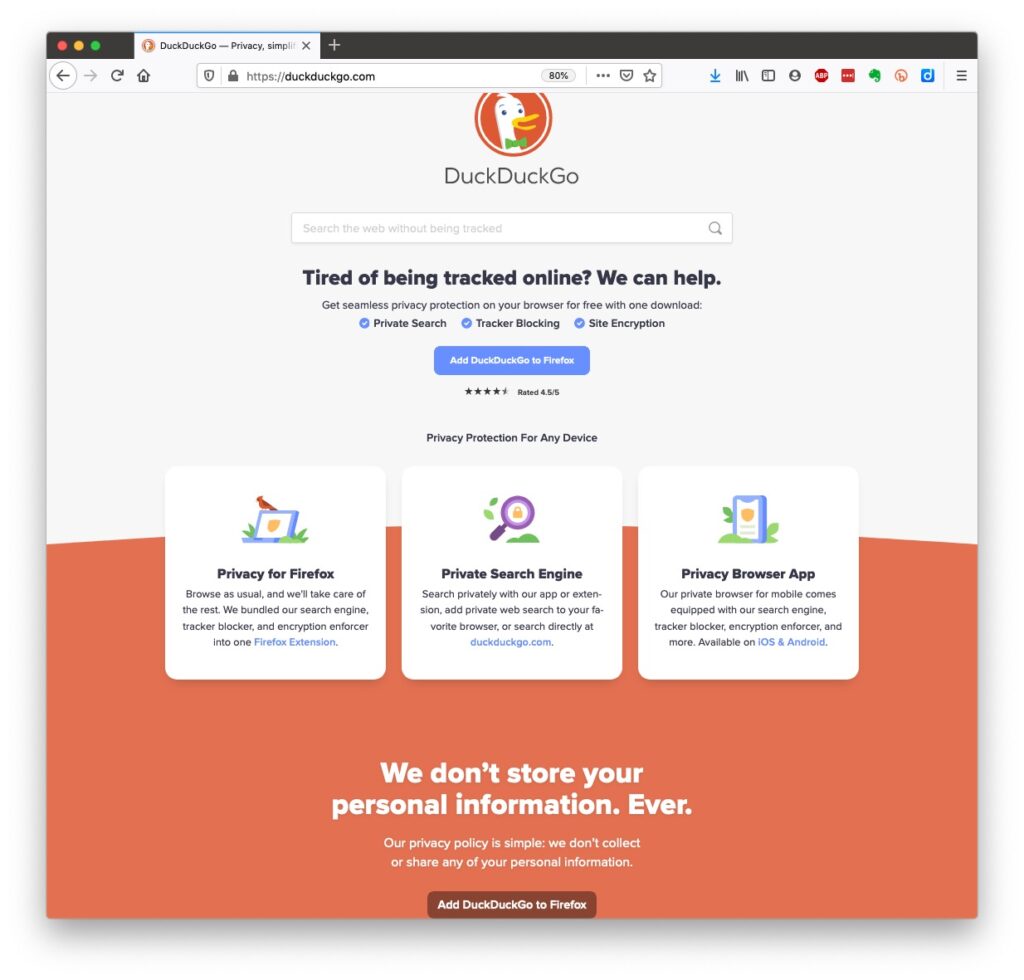
So what safe and private search engine could you use as an alternative to Google. I use DuckDuckGo …
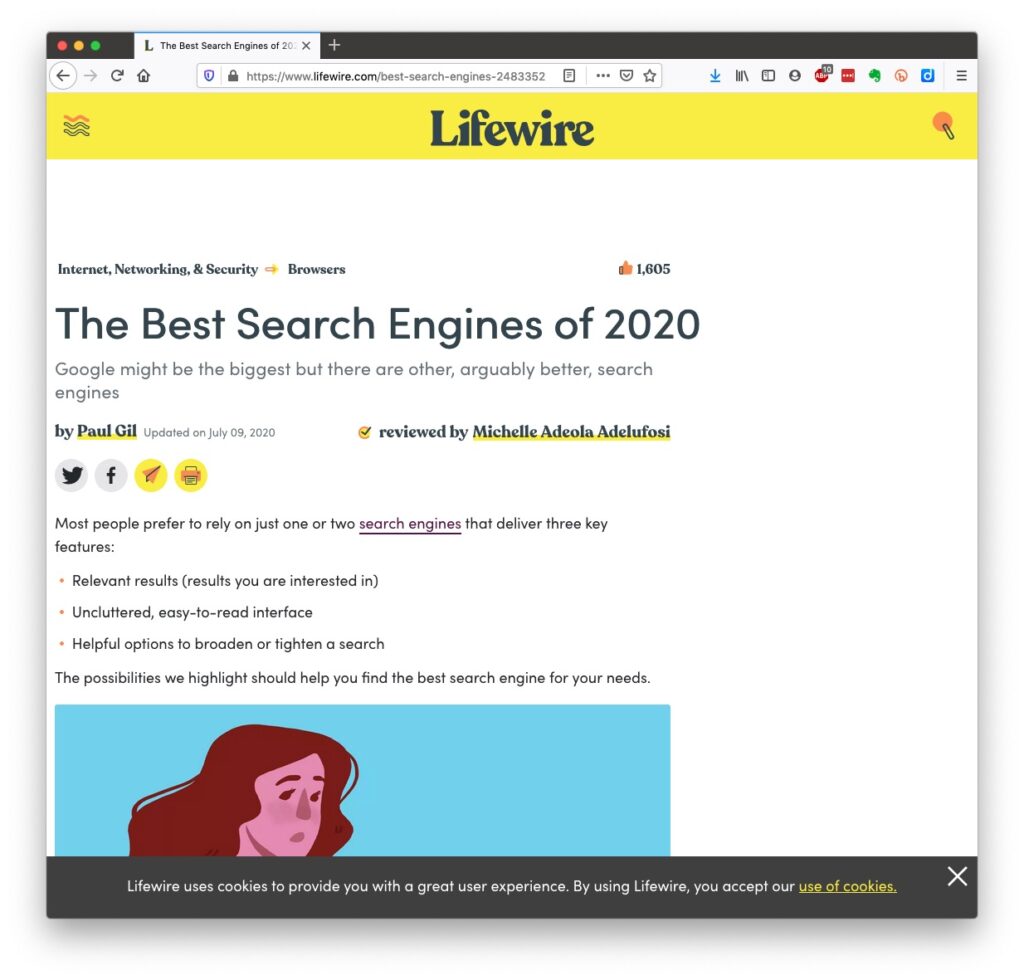
… but others I could have used might have been Ecosia, Bing, Yahoo or another one you might choose from this article or the list of other articles at the end of it …
There are many specialist search engines (as explained in the above article) that can give you much better, and more targeted results than a broad-spectrum Google search with the priority of results returned by relevance, not payment received by Google.
Finally, no discussion of Privacy can ignore Social Media and Facebook in particular. These applications, if left to their own default settings, are effectively personal information mining engines. They grab what information they can from you, and sell it on to whoever is willing to pay for it; or are indeed the platform for data mining, vis the Cambridge Analytica affair.
Recent enforcement of data privacy legislation by the EU on Meta has resulted in them being hit with massive fines for breaches of GDPR law by Facebook, Instagram and WhatsApp.
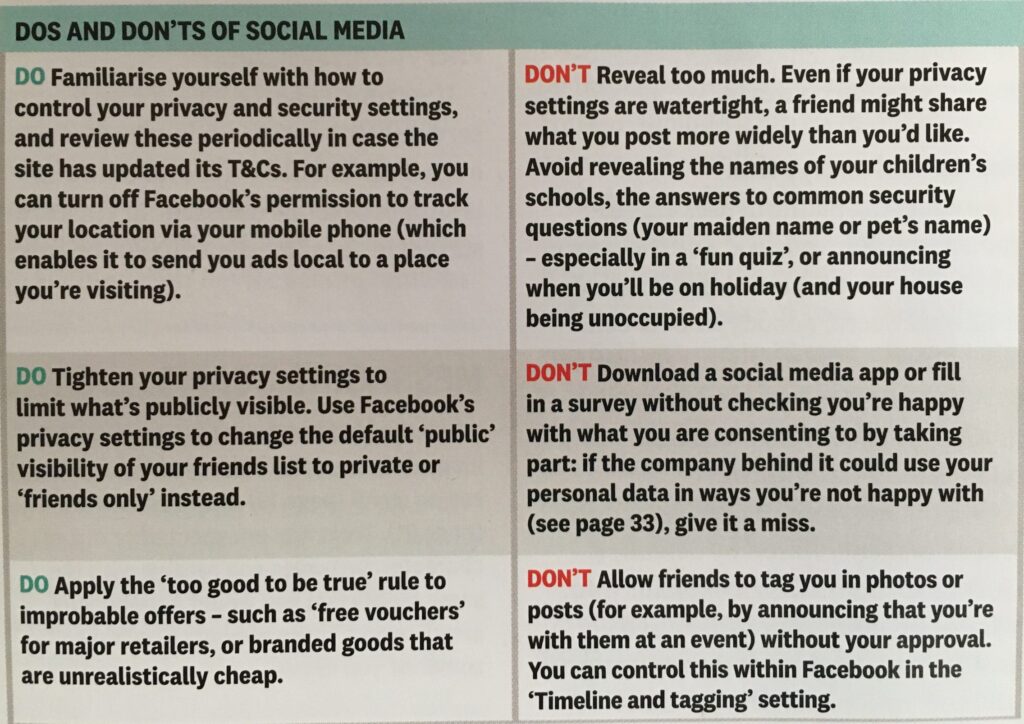
Online retailers are not exempt from this and Amazon for instance has a wonderful record of your browsing history! Are you sure you know what it’s doing with that information? So look at this table taken from a recent Which? supplement – Staying Secure in a Digital World – and just check whether you need to change your settings if you use any Social Media apps …
So that’s Privacy dealt with.
Should you be frightened?
The take away message I want you to have is Frightened – no; cautious – yes!
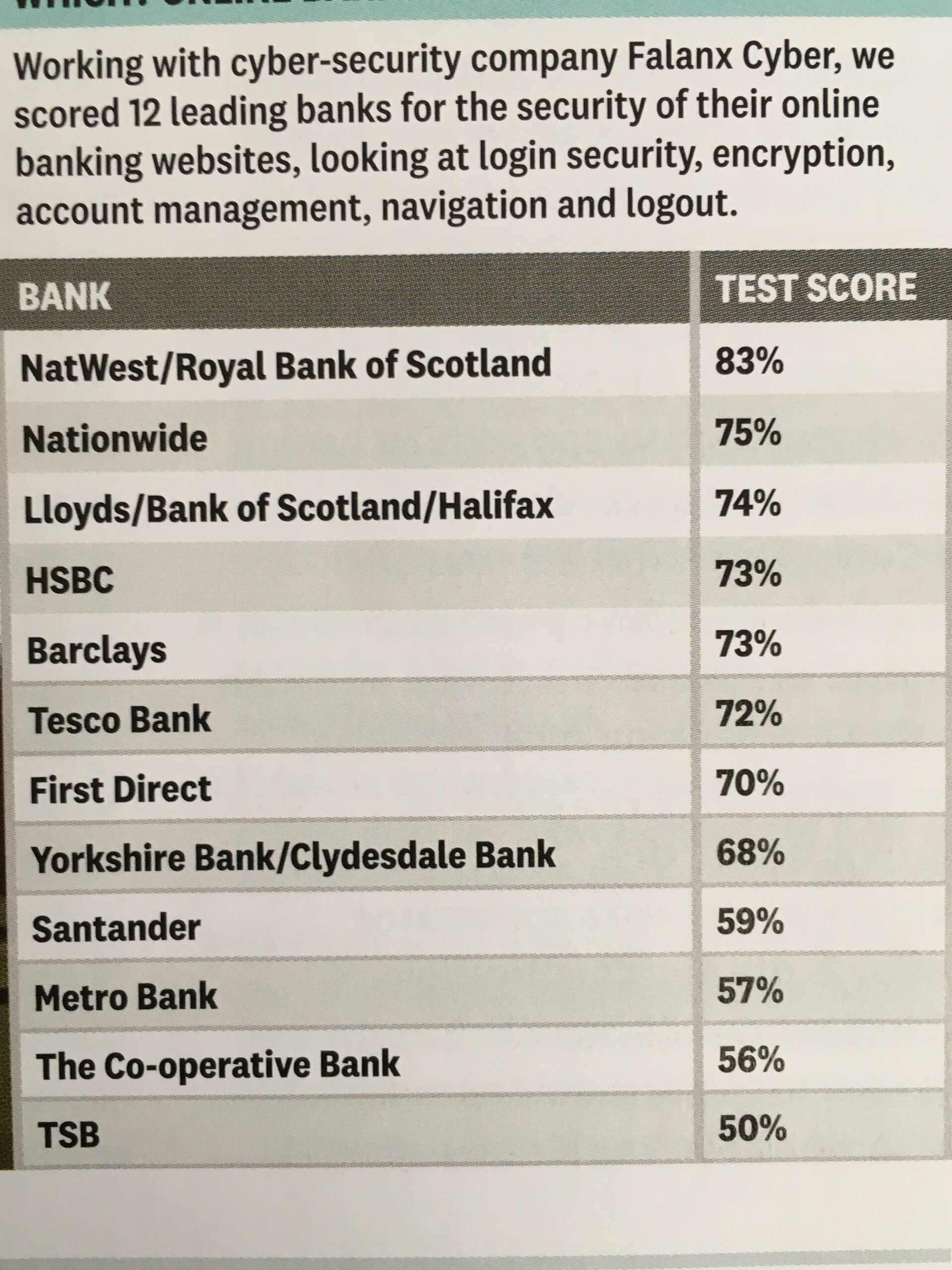
Online banking is very secure – a recent survey in Which? produced the following scores …
… plus you are protected and most of the banks are increasingly opting to adopt an online and mobile guarantee to refund you where you’ve been the innocent victim of a fraud. Here for instance is Barclay’s “Online and Mobile Banking Guarantee.”
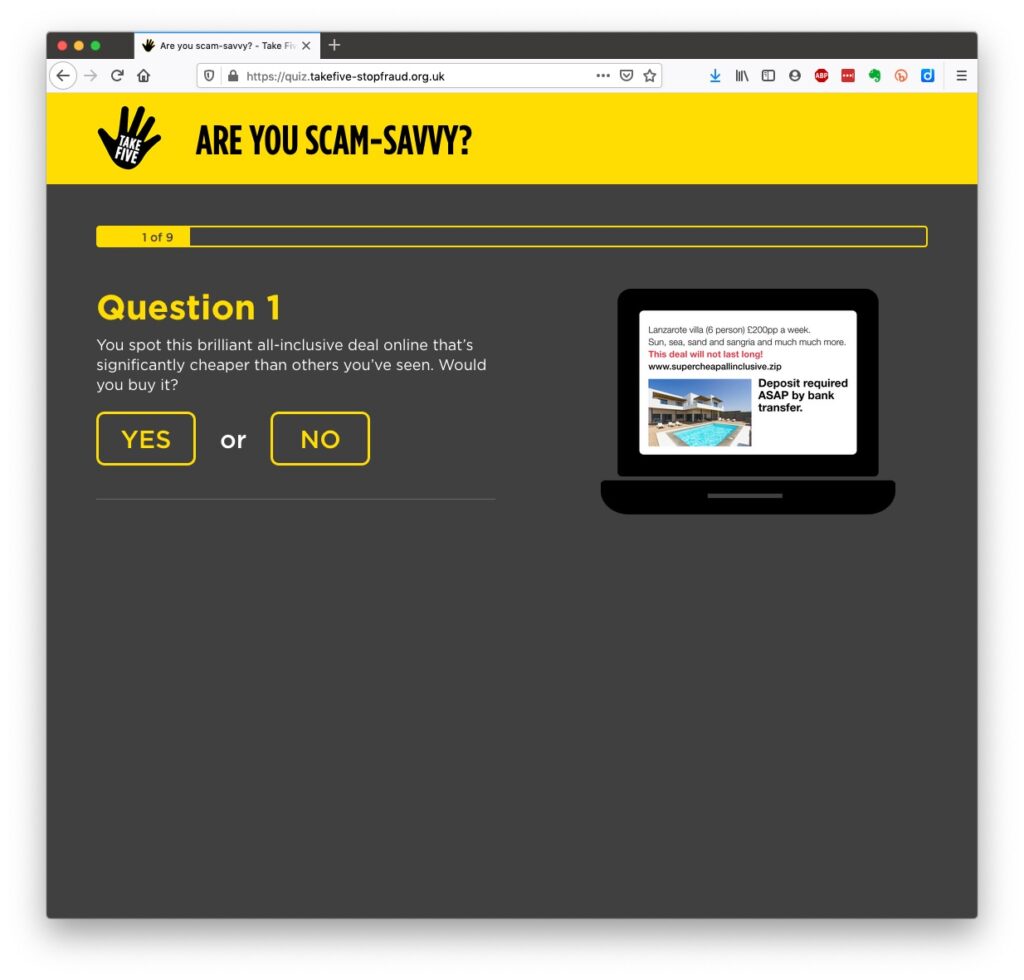
They really don’t want to shell out money, so they are trying to educate us to be wise to scams. So let’s take a scam test …
Banks are also often supplying software free (or at reduced cost) for you to install to protect your machine, to protect you from fraud – and of course themselves from having to pay out! I was recently offered a piece of software called Malwarebytes by the NatWest and although I have an Apple Mac computer which are well known to be relatively secure from Viruses, Spyware, Trojans and other malware, I installed it. I was pleased to note that I didn’t have any malware on the machine.
Surprisingly you might think … it’s safer to use the mobile app on your phone, or tablet to do online banking and retail purchases than a web browser. This is because the app on the mobile device has to be verified by Google for Android (Google Play Store) or Apple for iOS/iPadOS (Apple Store). Whereas a browser could be infected, or compromised with malware. [That’s something I’ve learnt whilst preparing this post!!!]
When you’re out and about and NEED to do an online transaction from your mobile – use cellular rather than WiFi. The latter can be really open to “sniffers”. [I must admit I try to avoid doing online transactions when away from a domestic network.]
Alternatively consider buying and installing Virtual Private Network (VPN) software, such as NordNet so that you can use the free public WiFi in a public area.
You can find out a whole lot about the range of scams at the NatWest’s Security Centre.
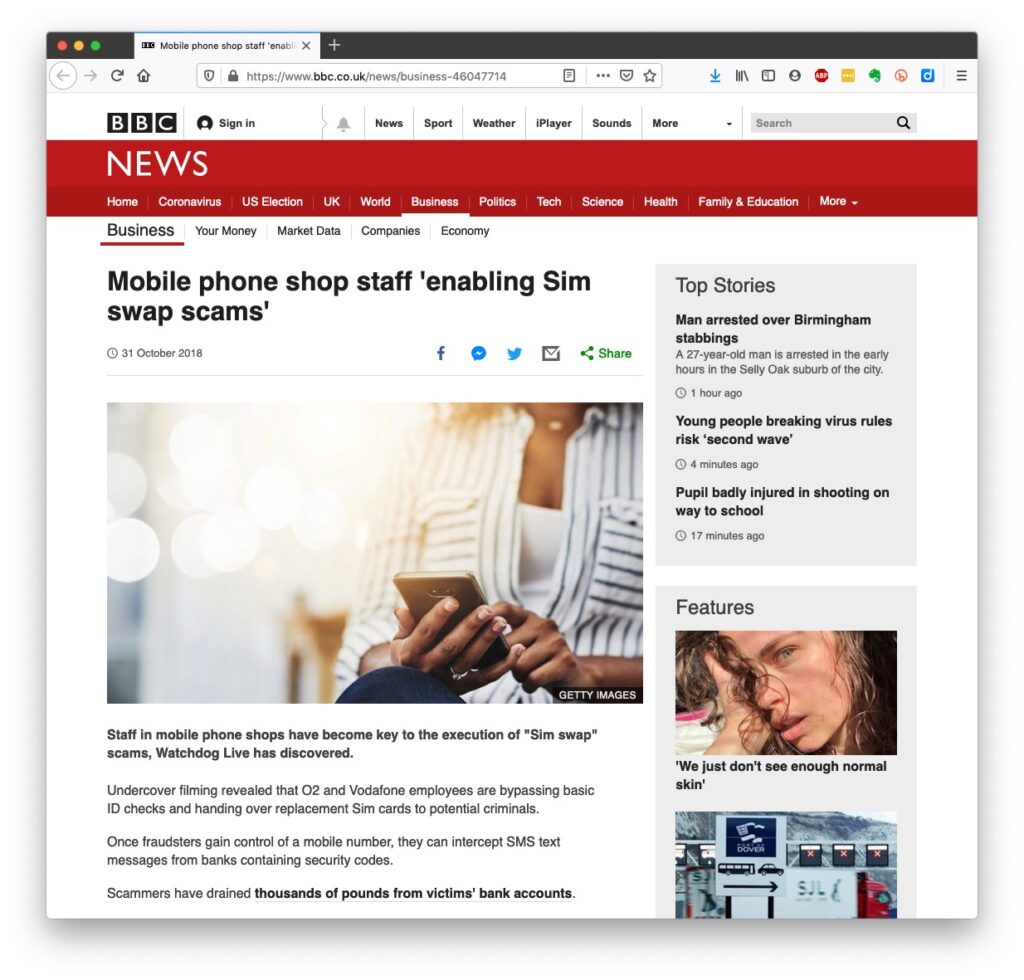
However the most scary scam I’ve been made aware of is one that befell a member of my family when they were distracted sufficiently to become the victim of SIM swapping.
I’ve discussed this with you before and you can read the updated post here.
I also covered this issue in another post which involved stealing a phone, to obtain access to your identity and commit fraud, and we covered the even more disturbing theft of a credit card with the complicity of the US Postal service to obtain a SIM in a recent meeting as well.
What should you do to protect yourself?
Some of these pieces of advice are really quite straightforward, but some require some intervention by yourselves.
Keep your operating software up to date. This is particularly true if you’re a Windows user, and even more true if you are still running an older version of Windows than Windows 10. If you’re using Windows XP, Windows Vista or even Windows 7 you should seriously consider disconnecting your machine from the internet because even if you’ve got anti-malware software running this is probably not protecting you against the latest threats.
Install anti-malware, or anti-virus software, particularly if you’re a Windows user. Don’t pay more than you need to. Windows Defender from Microsoft is Free and for our demographic relatively undemanding and unsophisticated users, more than sufficient. Keep it up-to-date as well! [As I said previously, your bank might be offering free software as well.]
Keep the software you use regularly up to date as well. Consider removing any software from your machine that you don’t use – this is because software vulnerabilities are discovered sometimes quite a while after the software was first released. It will also save you disc space!
Be cautious over installing extensions into your browser. These are often extremely useful and valuable tools, ie password managers, Dropbox, note taking, Google Back up and Sync, but if you don’t get them from the official sources then you might be importing vulnerabilities, eg spyware and trojans to your system.
Very seriously consider logging-out from social media and other retail sites when you’ve finished using them, especially Facebook, you just don’t know what tracking and logging of what you do, even where you are, if you leave yourself logged in on a mobile device.
Free software is both a boon and a curse. Only download open source software from a reputable site such as Softpedia, and never try and get proprietary software for free. Read this article about Free download sites if you want to know more.
Remember the golden rule 1 – if it seems too good to be true, it probably is, so steer clear!
Remember the golden rule 2 – don’t speak to strangers (an oldie but goldie that one); in other words if you don’t know where an email has come from – ignore it; if the website address looks a little strange – do an internet search on the company or organisation to check if the address you’re looking at is a spoof of the proper one.
Have more than one email address. Use one as your personal address, then use other ones that you can “throw away”when you need to register to a website, but you’re unlikely ever to go back to it again. Or have an email address (UserID) specifically for online purchases. Splitting things like this reduces the risk of you being the victim of fraud.
Seriously consider using an email service that is NOT connected to your Internet Service Provider (ISP). If you decide to change your ISP, and you should review them periodically, then you will have real problems if your email address is linked to their service!
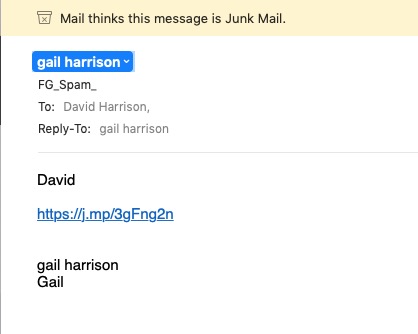
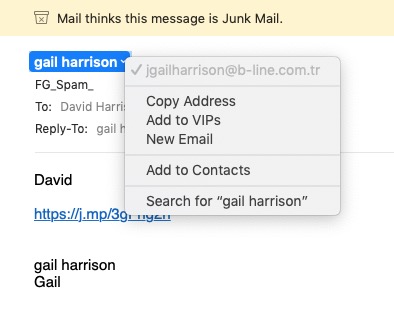
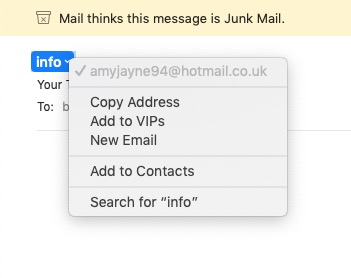
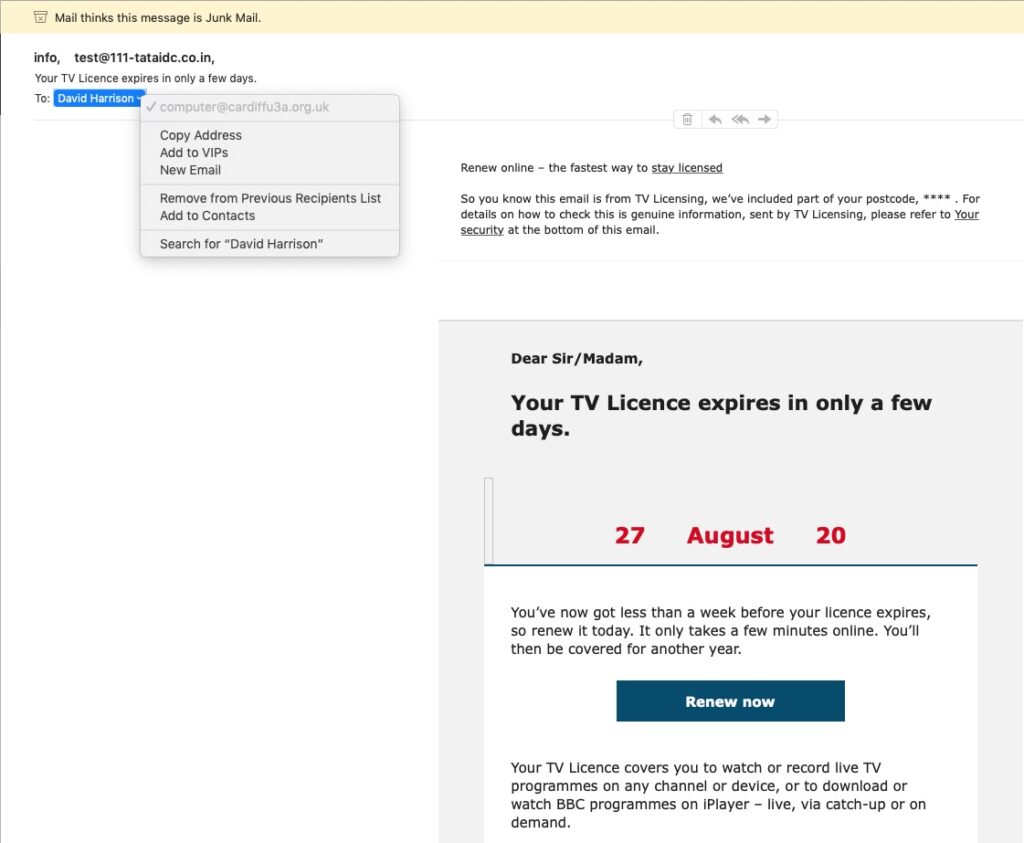
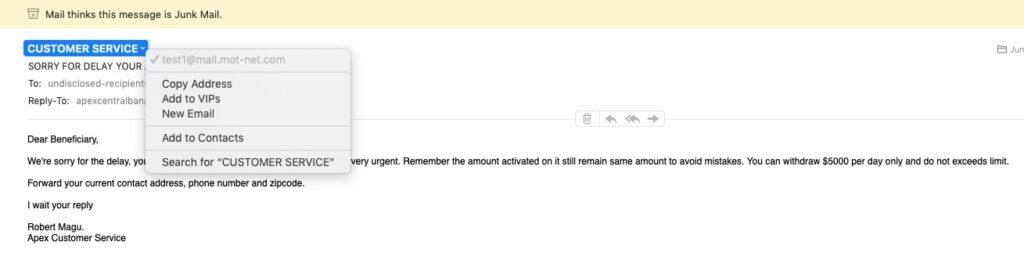
You’ve got Spam filters running? Of course you have – but you better check! Probably your ISP, or email provider (eg Gmail, Yahoo, Microsoft Outlook or Hotmail) is filtering out what it thinks is spam, but occasionally some gets through. If that’s the case then you can always look at the real sender of your message. Take a look at the examples below …
You can also apply filters to divert incoming email into different folders in your email system. That reduces the amount of Junk that you need to review. [I’ve also advocated using the “native” email application for your device rather than rely on the web-based service the email provider has. Thus on a Windows device – use Windows Mail (or Outlook); on a Mac use Mail. You can then easily synchronise your email between devices from multiple email accounts. Tidy!]
So we come to Passwords …
… this is the point at which you need to consider intervention and changing your behaviour! You might also need to do a fair bit of work, but it’s worth it if you want to have a secure internet experience.
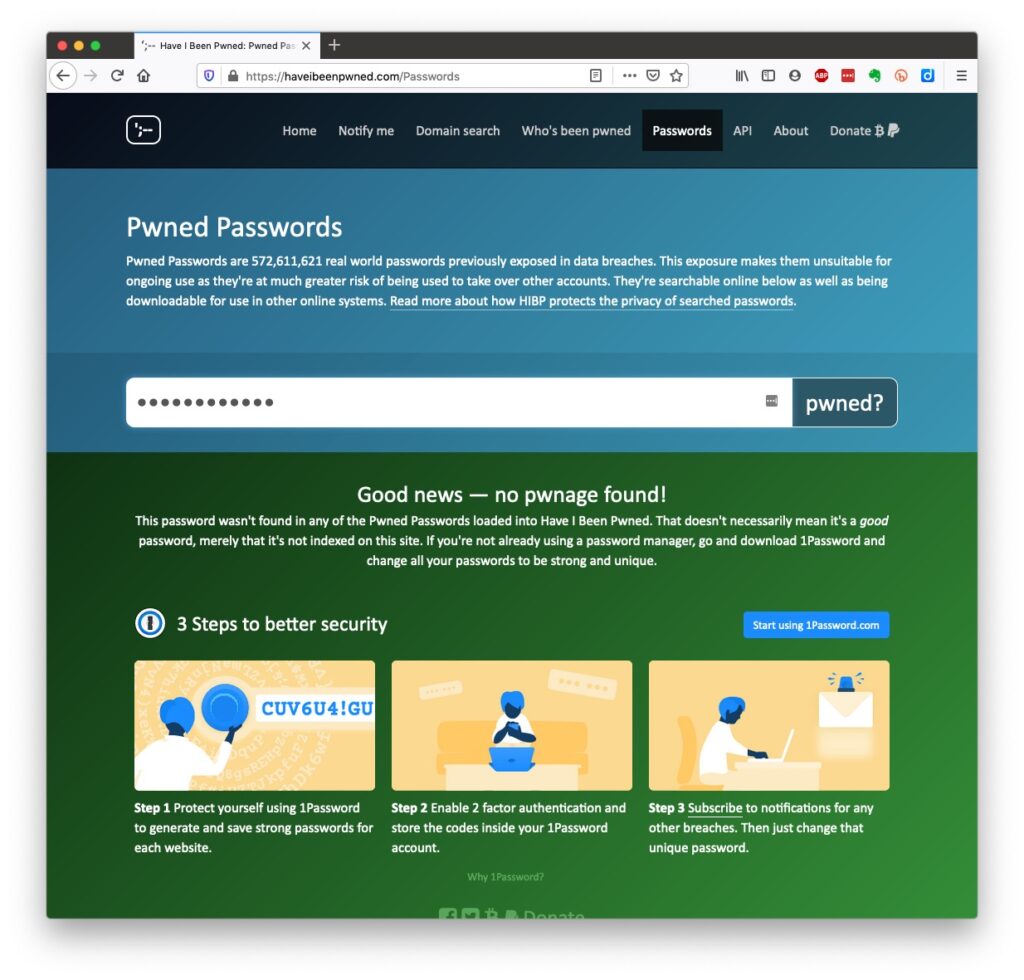
Let’s just see what using an insecure Password can lay yourself open to. Type in the word Password, or ABC123 from the link above – frightening eh!?
The most common password I use – and I know I shouldn’t reuse the same password, but I am human – has not been discovered on any pwned site. Phew!
What about the combination of your email address with your password – has that been “pwned” (ie stolen through a data breach)? Try typing your email address into the link above.
Oh no! I’ve been pwned … but it was a long time ago and I’ve changed my password many times since then!Ah! That’s better – my “throwaway” email and passwords are “safe”!
And if you want to see a list of which websites have been breached, it’s alarmingly long!
So … use a unique password for everywhere you sign on. There’s lots of tricks to achieve this; some of which I wrote about in a post quite a long time ago …
… but the real change of behaviour is to use a Password Manager – again I wrote about this a little while ago and linked it to using Two Factor Authentication, which is also covered in the same post …
Password managers
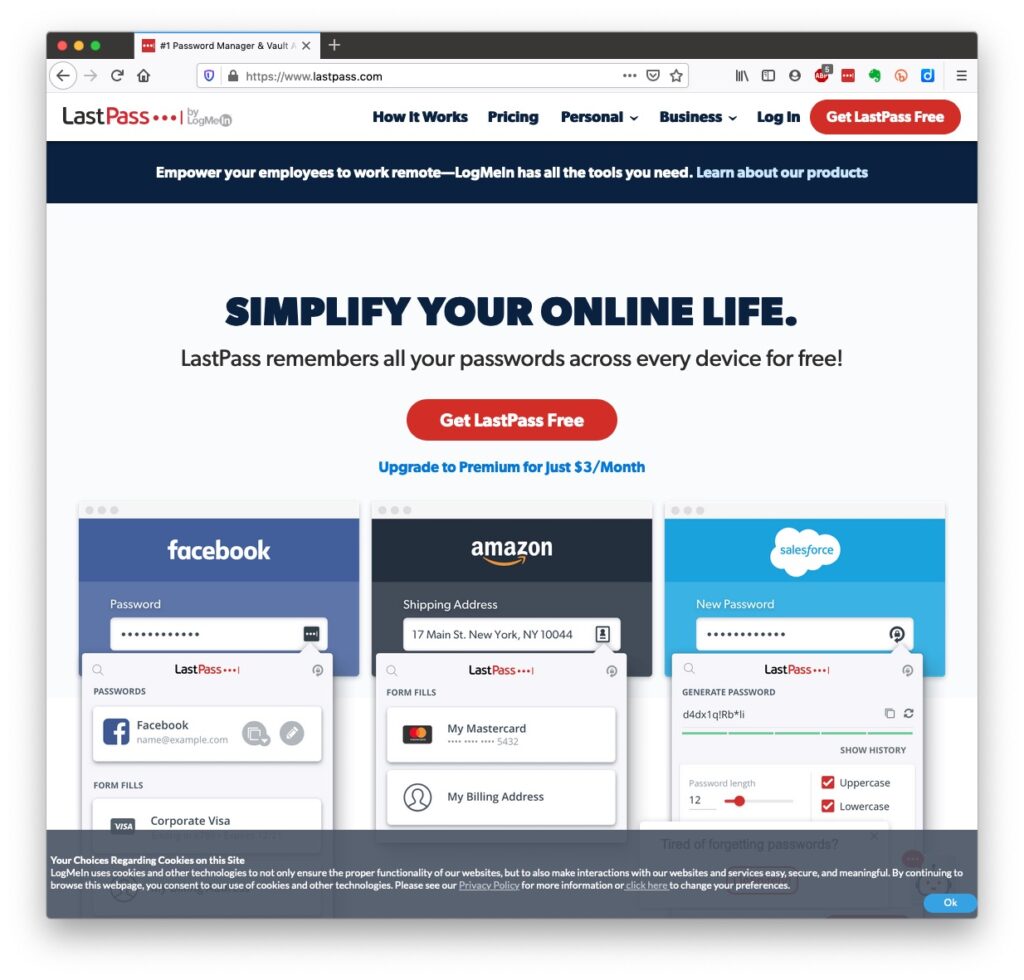
I still use LastPass, but as a back-up and archive of my old passwords. I now use Keychain as I only have Apple devices (as do most of my family, and so it makes sense to use a system that is linked to the hardware I use. Other common password managers are Dashlane and 1Password. Please make up your own minds after reading some Reviews and seriously consider using one.
An authoritative article on using Password Managers is provided by the National Cyber Security Research Centre. They also give an opinion on whether you should use the browser offered option to save your passwords.
However … the future is Passkeys
The major tech companies – Microsoft, Google and Apple amongst them, have been working in alliance on a project called FIDO that will mean the combination of UserID and Password can be consigned to the waste basket. This article explains what they are, and what it means for us really well. Although Apple stole a lead, announcing their implementation a year ago, Google has now launched it’s implementation, and this article describes how to set them up on your Google account. Microsoft also allow a password-less way forward, but I’m not clear on how to set it up – not being a M$ user.
On Apple – here’s how you set up Passkeys on your iPhone, iPad and Mac. Another reason why I chose to move from LastPass to Keychain.
Whilst if you’re a 1Password user, you can combine your legacy use of a Password Manager with Passkeys, and these will also work much better together on your iPhone. Watch out for an announcement shortly!
[NB It is possible to move between password managers, ie from LastPass to 1Password.]
And that’s about it for this year. We can look forward to much more about Passkeys in the coming 12 months; much more about GDPR and how the UK government’s online security legislation is reviewed (and hopefully revised) before implementation; much more about “big tech” and corporations re-acting to whether they are responsible for content, or are just a platform providing a service, rather than a publisher. Interesting times!
These may not be available in your Public Library, hopefully that isn’t the case.
… but these are available … Which? webpages – Scams & older people
I seriously do recommend signing up for the Which? Scam Alert Service – sign up for an email alert – and I seriously recommend you NOT broadcasting other people’s warnings to you about scams; they could be old, they could be inaccurate, they could be scams in themselves.
Look on the Age UK webpages – Staying safe in your digital world and specifically How to stay safe online
Your bank will undoubtedly have Internet Security webpages. Mine has a Security Centre web presence and particularly they provide a number of Fraud Guides
I could give a million references to changing your privacy settings on Social Media, but here are a couple relating to Facebook, perhaps the most challenging service of the lot.
First – what Facebook unchallenged will want to get from you. You are able to disable (prevent) all or some of these … Sign up for Facebook – this is not sign-up site, it’s just one to educate you on the privacy you might give up without realising before you sign up (but of course you can run the checklist at any time); then How to change settings on Facebook and finally Securing Facebook: Keep your data safe with these privacy settings.
I’ve written before about how it might be wise to look at subscription services rather than rely on free services and back in October 2020 I wrote a piece about the distinctions between Open Source and “free” software in general. Now it’s time to pick (and update) my winners in a number of categories. They will have to work on multiple platforms as well – PC (Windows), Mac (MacOS and Linux, and hopefully on smartphones and tablets as well. I will stake my reputation on the fact that if you download any of these pieces from the links I provide that it will be safe, and reliable.
Office software – word processing, spreadsheets and slide presentation. Here there are two close contenders but I’ll tip towards the true Open Source offering which is LibreOffice. At one time I used to recommend OpenOffice as an alternative to Microsoft Office, but the better file formats supported in LibreOffice tips the balance in their direction. Here’s a review of LibreOffice – a brilliant piece of Donationware. The runner-up would be the Google suite of applications (Docs, Sheets and Slides), but they’re not truly free … are they? Alternatively, recognising the competition of Google, Microsoft has made Office 365 Online freely available to be used with OneDrive.
Desktop publishing – you might like to look at Scribus; I have no experience of using it but here’s a review.
Media Player – there’s really only one player in this category. It’s VLC Media Player. It runs on really old hardware too, and supports almost every media format – here’s a review.
Photo editor – if you don’t want to shell out on Adobe software (Photoshop and Lightroom) or Paintshop Pro, or others, then again there’s only really one leader in this class. It’s Gimp. Here’s a review. There’s plentiful documentation and videos on using Gimp available on YouTube too. If it looks too complicated for you then Paint.net, or the new Google Photos (yes I know I said it wasn’t truly free) would be worth looking at.
Video editor – one that I’ve begun to “get into” recently has been Shotcut. I can truly say that once you’ve got over the shock of so many panels and options, and have spent a little while reading the good documentation and watching a few YouTube tutorials, that this is a little gem. Here’s a review. If you want to change video formats, then take a look at Handbrake – it’s saved my life a few times; a brilliant piece of software that changes one format of video to another, and also allows you to copy non-copyright protected DVDs to MP4 (for instance).
Audio editor – this is one that Jim’s recently been using and one that I’ve relied on a few times too. It’s Audacity. A clean multi-panelled window that’s reasonably intuitive I felt. If you want to edit audio tracks, change their format, or create a playlist, give it a try. Here’s a review.
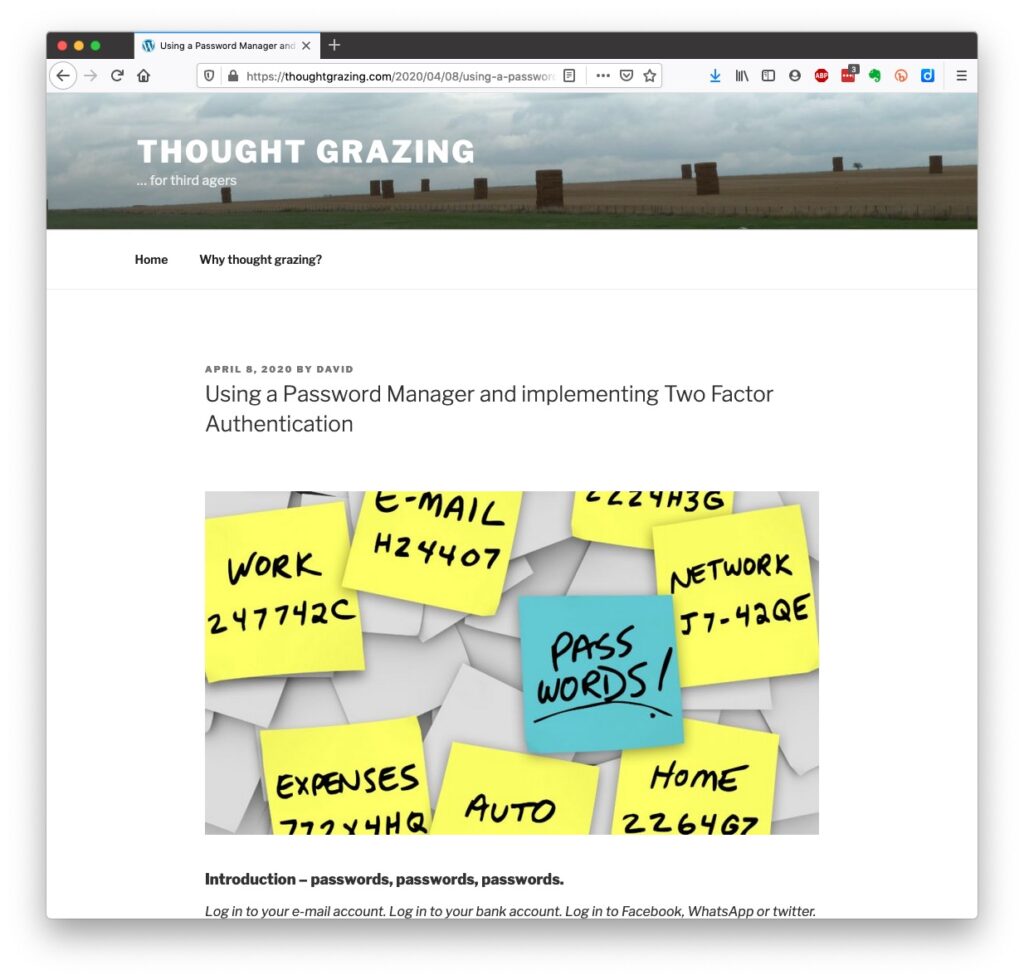
Password Manager – I’ve gone on about the importance to consider using a password manager as a way of allowing you to “remember” different passwords without resorting to yellow stickers, or notebooks. In a crowded field of freeware contenders I go with the one I used to use – LastPass – here’s a review, but you you might easily choose an alternative, eg the freemium 1Password or the open source KeePass. [NB I’m now using Apple’s Keychain as I only have Apple kit. I still have a LastPass as a legacy repository for quick checks, and you can migrate out of LastPass to Keychain, or any other password manager.]
Anti-virus – no real recommendation but the freemium possibility is Avast. If I was a Windows user, I’d rely on Windows Defender. As I’m a Mac user I’ve installed Malwarebytes – supplied by my bank – but it’s never recorded a virus, or any malware. [Fingers crossed.]
Email client – if you’ve got Outlook, use the Microsoft client (or app); if you’ve got a Mac, use the Mail app; if you solely use Gmail, use a Google client (or app); BUT if you want to try something different and Open Source why not look at Thunderbird. It’s from the Mozilla Foundation (where the Firefox browser comes from) and it’s multi-platform and multi-email system supporting. Here’s a review of it. [Health warning: I have used it in the past, but not using it now as I am so immersed in the Apple ecosystem, but if I wasn’t, I’d be seriously looking at using it.]
Group Messaging – it used to be WhatsApp, but now it’s Signal which is Open Source, and Donationware. I give a small monthly donation to support.
Web browsers – both a difficult and easy one. It has to be either Firefox, or Brave in my book. I can’t distinguish between them. I like them both, but I suppose I still just tip towards Brave because it’s more like Chrome (unsurprisingly).
Search engines – again, for me, a relatively easy one to pick; it’s DuckDuckGo. Don’t just Google It – DuckDuckGo It. It should be available as a choice on “all good browsers”. If it’s not – change your browser, or add it to the list offered by your browser.
Web-design, blogging and the rest – for me, no competition – it’s WordPress. You’ll need to shell-out to buy a domain (eg thoughtgrazing.org), but after that you can use wordpress.com to commit your thoughts to the internet. WordPress will offer to host your website for an annual fee, but the use of the software is free. If you want to take it further you can find a hosting company, move your domain there (or purchase it there) and install wordpress.org and have access to the vast number of plugins that are available to tailor your website to just the way you want it. Many of these plugins are free, or are made available as freemium software.
Miscellaneous
an AdBlocker – go for the freemium AdBlock Plus (look out for similar sounding ones, and avoid them).
Note-taking – it used to be EverNote for me, but now I’m recommending either Microsoft’s OneNote coupled with OneDrive (if you’re a Windows user) and the greatly improved Apple Notes (if you’re a Mac/iOS user).
RSS Reader to scrape and archive content from websites I follow – it’s Feedly. I subscribe to their premium service.
Bookmarking – I used to use diigo, but now find that with the improved functionality in browsers and the integration with the cloud that it’s best to use your browser capability.
For offline reading I find Pocket a wonderful resource which I subscribe to as a premium service as I do Flipboard, from which I curate magazines which you can share – and I do!. [NB I’ve updated a post I wrote back in 2018 which describes the workflow I follow EVERY morning to do this – aren’t I boring!!]
Mapping – OpenStreetMap is a great piece of software that I haven’t used in an active sense, but I must investigate! [As an aside, take a look at Open Canal Map, not software but a community initiative that uses other publicly available maps to build upon.]
Google Earth Pro – the often forgotten global visualisation software, available from your browser, or in an app.
Video-conferencing – it used to be Skype, now it’s the freemium Zoom.
Online communities – a replacement for the sadly “sunsetted” Google+ could be Discord. This has achieved some notoriety in recent weeks, but it is also used for more than gaming and sharing secrets.
Media-server – you don’t need to rely on Apple TV, Netflix, Britbox or whatever. You can setup your own media-server with the freemium Plex server, and add your videos, music and images to your own server which you can access anywhere in the world, or just use their Plex player to view their streaming service.
I could go on and on, but that’s enough for the moment. Have fun!
I didn’t do any Notes from the Meeting which was a Christmas Quiz hosted by Phil Edwards, but Jim obliged with a photo – sorry for the delay in posting; I’d left it as a draft post. Duh!
I think this might have been our largest attendance at a zoom meeting and as usual we had a lively discussion with a lot of good craic.
I kicked off with a quick follow-up from the previous meeting on 19th November, I wondered whether David H’s issues with Linux on his wife’s laptop might be due to missing a setting for US/UK keyboard during install, and Phil supported this view. We agreed to look at this again when we could meet in person. We briefly discussed the session with Digital Communities Wales and confirmed that we’d now wait to see what the Cardiff U3A Exec wanted to do about digital inclusion for our members. Phil noted that Cardiff City Council were now promoting a scheme to provide equipment to those on benefit. We noted a couple of new scams involving HSBC, Amazon and DPD – these had been reported on our WhatsApp group. Thanks. I also gave a quick demonstration on editing in the new WordPress Block editor and pointed to the Help files that might be of assistance too. Finally I drew members attention again to the Flipboard magazine and the link to it that now appears under the Computer Group menu.
We then went “round the screen”.
John was having some issues with his use of Lightroom Classic – I suggested that he brought this up at the next session of the Lightroom Pantry Group. [He did, and we then had a follow-up session]
Renee was experiencing a strange behaviour when using Powerpoint and Zoom (with Screen Sharing) where her cursor (on a Mac) seemed to disappear. I couldn’t think of any reason why this might be. Hopefully, it will resolve itself 🙂
Margaret described a very sorry tale connected to her “smart” hearing aid, an app that couldn’t be upgraded and the inability to pair the aid to her phone. Hopefully there will be a positive outcome but unfortunately this is only too likely to happen as suppliers don’t keep their apps up–to-date with changing technologies. She also advised that she’d managed to resolve her printer problem (from the previous meeting) after she’d found an old cartridge which when fitted had allowed the printer to spring back into life!
Christine described a problem that she was experiencing when using WiFi on her new Lenovo Chromebook. When connected to the same network and sitting near to another machine to play chess there was a lot of interference. I said this happened to me as well and the only solution would probably be to sit further apart – even in different rooms. It will be interesting to see whether this problem can be resolved.
Sianed told us about a C4 series on Amazon and noted that Amazon was increasingly being used as a search engine (rather than Google). I can understand why. Often I do a Google search that then leads me to click on a link to Amazon – why use Google in such a scenario!!!
Jim advised us that he hadn’t yet decided on his new laptop.
David H told us about the saga of the M&S hamper to his grand-daughter which led to it being left on the doorstep of her house fronting the street. When he’d complained he was impressed at the way the company had responded. Good customer service.
Paul was having some difficulty with his Google Contacts. He would report back on his progress. He also told the group that Aldi were now doing Click’n’Collect.
Marilyn was still having problems with her external SSD (MacOS) and was going to back-up the disk and re-format it as APFS as she now felt there was little need to have it formatted as Ex-FAT (for MS-DOS/Windows compatibility).
Stella was having problems with LastPass – I’m afraid my notes/memory on what it was fails me. Sorry. She also had reported a scam from 3 to the authorities.
Marie-Christine reported that the OU Photography course she’d hoped to have followed had to be abandoned due to a hack of the URL for the course. She had been recompensed however.
Mario asked about the nature of WordPress. I gave a brief outline of what it was and why it was not just a blogging platform but a website design and delivery tool in its own right.
Don reported that after the previous meeting in trying to improve performance of his machine, he’d removed unused extensions from his Chrome browser and this had helped. He also described how he’d solved a problem of being unable to do double-sided printing from Word 2007 by emailing the document and then printing from the email. Magic!! He also reported that he’d had excellent customer service recently from Amazon in the matter of a wildlife camera he’d purchased.
Ann gave a big thumbs-up to Paul for his advice on purchasing a kit to copy VCR to DVD. She was glad she’d spent a little more to get a kit with a Help Tutorial guide but reported that the transfer was not quick!! She also advised us that Google Play was no longer available (needs clarification – not sure what this refers to) and that she was still having problems with the Sky Internet Service slowing down.
Finally Mike announced that he was well-satisfied by his upgrade for less cost from TalkTalk – to their Fibre65 plan. It was better and cheaper. Isn’t it a shame that you have to lobby and threaten people to get the service you require, which is not what they’re delivering.
Again, we’d run out of time, so my proposed session on Google settings had to be postponed. I may actually write it up as a blog post instead.
Most of the time people join flickr to showcase their photos, to get faves, and to get comments (hopefully both positive and constructive) to enable them to improve their photography. The photos you upload are shown in your flickr Photostream (or Camera Roll) which you can browse and put into Albums. You can create your own Galleries of your (and other people’s) images; Fave images that appear in your Activity stream (see later) and Follow people whose photos you like.
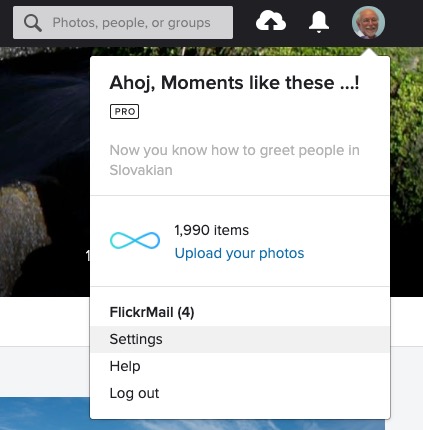
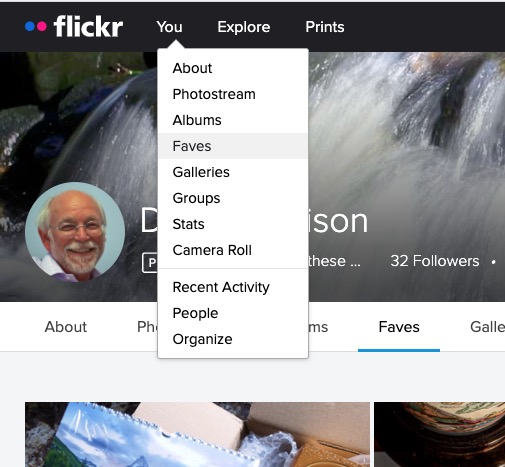
We’ll start by looking at the default privacy settings you can apply to the images you upload. The Settings page is accessed from your profile tab …
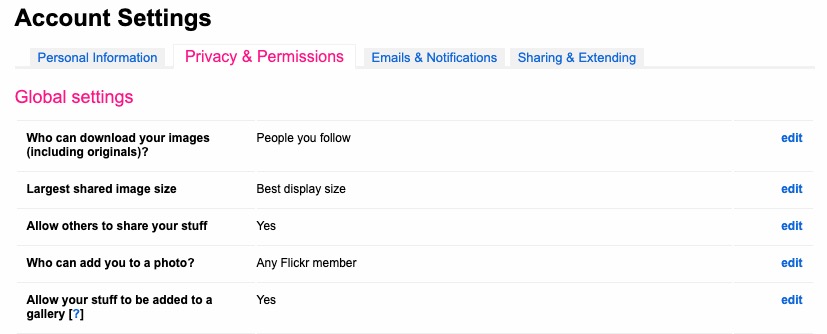
… which gives you access to a page with these headings …
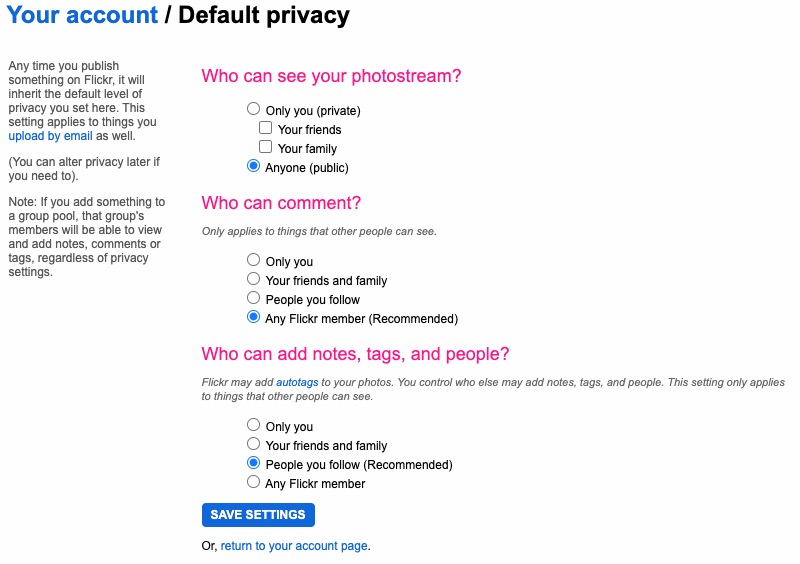
… clicking on Privacy and Permissions brings up this screen – from which you should first look at Defaults for new uploads …
Read carefully the Note: “if you add something to a group pool, that group’s members will be able to view and add notes, comments or tags, regardless of privacy settings.” There’s no privacy within a group. All members of the group can see all members’ photos. If you’ve declared your image to have restricted viewing to Friends, or Family however they will not be visible for public viewing in the group, even though the group page might be visible for public viewing.
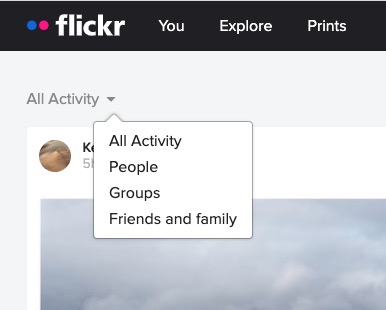
After uploading your photos they will (unless you’ve changed the default settings) appear by default in the Activity stream which you can access from the flickr logo …
… from which you will also be able to see the images of the people and groups you follow. This is the default view when you open Flickr on a mobile device.
Any photo you fave is then attached to your account so that you can return to view it on a later occasion.
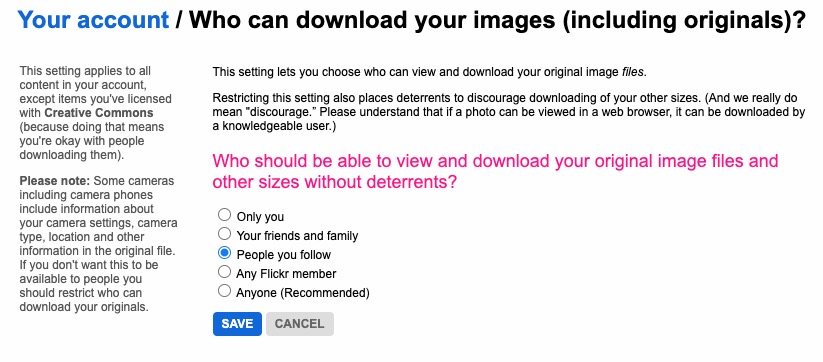
It is also possible – unless you’ve prevented it – for someone to download the photo, or add it to their own Photostream as their own! You might wish to check your settings to prevent that happening.
… and …
… so it’s important that you know what you’re doing when you follow someone – I certainly wouldn’t recommend the default setting of “Anyone”.
There are occasions however when you might wish to keep your photos completely private, or to share them privately within a Group. The settings in flickr to allow this are not exactly as intuitive as they might be so this post continues by seeking to help understand how you can “hide” your photos from the Public photostream, but to show them within a Group. Let’s start there.
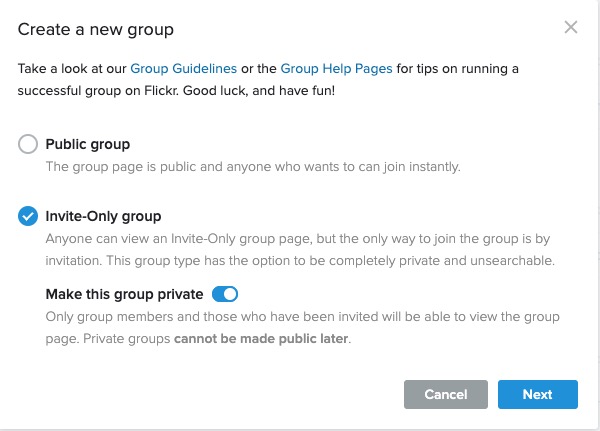
Groups can either be Public, open to invited membership (or upon application to join) and then also to be Private. Note especially carefully the note attached to Invite-Only Group which can be either Public or Private … “Anyone can view an Invite-Only group page …”
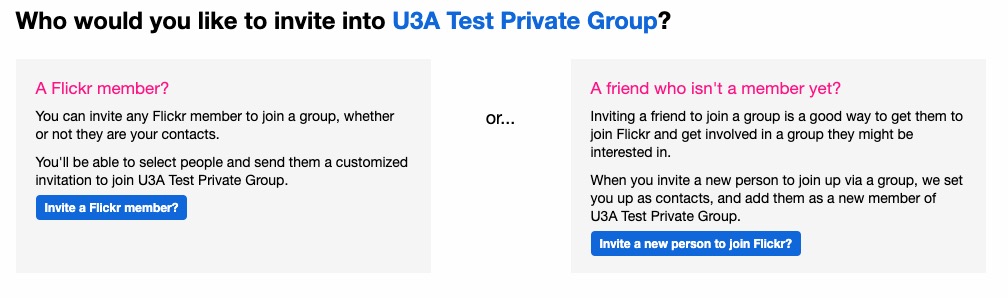
The last case is obviously the most restrictive and in this situation a Group is setup by a Flickr member and they invite either existing Flickr members, or non-members to join the group.
They will be sent an invite to join flickr, and the Group, as a member. You can therefore appreciate that you have to be a flickr member to view Photos which are in a Group. However if they’re not hidden from the Activity Stream by changing the default privacy settings (as above) and if it isn’t a Private group – they’ll still be visible to anyone unless you’ve also changed your search profile …
For the Invite-Only Group which has not been declared Private it is important to note that anyone (even non-Flickr members) can view the group page, so as we shall next, if you want your photos to be completely invisible to the outside world, you’ll have to do something else to make them invisible!!
If you want to keep your photos visible only to members of a Group, you need to specify on the Default privacy settings page either “Your friends”, or “Your family” depending upon the nature of the Group; similarly you should restrict Comments (and Notes, Tags and People) to “Your friends and family”.
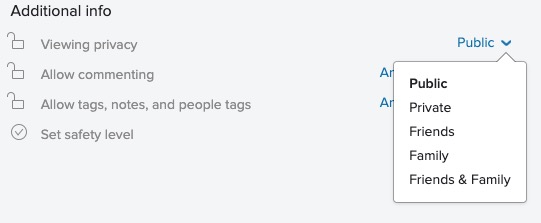
However these settings will then apply to every image that you upload and that might be more privacy than you really want, so you are able to choose the level of privacy on an image by image basis after you’ve uploaded them. This is done by looking at the information attached to an image after you’ve clicked on it in your Photostream …
… so, as an alternative, you could leave your Photostream relatively open using settings similar to the ones in the screenshots above and then restrict viewing of individual photos to Friends, or Family, etc. within Groups.
Soon after retiring and joining U3A I was asked to prepare something to show people how to use computers to research their family tree. Well, that really sparked an interest. I started researching my grandfather, George Henry Davies (Harry). He was a colliery farrier from Blaenllechau in the Rhondda Valley. I was two years old when he died. Sadly, I have no memories of him.
As a younger man, he joined the army in 1915. After a very short period in France, he was shipped to Salonika in Greece. These days, not many people remember that any fighting went on there. Harry stayed in Salonika until early 1918.
During 2020 the whole world changed beyond all measure as countries around the globe suffered the effects of the Covid 19 pandemic. For many, including myself, had to endure many months in lockdown with limited opportunity to go out and socialise. My music making with my recorder group, Morris dancers and folk sessions all came to a grinding halt. For many months I simply didn’t feel like playing any music at all. Then a friend introduced me to the idea of making Acapella videos .
Using this system it is possible to create little arrangements with myself playing all of the parts.
Around the same time I learned that the Imperial War Museum had a set of pantomimes from the First World War Salonika front. These pantomimes were performed by a party of traveling ambulance men, the 85th Field Ambulance. With the help of the Salonika Campaign Society, I’ve managed to get scanned images of the three pantomimes, Dick Whittington, Bluebeard, and Aladdin in Macedonia. They provide a strange and unique insight into the lives of soldiers posted to this long-forgotten battlefront.
At the moment, I’m trying to put together some of those Acapella videos, trying to breathe new life into those old tunes. I’m keying in each note of the tunes into Musescore software. This must be a bit like following a knitting pattern stitch by stitch with no idea what the finished item will ever look like. I’ve created some musical videos with the help of Apple iMovie and Acapella :- Pitch Perfect.
Initially, I thought I’d try to learn one or two of the tunes. I couldn’t be certain that my grandfather Harry had ever attended any of these pantomimes but after a short period of study, I feel that he probably did.
The Macedonia front was quite unlike the experience of the Western Front in France. During Summer, it was fiercely hot but Winter brought freezing conditions and snow. For most of the time, the battle lines were fairly static. There was little chance of any entertainment. Only lucky soldiers managed to visit the town of Salonika. Curiously, soldiers developed a strange form of entertainment:- Racing tortoises. Well, that was impossible during Winter as the tortoises would be in hibernation.
Also, it appears that these pantomimes were incredibly popular, frequently out-performing pantomime productions staged at Drury Lane.
Let’s imagine then that grandfather Harry did manage to get a ticket for the pantomime. Imagine him trudging through the snow to a small barn, nicknamed The Kopriva Palace Theatre. We’ll take a seat beside him and enjoy some of the tunes that he would have enjoyed all those years ago.
I’ve finished three videos of songs from Music of Macedonia. You can see them here.
I experienced a strange coincidence when I was looking through the music from Aladdin in Macedonia. Look at the name of the composer. Not my grandfather, G.H. Davies but a strange coincidence, another G.H. Davies.
Got my act together this time, and sitting down quickly to write up the notes of the meeting which saw three guests attend – Tony Baines (the Vice-Chairperson of Cardiff U3A), Matthew Lloyd (on his last day as South East Programme Manager for Digital Communities Wales) and Jenny Phillips (their Wales Volunteer Co-ordinator).
We started the meeting as normal by reviewing the Notes from the previous meeting and what had been on WhatsApp. I advised the group that there was now a link to the Thought grazing Flipboard “magazine” under the Computer Group tab on the website; I mentioned that I’d put some links to Which? articles on Black Friday on WhatsApp and would copy them into a Forum on the website asap; I’d written an article for the website on Purchasing a Laptop – copy’n’pasted from Which?; Paul had posted a screenshot of Google many years on, reflecting on how things had changed – Where is the Advanced Search these days???
John had sent me some links in an email re. Surge Pricing which was something I’d not heard of before linked to Smart Meters. I also said I’d check whether there was anything on Which? about this issue. There isn’t. However, it seems to be an issue that emerged in 2018 (mainly in right-wing press, it has to be said) and all has gone quiet since then. There’s an interesting (and perhaps useful) discussion on the Smart Meter roll-out in this article, which also explains what Surge Pricing might mean and involve, as well as discussing where we are with SMETS 1 and SMETS 2 meters.
I also reported in response to Anne’s query at the last meeting that I’d installed the Java Runtime Environment on my iMac and LibreOffic Base (their database) was then able to run.
We noted Phil’s letter in “Age Matters” and Don had been having difficulties in wiping a Hard disk clean. [This was resolved by Don taking the machine to Neil and “donating” it to him on the basis that he’d wipe the disk clean as this was an issue with the version of XP (Home Edition) which was on the machine which didn’t allow a Format.] I also reported that I’d posted articles on URL shortening and Taking Screenshots on the website.
David H thanked Phil in his absence for providing a second Linux USB stick and he’d tried to install it on an old laptop, but the keyboard had failed for some reason. They will return to visit the issue when they can meet in person. [Just a thought – it’s not something as obvious as US vs UK keyboards in the Linux setup???] However, they had received wonderful service from Curry’s who had delivered a new full-size iPad within a couple of days of ordering and he was most impressed at how easy it was to transfer everything from their old iPad Mini to the new machine. Renee confirmed it was a very straightforward and simple operation.
Mike told us that he had been in conversation with TalkTalk re. his poor internet reception and had managed an upgrade to Fibre65 and had reduced his monthly charge from £32 to £42, Threatening to leave is an unfortunate but essential tool in the armoury of the consumer.
Owen encouraged to read the reports and vote on the AGM motions on the Cardiff U3A website.
Jim was still in the process of deciding on a laptop and wanted to get a 15″ one with audio input/output, HDMI and USB. It was suggested that he perhaps looked at: a) a smaller (and cheaper) laptop and using an external screen; b) getting a small desktop – this is what Marilyn had done last year – instead of a laptop if it wasn’t going to be needed outside the home; or even c) get a MacMini and use it with a large TV screen or external monitor. [Guess who suggested the latter, fired-up by the new Apple M1 MacMini launch the previous week.]
Stella informed us that you needed to renew your iPlayer account every two years – I hadn’t realised that – and that she had experienced some fun and games in doing that before she managed to do it from her phone – Voila, she said!
Christine had decided to go for a laptop rather than a tablet, and this now enabled her and her husband to play online games, or quizes (??) separately; she also advised us about disabling Face Recognition in Facebook. [Note to self: I think we ought to have an annual session on Facebook settings as well as the Google account one I committed to last time.]
Don recounted his issues with scrubbing his hard disk (mentioned above); had been writing a report on church matters and had been playing online chess with his grandson.
Renee cheered me up by saying that she’d been reading the meeting notes and had downloaded bit.ly; taken screenshots and was now using Brave and LastPass – makes my ramblings so much more worthwhile when someone follows up on things. Thanks.
Paul had suffered from problems with his BT Home Hub Mesh setup and after not being able to fault resolve over the phone; the engineer (from the North East of England) had arranged the dispatch of replacement units – which were now working well. He also brought us up to speed with his look at Cardiff County Council’s website for Digital Inclusion (referenced in the last set of meeting notes.
This was a good introduction to Fred and Jenny bringing us to speed on what they’d done (mainly referenced in my late set of meeting notes from last time) and which then led into a general discussion on how we would handle our guests who joined the meeting at about 3:00pm. I admitted Tony Baines to the meeting first and he explained his role (mainly concerned with Cardiff U3A strategy) and he described how we could see things in either an out-facing (to non-Cardiff U3A members), or in-facing (exclusively to Cardiff U3A members) – this was a useful distinction to bear in mind as we admitted Matthew and Jenny to the meeting.
I gave a brief introduction about the Group, introduced Tony, and handed the meeting over to Matthew who presented through some slides. These are embedded below. He handed over to Jenny who described her role as helping, facilitating, training Digital Champions within communities and organisations. I believe that was the activity that she felt that DCW could offer to Cardiff U3A were we to identify some Digital Champions who would be working with Digital Companions who themselves would be alongside our members who felt they needed assistance to get online, etc.
In questions they asked us to think how best they might get their message out; we identified the issue of “digital poverty” – the removal of a bus service and the replacement with an app to summons a personal bus on paper seems a good idea, but not if you’re not digitally aware, or confident.
After they left the meeting we had a brief discussion on “what’s next” and asked Tony to consider whether in-facing digital awareness should be part of Cardiff U3A’s strategy for next year; I encouraged members of the Group to feed back to me their thoughts; and whether they could be digital champions, or digital companions. You can do that either through WhatsApp, or by email to me.
Five crucial questions you need to ask to find the perfect laptop.
With hundreds of models to choose from, you’ll want to a laptop that ticks the boxes and will last the test of time. One of the biggest decisions will be how much you want to spend – what many don’t realise is that if you’re after a good all-rounder for day-to-day tasks, it doesn’t have to be a lot.
We award Best Buys to our top-performing laptops, and our cheapest Best Buys costs less than £500. Plus if you’re willing to compromise you can find good models for as little as £150.
Top five questions to ask before buying a laptop
Before you start shopping for a laptop, it will help to know the answers to the following five key questions.
1. How much should I spend on a laptop?
Less than £200 – Intel Celeron or Atom processors, 2GB of Ram and 32GB of storage. Won’t be particularly fast, but fine for note taking and browsing the internet.
Less than £400 – Intel Pentium, Core i3, AMD Ryzen 3 and 4GB Ram. Fast enough for web browsing and research work. Aim for a Full HD screen and an SSD if you can.
Less than £600 – Intel Core i5, i7, AMD Ryzen 5, 7 and 8GB of Ram. Should be ideal for photo editing and some light video work. Look for a thin and light design, a Full HD screen and an SSD.
Less than £800 – As above, but in increasingly high-end designs. Look for great battery life on premium ultrabooks.
More than £800 – Some stunning designs, great screens and good speakers. High-end laptops will suit more intensive tasks, such as video editing or playing games. You can buy Apple MacBooks from £950 and above.
2. Operating system – what type of laptop do I need?
There are three major players when it comes to the software (operating system) your computer runs on. Windows, MacOS, and ChromeOS.
Buy a Windows 10 laptop if…
You prefer the familiarity of Windows
Have specialist software you can’t live without
Want a big variety of laptops to choose from
Buy a MacBook if…
You have a budget of at least £950
Value longevity and build quality
Use other Apple products, or are happy to learn a new operating system
Buy a Chromebook if…
You’re on a budget
Value simplicity
Don’t mind working in web-based applications
3. How powerful does my laptop need to be?
In short: If you need a laptop for light use and note taking, look for Intel Pentium or Intel Core i3 and at least 4GB of Ram for a great experience. Go for Intel Core i5 and i7 and AMD Ryzen 5 and 7 and at least 8GB of Ram if you’re a heavy user. Look for dedicated graphics from Nvidia and AMD if you want to game.
Processing power really matters if you’re planning on using a laptop for photo or video editing, or are otherwise a very heavy user, opening lots of programs and browser tabs.
When looking at laptop processors, you’ll see two main specifications beyond the product name: clock speed (measured in Gigahertz or GHz and number of cores) and Ram. Think of clock speed as the speed limit on a road and the number of cores as the number of lanes. As on a road, depending on traffic conditions – the tasks being done on your computer – a road might see a greater benefit from more lanes or a higher speed limit.
In the simplest way possible, more of both is better, and all of our reviews describe what sort of tasks a laptop is good for.
Think of Ram (Random Access Memory) like a desk and your hard drive like a filing cabinet. You pull files out of the cabinet and it takes a while, but once they’re on your desk, you can reach for them instantly. The same is true of Ram; once you have loaded a file from the hard drive, it’s now in the Ram and can be accessed almost instantaneously.
The bigger the desk you have, the more items you can access more quickly, and the same goes for Ram. Most mid-range laptops come with at least 4GB of Ram, and we’d tend to recommend 8GB for people who are heavy web users or usually have lots of documents and pictures open.
You can manage with less, but you’ll have to rein in your use. If you fill up your Ram, some of the things you’re working on will be moved back to the hard drive, making things feel a lot slower.
Some cheap computers come with 2GB – this is usually fine on a cheap Chromebook, but some Windows 10 laptops will struggle.
When you close a program or file, it is removed from the Ram and makes room for other things to be accessed immediately. This is part of the reason why closing programs you aren’t using can make your computer faster.
4. Screen – what size and resolution of laptop display do I need?
In short: Unless you have a very low budget, don’t settle for less than Full HD, no matter the size.
A laptop’s screen is one case where bigger isn’t always better. If you want a longer-lasting battery and a more portable device, you may want to go for an 11, 12 or 13-inch display; most of these will weigh between 1kg and 1.5kg.
The largest you’re likely to see is 15 or 17 inches, with weight increasing to around 2kg to 3kg.
Most machines on the shelves now have a Full-HD 1,920×1,080-pixel resolution display, and high-end models can have even sharper screens with even more pixels up to and beyond 4K Ultra HD. Generally, the higher the resolution, the sharper the picture.
Only cheaper laptops should have a lower screen resolution of 1,366×768. This is fine for most people, but if you like to have lots of items on screen at once you’ll prefer a higher-resolution display.
5. How much laptop storage do I really need?
In short: Go for an SSD unless you really, really need more storage at all times. Storage capacity, measured in the size of the hard disk drive (HDD) in gigabytes (GB) or terabytes (TB, equal to 1,000GB), determines how many things your PC can hold.
Documents, photos, music, movies, programs – they all take up space. Bigger is usually better, although solid-state drives (SSDs) are often more expensive for considerably less space. This is because they load much quicker and are completely silent.
We’re also seeing a lot of cheaper laptops (including Chromebooks) carrying eMMC (embedded Multi-Media Controller) flash storage, which is slower than SSDs and gives you very little storage space.
If you cleared out all the stuff on your computer you don’t actually need, how much space do you think you’d have? How much do you have now? Check ‘My Computer’ if you’re using Windows to gauge how big your next laptop’s storage needs to be.
Laptop battery life: manufacturer claims vs reality
In short: Manufacturer battery claims aren’t useful unless you’re only comparing models from the same brand. Use our reviews to get the full picture. Manufacturers often make heady claims about how long their laptops’ batteries last. Our tests ignore the manufacturer claims and involve multiple battery rundowns while simulating web browsing and watching videos.
If you’re buying a portable laptop that you intend to use when travelling or on your commute, make sure the battery life is at least six hours based on our reviews. We’ve tested some models that last for more than 10 hours before they need recharging.
But we’ve also found companies claiming 10 hours of battery life on average, while our own tests found 6.3 hours was closer to the mark.
Battery stamina on large, desktop-replacement models won’t be as crucial, as they’ll almost always be near a power socket, but we still mark them down if they run out of juice in under four hours.
It’s often useful to be able to send an image of your screen, or part of your screen to someone. In fact I use this facility all the time when creating these blog posts.
On the Mac, it’s very easy …
Press Cmd-Alt-3 to capture a complete screen
Press Cmd-Alt-4 to draw a window that you want captured
To be guided through the options you can
Press Cmd-Alt-5 and from the Options screen decider where you want to save your Screen shots [I save them to a Dropbox folder so they’re available between my two machines], and also choose the option for the type of screen capture you want, or even to Record a series of actions.
On the iPad/iPhone, it’s straightforward too. You can capture a screen by Pressing the Power Button and the Home Button together [It works best if you press the former just before you press the latter].
“It might be helpful for your notes if I run through my Windows 10 sequence. The relevant key on my laptop is labelled SYSRQ/PRTSC, so I have to press the ALT key at the same time to print the screen. This puts the image onto the clipboard, so I then have to save it somewhere. I usually go to Paint Shop Pro and paste it as a new image. One thing I am investigating is what happens if you have two pages at once on the screen. At the moment I can only print one of the pages, depending on which I click on.“



 Essentially, they record what you do on a website so that when you return to it some of the settings are remembered and applied. Cookies do however also have a downside in that some can also act to track your activity once you’ve left the site. For that reason, you should disable in your browser the ability of third-parties to glean information from a cookie, and also to prevent them tracking your activity once you’ve left the site. You can at anytime, clear the cookies from your browser, and indeed on some internet browsers set them up to delete cookies when you leave (close the window) the site. If you use Firefox as your browser it will alert you the first time you go to a site that it is using a Fingerprinting cookie itself. For instance from the Norton site above …