Systems that operate – 9th January 2020

Boot-up

Happy New Year

Your Computing or Digital Resolutions? These were received and will prove very useful in framing the programme for the next few months. I’ll try and get a pretty copy of it prepared and provide a link to it so that you can all see what you wanted to achieve!

News and other issues raised

Last time I showed you Ookla’s Speedtest to find out the bandwidth (speed) of your home internet connections from wired and WiFi connections to your Router. We’ve got some Speedtest results posted on WhatsApp, but could do with some more. Any comments from David, Jim, Marilyn and Paul?
Anyone on Virgin, who’s seen an improvement in their bandwidth? They’re upgrading all their customers (pre 1st Dec 2019) to 100Mbps download.
End of life for Windows 7  (with video)
What does this mean? What should you do? Further reading with suggested alternatives should you not wish to upgrade to Windows 10.

Gear Guide

Has anyone bought, or obtained anything recently they’d like to tell us about? It doesn’t have to be a computer, laptop, tablet or phone – just something that’s digital, ie used a computer processor in some way?

Did anyone buy (or was given) anything interesting for Christmas

What about the Turing Tumble – Build Marble-Powered Computers
I bought an Apple HomePod and we’re delighted with it, although Siri does seem to be selective in what it finds from our Music Library, preferring to search Apple Music rather than look for our locally installed tracks. I’ve linked it to our Sonos Play:5 system – which has very good sound quality and through our Apple TV I can also play the Siri selected music through the HiFi system. It’s been an interesting project!

Apps Galore

That slot in the meeting where members are encouraged to share their experience (and possibly excitement) at a new app they’ve started using for their smartphone, tablet, laptop or desktop machine.
Mario told us about an App that he’s found very useful in getting vertical lines for door frames, etc – or even getting the coffee table level! It is called Clinometer HD (on Android) and I think the same app is called Clinometer + bubble level (on iOS) where it costs £1.99.
Renee told us about iNaturalist which is Free on iOS (not sure whether it’s available on Android) which is helpful in identifying matters natural (plants, etc.)
I added there was an app called iGeology which gives you an idea of the geology of anywhere in the UK through maps.

What’s IT all about?

What’s an Operating System?

I thought given the immediacy of the Windows 7 “end-of-life” date, that discussing and talking about Operating Systems might be appropriate, and thanks Paul for planting the seed of the idea!
First a set of videos to set the scene …
An introduction (see Reference List below for text accompanying this video) …

… and the place of Operating Systems in a historical context …

… and then the beginnings of a technical information fo what they do …

[If you want to learn more you can follow the later videos in the series of the last one.] So … some of important functions of an Operating System that originated and still exist in multi-user computers  – the ones we may connect to when doing online banking, or shopping, are:

  • Memory Management
  • Processor Management
  • Device Management
  • File Management
  • Security
  • Control over system performance
  • Job accounting
  • Error detecting aids
  • Coordination between other software (applications) and users including the provision of application program interfaces to allow applications access to core OS functions

… and some of the important activities that an Operating System performs on a shared multi-user mainframe-like computer are:

  • Security − By means of password and similar other techniques, it prevents unauthorised access to programs and data.
  • Control over system performance − Recording delays between request for a service and response from the system.
  • Job accounting − Keeping track of time and resources used by various jobs and users.
  • Error detecting aids − Production of dumps, traces, error messages, and other debugging and error detecting aids.
  • Coordination between other softwares and users − Coordination and assignment of compilers, interpreters, assemblers and other software to the various users of the computer systems.

Of course Operating Systems have evolved from being programs that manage multi-user access to a shared computer, to being the program that controls (manages) a single-user’s access to their personal computer or mobile device through a User Interface – perhaps the feature most users equate with an Operating System –  but that’s not where it ends.
The OS is critically involved in the way that computers are connected to networks, and in the way that computers (devices) are connected to each other. This extension of the Operating System (the incorporation of the way personal computing devices connect together using a LAN, dial-up or WiFi into the code of the OS) is where we are today. Together they work effectively as the brain of the computer.
From the second reference below …
An operating system is the core set of software on a device that keeps everything together. Operating systems communicate with the device’s hardware. They handle everything from your keyboard and mice to the Wi-Fi radio, storage devices, and display. In other words, an operating system handles input and output devices. Operating systems use device drivers written by hardware creators to communicate with their devices.
Operating systems also include a lot of software—things like common system services, libraries, and application programming interfaces (APIs) that developers can use to write programs that run on the operating system.
The operating system sits in between the applications you run and the hardware, using the hardware drivers as the interface between the two. For example, when an application wants to print something, it hands that task off to the operating system. The operating system sends the instructions to the printer, using the printer’s drivers to send the correct signals. The application that’s printing doesn’t have to care about what printer you have or understand how it works. The OS handles the details.

The OS also handles multi-tasking, allocating hardware resources among multiple running programs. The operating system controls which processes run, and it allocates them between different CPUs if you have a computer with multiple CPUs or cores, letting multiple processes run in parallel. It also manages the system’s internal memory, allocating memory between running applications.
The operating system is the one big piece of software running the show, and it’s in charge of everything else. For example, the operating system also controls the files and other resources these programs can access.
Most software applications are written for operating systems, which lets the operating system do a lot of the heavy lifting. For example, when you run Minecraft, you run it on an operating system. Minecraft doesn’t have to know exactly how each different hardware component works. Minecraft uses a variety of operating system functions, and the operating system translates those into low-level hardware instructions. This saves the developers of Minecraft—and every other program that runs on an operating system—a lot of trouble.
In complex control systems such as a power station, or weapons system there will be elements of a stripped down operating system at the core of the dedicated task the system is programmed to carry out. It is important that there is at the heart of every system some core code that interacts with the basic components of the system – its processor, its memory, the resources it calls upon and the devices it controls. That is the Operating System.
A selected reading list:
What is an Operating System (with the first video)
What is an Operating System (a bit more technical, and informative)
How Operating Systems Work (the more or less complete guide for those who have difficulty sleeping)
… and here with a little history for those that have an Apple bent …

… and for a bit of fun, back to 1998 when personal computers first became a piece of equipment that you’d consider having in your living room …

… by the way, I have a friend who still has a working G3 iMac. I’m moving his work on it on to a new iMac in the next couple of weeks.
 

It's Internet Thursday – 28th November 2019

Boot-up
No meeting in December – apologies
News and other issues raised
I came across this in my Feedly – which I wouldn’t have seen in any other way – you might want to follow it up. Energy Pricing from the Big Six.
Gear Guide
Has anyone bought, or obtained anything recently they’d like to tell us about? It doesn’t have to be a computer, laptop, tablet or phone – just something that’s digital, ie used a computer processor in some way?
Not bought but perhaps considering buying a grandchild, niece or nephew a camera? [US site, so you’ll have to search for a UK price and supplier.] Similarly, not gear exactly but are you making the most of your Amazon Prime subscription – if you’ve got one?
Christmas Gift Ideas
Turing Tumble – Build Marble-Powered Computers
Apps Galore
That slot in the meeting where members are encouraged to share their experience (and possibly excitement) at a new app they’ve started using for their smartphone, tablet, laptop or desktop machine.
Feedly, Flipboard, Pocket and Evernote re-visited – getting the information delivered to you, that you want, when you want it! Today I want to look principally at Feedly.
Feedly and Feedly Pro
– the Pro version offers no adverts, ability to save to Pocket, Evernote, etc. Let’s look at the free version (using a free account I set up earlier) …
Login to Feedly
Flipboard
I use this application to create magazines as I’ve described in the link to an earlier post; but you can also use it in a similar way to Feedly to search for content and have that delivered to you. The latest article I added to my Thought Grazing magazine for you to read is here. It describes the way that Firefox is attempting to create a “more friendly” web. A subject we’ll return to later.
Pocket and Evernote I’ve recently discussed. These are (with Browser extensions, or linked apps on a smartphone, or tablet) great ways of curating, or archiving, content to read later.
What’s IT all about?
About time for another batch of Speedtest results? Get the Speedtest app from your Apple or Google app store to test your Internet speed and share the results on WhatsApp.
Here’s the result from my iMac beside the router that sits on my desk …

… and an impressive result using WiFi from the computer to the router beside the computer …

 
… and for my iPad beside the iMac, using WiFi …

What do you think that tells me? You can even share your results using a link like this one.
A contract for the web
The Richard Dimbleby Lecture (ignoring the rudeness of Jonathan D. towards the Russian Embassy person towards the end) on iPlayer.
Tim Berners-Lee and “Contract for the Web
An Article in The Guardian from earlier this year and one from the NY Times this week.

Video-calling, new use for Kindle/Evernote, different realities? – 14th November 2019

Boot-up
Visits. We agreed visits to the Barclays ‘Maker Space’ which Mario will arrange for us after Christmas, and also a visit to the new BBC Centre after Easter.
Fred has offered to contact Brains and their new brewery at Cardiff Gate for a visit before Christmas. This has fallen through – should we have a social event instead; maybe at Cornerstone?
I have agreed with Mario that I will make the arrangements for the ‘Maker Space’ visit.
News and other issues raised
Posting to the blog – thanks Jim; you’re all welcome and able to post.
A thumbs-up for “We will fix your PC” – Renee and Margaret …
“Located on Parc Ty Glas directly opposite Bannatynes Health Club. 39 Lambourne Crescent Cardiff Business Park CF14 5GG.
Mon – Fri 9 – 17 30 Sat 10 – 14 30. No appointment needed.
Friendly. Experienced. Local. No fix no fee. Free quote.
Phones repaired whilst you wait.
iPhones fixed within 15 – 60 minutes.
iPads repaired the same day.
Walk in service. 02920 766039. 07999 056096″.
… personal recommendations from at least three members!
An update for older iOS (Apple) devices – linked to GPS signals changing which mean location-based services on old iPhones/iPads would cease to work.
New Apple MacBook Pro announced … in time for Christmas. Anyone got £2500 to spare for the base model.
Gear Guide
Has anyone bought, or obtained anything recently they’d like to tell us about? It doesn’t have to be a computer, laptop, tablet or phone – just something that’s digital, ie used a computer processor in some way?
Bluetooth transmitter [Marilyn, David] Augmented reality on a phone [Jim] Apps Galore
That slot in the meeting where members are encouraged to share their experience (and possibly excitement) at a new app they’ve started using for their smartphone, tablet, laptop or desktop machine.
Using a Kindle, or a Kindle app (desktop or tablet) in a novel way. An attempt at a demonstration??
Removing content from a Kindle Device and deleting it from your Amazon account
Another use for Evernote – Evernote Web Clipper extension. Demonstration.
What’s IT all about?
Not this week
Video-calling
Facebook Portal – and options
Can you trust Facebook Portal devices with your Privacy – surprisingly … possibly yes! It works with Facebook Messenger and WhatsApp and makes use of Alexa.
What are the alternatives?
Google Hangouts – multi-point video-conferencing (Personal if using Chrome/Brave and logged-in to your Google account) and Google Duo – new point-to-point video-calling (Personal – same advice applies).
Apple Facetime and Group calls
Amazon Alexa and Echo
Always Skype (from Microsoft) – same flexibility as Google Hangouts
and of course video-calls in WhatsApp
A review from Time magazine of the alternatives.


Updating Browsers etc

Once a week I check to see if my Chrome and Firefox browsers are up to date, and occasionally they will install an update.  Maybe that would happen automatically, I’m not sure, but it’s nice to know they are up to  date.  To do this I click on About Google Chrome or About Firefox, which are both in the Help menus.  The Firefox menu is via a tab at the top of the page, the Chrome one is via the three dots on the top right.
This also applies to updating other programs, by the way.

Photos on Your Phone

Prompted by an article in the latest WebUser mag, I have installed Microsoft’s Your Phone app on my laptop. This allows me to see the last 25 photos I have taken with my Android phone on my laptop without going to Google Photos. I can also read and reply to text messages, and receive notifications, should I wish to. I already had the WhatsApp app installed, to read and reply to messages there.
On a related matter, I only recently discovered that my phone’s photos are stored in the My Files folder, and there are over 400 of them. I don’t see the need for that, so I will be doing some de-cluttering to reduce the memory used.

Microsoft PIN

I tried to log in to my Windows 10 laptop with a password as usual yesterday, but Microsoft insisted I had to choose a PIN instead.  While I resented that at the time, it does in fact speed things up.
Update: Whatever happened when I was asked to choose a PIN, I do now have the option to go back to using a  password, should I so wish.

Making your browser work for you – 24th October 2019

Boot-up
Is anyone having any difficulties in connecting to the Thought grazing website?
Does anyone want to join the WhatsApp Group but is unsure how to do it?
[Note for self … I need to add member to Contacts on my phone, then I can see them in WhatsApp to add them as a member of the Group. Easy when you know how … duh!]
Incidentally Paul has written a post detailing how you can add WhatsApp to a Tablet.
Any other ideas?
Visits. We agreed visits to the Barclays ‘Maker Space’ which Mario will arrange for us after Chrtistmas, and also a visit to the new BBC Centre after Easter.
Fred has offered to contact Brains and their new brewery at Cardiff Gate for a visit before Christmas. Any update?
News and other issues raised
Renee asked about opening compressed files in emails on an iPhone. We got some way to solving that one, but agreed to take it onboard as a conversation on the WhatsApp Group. I must confess to having forgotten about this – apologies.
I’ve switched-off Office 2011 already as my default app on my Mac for opening Microsoft Office files, it’s now the Apple programs that open these for me, but you could chose Open Office, Libre Office or Google Docs – they are all compatible with the .docx, and .xlsx file formats. I covered how to change the default apps to open a document for MacOS last time, here (taken from this link) are the instructions for doing the same in Windows 10 …

You may need to deal with different types of files on daily use. Windows 10 uses certain program to open certain types of files by default. For example, a text file with .txt extension will always open in a Notepad app. It works fine in general scenario for quickly accessing the file content. However, it will be annoying to open HTML file in Edge when you want to open it in Google Chrome installed on your PC. Good thing is that you can choose the default program to open a file type in Windows. In addition, you can also setup default applications like browsers for general use and select the different programs on need basis.
To skip to the place where you can assign a file extension to an application – scroll down to Point 4. Also note (as in Point 7) that Windows allows you to do things in more than one way – choose whichever one you feel comfortable with. Finally Point 9 allows you to change the default app to open the file by right-clicking on the filename – much the same way as I described for the Mac.

1. Setup Default Apps in Windows 10

Windows 10 offers a dedicated setting to setup default apps to open different files. Press “Win + I” shortcut keys and open Windows Settings app and click on the “Apps” option.

Windows App Settings

Select “Default apps” from the left sidebar. You will see a list of default apps assigned to open email, music, photos and web browser.

Windows Default Apps Settings

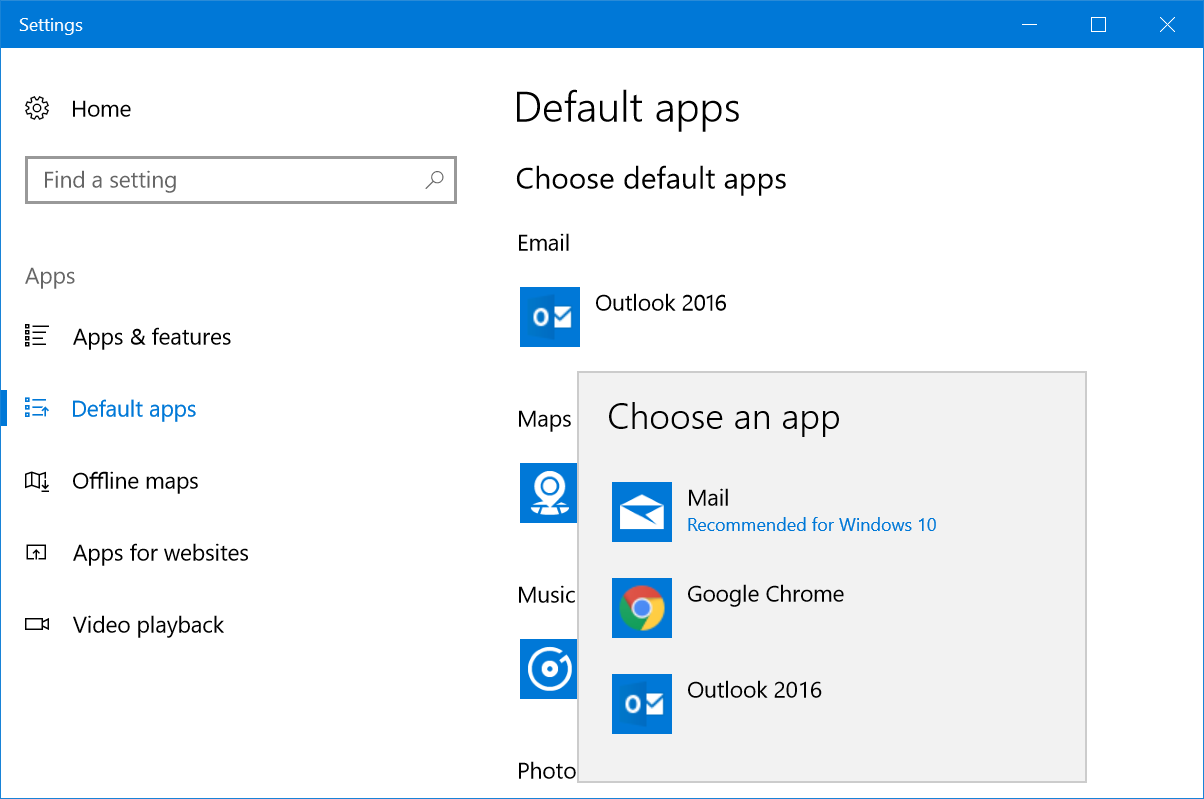
Click on any of the app to change the default settings. For example, you will see that Outlook 2016 has been set here as a default email client, however Windows 10 recommends using the Mail app. You can change the default Email client from Outlook 2016 to the Mail app. Click on Outlook 2016 and a popup will show all available email apps on your computer.

Change Default Email App

Select Mail app from the list and the default Email app will change immediately. However, should you want to change the web browser to Chrome or Firefox, Windows will push will push you to confirm the switch.

2. Additional Default Apps Settings

Scroll down the settings page to view additional options:

  • Reset
  • Assign app for file types
  • Setup apps for protocols
  • Set defaults by app
Resetting and Other Default Apps Settings

3. Resetting Default Apps to Recommended Apps

Windows 10 recommends apps like Mail for opening emails. If you have changed the default app settings, click on “Reset” button. This will help you to reset back the recommended apps as your default apps.

4. Choose Apps for File Types

Scroll down to the bottom of “Default apps” settings screen and click on the link on “Choose default apps by file type”. You will see a huge list of file extensions and the application you can use to open each file type. For example, the default app to open .pdf file is Microsoft Edge. However, you can click on it and change to Adobe Acrobat Reader.

Choose Apps for File Types

You will see a “Choose a default” option when there are no default apps available. This is a useful option to check and assign apps or install required apps to open a file type. So that each time you do not need to select or search the app.


5. Choose Default Apps by Protocol

Windows use many protocols to open specific files. For example, it uses the popular HTTP or HTTPS whenever you access a HTML webpages. It uses MailTo protocol for opening email messages. So, click on “Choose default apps by protocol” link if you want to set up default apps according to individual protocols. You can assign a new app when there are no default apps setup or change the existing app by clicking on it and choosing a new one.

Setup Apps Based on Protocols

6. Set Defaults by App

Windows 10 also allows you to set defaults for any installed apps on your computer. This feature is useful when you have multiple apps installed on your PC which can open same file types. Simple example is Firefox or Chrome which open HTML pages similar to Edge. Click on the “Set defaults by app” link and choose the app from the list. You will see a “Manage” button and click on it.

Set Defaults by Apps

On the next screen, you can assign the app to open supported file types.

File Types Supported by App

7. Accessing Default Apps from Control Panel

The problem with Windows operating system is that you can the same settings in different ways. Being said that, you could also access “Default apps” settings from Control Panel.

  • Press “Win + E” keys to open File Explorer.
  • Paste this path on the address bar “Control Panel\Programs\Default Programs” and hit enter key.
  • You will see the “Default Programs” settings open from Control Panel like below.
  • Click on one of the following links to go the “Default apps” settings as explained above.
    • Set your default programs
    • Associate a file type or protocol with a program
    • Set program access and computer defaults
Default Programs Settings from Control Panel

8. Choosing Default App When Opening File

It is difficult to setup the default programs in advance when you do not have a specific file on your PC. For example, someone can send you a YAML file in email and Windows 10 will not have any default apps associated to open .yaml files.
When you have a file with no associated apps, Windows 10 will show the file with plain white file icon. Double click on the file and choose “Try an app on this PC”.

Double Click to Choose App

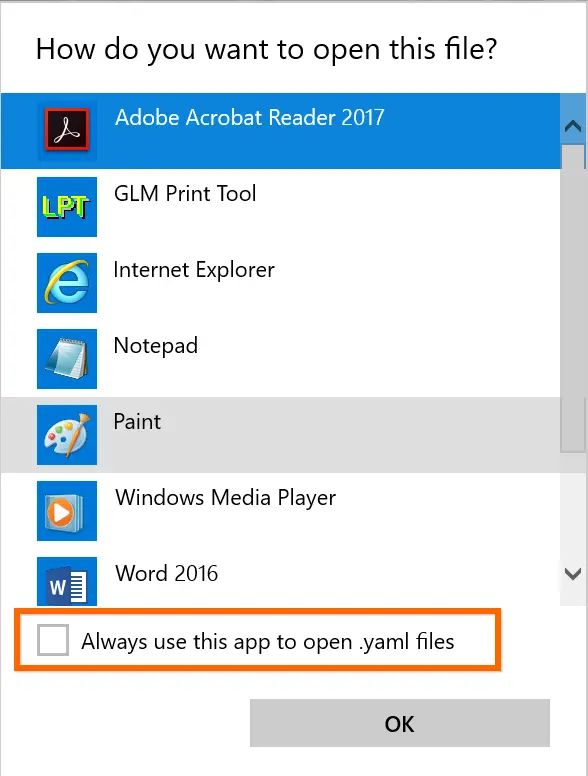
You will see list of apps that can help to open the file. Choose an app and click “OK” to open the file.
If you always want to open the file type with the selected app, then check the option “Always use this option to open .xxxx files”. Now that Windows will change, the file icon with the selected app icon file and always open the file with the selected apps. In this way, you can setup default apps when you received an unknown file type.

Set Default Apps
Set Default Apps

9. Change Default Apps

Finally, you may have another scenario wrongly assigned a default app to a file type. Do not worry! Right click on the file and you will see different content menu depending on the file type.

  • Click on “Open with…” option.
  • Select “More apps”.
  • Choose the app you want to change.
  • You can use different app for one time or check “Always use this app… option to change the default app.
Change Default App
Change Default App

On certain apps, the “Open with” menu will also show additional sub-menu items like below.

Sub Menu for Open With Option
  • Choose one of the available apps to open the file for one time with that app.
  • Select “Search the Store” to open Windows Store and search relevant apps to open the file.
  • Click “Choose another app” and choose another app that is not showing in the list. You can use the app for one time and set it as a default app.

Conclusion

Many times, you will receive unknown files from your family or friends and you cannot open in Windows 10 default apps. Now you know how to setup default apps, change them and search in Windows Store for relevant apps. Good luck!

Opening a Compressed File on a Smartphone
Renee asked about opening compressed files on her iPhone. I found this article which seems quite comprehensive. It would appear that a general purpose way of doing things is first to “share” the file to the Files application which is present on iOS after v.7. You can then do much more with the file once you’ve moved it out of the email application. A similar post for Android is to be found from this link.
Email messages going to Spam Folder which are legitimate
This is a problematic issue. Generally there may be a number of levels of Spam intervention, and it’s not easy always to detect where the incorrect marking is going on.
Here is a lengthy article that explains how email is marked as Junk, and how to prevent it happening (so-called Whitelisting) for a number of eMail providers …
When emails arrive from <insert email address here> they may periodically be placed in your junk or spam folder by your email software. The information below describes how to stop this from happening.  The first step is usually to add <insert email address here> to your email contact list (so they know you know us).
Why you may be having email problems
The volume of Spam/Junk Mail/Bulk Mail nowadays has caused ALL email providers to now “filter” your emails on their mail server before they deliver them to you.
Unfortunately these filters tend to be very aggressive and are far from fool-proof. It’s very common for email filters to mistake legitimate email for junk, so emails you wanted to receive don’t get delivered to you.
How your email providers filtering system works
When someone sends you an email, first it arrives at your email providers mail server (eg btinternet.com, yahoo.com, hotmail.com, gmail.com, msn.com, etc) where their system filters it by scanning it and checking it for spam.
If the email looks legitimate, they then deliver it to your inbox.
But, if their filter suspects that the email might be junk, it places it in a separate “junk” folder where you can go in later and review it to decide for yourself if you want to receive it or not.
Below are listed instructions on how to whitelist (allow emails) for the most popular types of email programs. For email programs that run on your PC as well (i.e. Outlook Express or Microsoft Outlook), please see your programs help files for adding <insert email address here> to your address book.
Whitelist Instructions (alphabetically)
BTInternet
BT Internet is now operated by Yahoo Mail – you can go to this link to discover more if you still have your email service from BT supplied by Yahoo and follow the link “Marking emails as Spam or Not Spam”. If your service is supplied by their “new” email service – BT Mail – use this link. Follow the Safe Senders link on this page.
Gmail
For Gmail, I would suggest you look at this link.
Hotmail:
Click the Options link, on the main menu tabs, then Safe List. Type: <insert email address here> in your Safe List. If you see a message that should not be in your Junk Mail folder, click ‘This is not Junk Mail’ to avoid having e-mail from the same source sent to the Junk Mail folder in the future.
Apple iCloud 
Manage junk mail using the online iCloud service.  Click here for guidance

Mozilla Thunderbird

Initially, the automatic junk mail detection for incoming messages might not be very accurate and you should check your Junk folder to see whether e-mail has been mistakenly detected as junk. To prevent this from happening in the future, you need to mark e-mail as not junk. Do this by right-clicking on the e-mail and choose “Mark -< As Not Junk”.
Outlook 2003
If the Junk E-Mail Filter accidentally catches mail from <insert email address here>, you can simply add the From address, <insert email address here>, to the Safe Senders list, and no future e-mail from this address will be inspected by the filter.

Yahoo! Mail (also BTInternet)

Yahoo mail filters work on the Yahoo server so your emails are filtered by Yahoo BEFORE they arrive at your computers email program. So, if you’ve looked inside the spam folder on your computer and the email is not there, it is most probably sitting in your other spam folder on the Yahoo server:
Open your Yahoo mailbox (http://www.mail.yahoo.com) or BTYahoo mailbox (http://www.bt.yahoo.com).
Click Mail Options.
Click Filters.
Click Add Filter.
In the top row, labelled ‘From header:’ make sure Contains is selected in the pull-down menu. Click in the text box next to that pull-down menu, then enter the address: <insert email address here>
At the bottom, where it says “Move the Message To:” select Inbox from the pull-down menu. Click the Add Filter button again.
If Alert has been filtered to your “bulk” folder, simply open the message and click on the “This is not Spam” link next to the “From” field.

Other providers:

If an obvious option is not available, try moving the message to your ‘inbox’ or forwarding the message to yourself.
If subsequent messages continues to be filtered, call or e-mail your ISP’s technical support and ask how you can be sure to receive all e-mails from <insert email address here>.
If you use a Web mail system or email application not listed above, the instructions for whitelisting our address will depend on the specific email program you are using.
If you access the help files, instruction manual or customer support, there should be instructions on how to do this.
In most cases, just by adding our From address, <insert email address here>, to your address book, safe list, white list or contact list will be sufficient.
Otherwise, the most likely course of action to provide a solution if all else fails is to select one of the emails from <insert email address here>  and click on the Not Spam or Not Junk button, if available.
For more information about your mail application, please visit the help section that is associated with your mail application.
Here are some relevant links:
An easy guide covering the same ground as above.
Virginmeda Email spam settings
If you’re with TalkTalk – there may be a bit of an issue!!
Sky’s email is provided by Yahoo! So follow the advice above and mark email as “Not Spam” – hopefully it will learn!
Generally, I recommend using Gmail and ignore the ISP’s email – it’s much easier to switch supplier. If you don’t want to use Gmail, then use Apple’s email or Microsoft’s email – you know they won’t disappear and will be reliable.
Mailtrack (for Gmail) to get Reply Receipts
You can get Mailtrack for Gmail (to work in Chrome/Brave) or as an Android app. There isn’t an iOS version currently. After you’ve installed Mailtrack you will get a screen like this when you open Gmail after connecting Mailtrack to a Google Account …

… you can then compose a message …

… and you have the choice of being notified, or not, about the reception of the message. Opening the Sent Folder, you will see this …

… which shows one green tick against the message – it’s been sent, but not read. In the recipient’s Inbox you might see something like this …

… the message hasn’t been opened yet. Once I’ve opened it, the message appears at the bottom of the email that the Sender has been notified of read receipt …

… and returning to the sender’s email Sent Box you can see that the message now has two green ticks indicating read as well as sent …

… I hope this helps. I haven’t found anything similar for the iPhone/iOS but I understand Mailtrack may be working on it.

Gear Guide
Has anyone bought, or obtained anything recently they’d like to tell us about? It doesn’t have to be a computer, laptop, tablet or phone – just something that’s digital, ie used a computer processor in some way?
Apps Galore
That slot in the meeting where members are encouraged to share their experience (and possibly excitement) at a new app they’ve started using for their smartphone, tablet, laptop or desktop machine.
What’s IT all about?
Not this week
Making your browser work for you
But first … LastPass. A password manager is an application that stores URLs that you ask it to together with the user credentials that you supplied the website with when you registered with it. There are a number of password managers – here’s one review of the best of them and here’s another one. I’ve been using LastPass for a number of years now, and I don’t propose to change! So, I’ll be focussing on showing you how I use it. [Dashlane does come out as a possible alternative though.] Although there are Free (or trial) versions of most of these, if you want to use the same system on more than one machine, or have a version that works on your smartphone/tablet as well then you’ll probably have to pay something to use it. Against this expense you MUST match the convenience of never having to write your user credentials (UserID and Password) down in a book, stick it on a Post-IT note on your computer or a scrap of paper that you never can find again! And that it is secure. How does it work …
An introduction to LastPass
Setting up a Family Vault
A complete list of LastPass Training Videos
Setting up LastPass as a Browser Extension
… so Extensions – making life easier?!? Available for Chrome (Brave), Firefox, Safari and Microsoft Edge. I’ll try and show you how they work, how to install them. The ones I like and use are listed below …
LastPass
Evernote – clips content from a webpage so that I view it offline, annotate it and Bookmark it for future reference. You could also use OneNote in the same way.
Pocket – again a Bookmark application that stores the content of a webpage online and then syncs it to your device for offline reading.
AdBlock Plus – blocks ads, allows you to Whitelist certain sites
Zoom – to change the size of the fonts on the webpage
Bitly – shortens a URL, also Tiny URL


Online banking and shopping – 10th October 2019

Welcome & Boot-up
Introductions for the last time!
What do you want / expect from the Group?
Please tick your attendance, pay £1.50 and agree that you want to join the “Thought grazing” website I run where the notes of the meeting are posted, and if you are interested in joining a WhatsApp Group.

For those who’ve expressed an interest in “Thought grazing” and establishing a WhatsApp Group, I’ll send out an email following the meeting with UserIds and Initial Passwords for new members. [You can change your password if you want to – I’ll write a post that explains how you can do that.] The Password for Protected pages on the website is the same as everyone’s initial UserId Password, namely – Ca3rdyddU3A
Does anyone have any difficulties in connecting to the Thought grazing website?
Does anyone want to join the WhatsApp Group but is unsure how to do it?
[Note for self … I need to add member to Contacts on my phone, then I can see them in WhatsApp to add them as a member of the Group. Easy when you know how … duh!]
Incidentally Paul has written a post detailing how you can add WhatsApp to a Tablet.
Do we all know the difference between Google and an Internet Browser?  – Don’t be shy. This is perhaps the most important thing to be sure about before we go any further. Two links to look at – Just google it … and the notes from the first meeting last year.
What’s happening to Digital Projects? Well the first one has been announced, it’s a re-run of a Digital Photography course using Adobe Lightroom and the first session is next Wednesday at Cornerstone on Charles Street at 10:00am.
Which brings me to our webpage on the new website, has anybody other than Paul and David had any ideas? Paul has suggested this for the photo – https://pixabay.com/photos/computer-laptop-work-place-mouse-2982270/ – seems a good one to me! David suggested a photo (at least on the page) of Turing’s first computer; or it could be Leo – the one at Lyons Coffee; or even both!
Any other ideas?
Visits. We agreed visits to the Barclays ‘Maker Space’ which Mario will arrange for us, see details below …
In addition, as part of our community commitment,  we have also opened a new office in Cardiff designed to help businesses grow and start up in Cardiff. Great for budding Entrepreneurs (which statistics show can be high in the over 50s)  and inventors. Part of the Eagle Lab office hosts  a “Maker Space” that houses laser cutting, vinyl printing, 3D printing, electronics equipment including soldering etc. It has a distinctly digital feel too with a really switched on Engineer running the lab. We can host groups there and would be happy to chat with your Digital Projects group and your Science groups coordinators, to discuss with them what is available there and whether they would like to bring members along to take a look at the facilities, or host a meeting there. Please feel free to ask them to contact me and I can discuss what they need, what we have, what we can do to support your members.
… in the approach to Easter, and also a visit to the new BBC Centre after Easter.
Fred has offered to contact Brains and their new brewery at Cardiff Gate for a visit before Christmas.
I was unsuccessful in my first attempt at getting a visit to the Computer Centre of Cardiff University, however a second request targeted more closely at a tour of the Machine Room was successful, so I’ve said I will try and arrange that after Christmas.
News and other issues raised
Renee asked about opening compressed files in emails on an iPhone. We got some way to solving that one, but agreed to take it onboard as a conversation on the WhatsApp Group. I must confess to having forgotten about this – apologies.
I’m convinced there was something else that I’ve forgotten, can you help me?
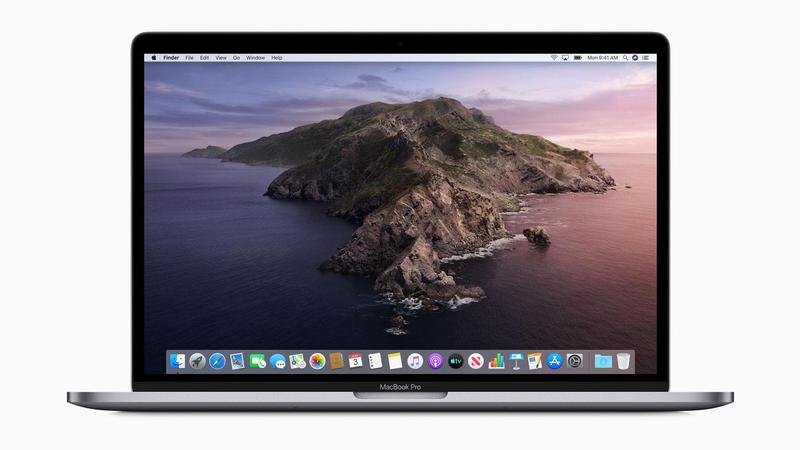
Finally Catalina – the new operating system for the Mac – was released this week (as expected). My advice, as ever – and this is true for Windows as well, is to wait – let others suffer the pain, rather than you, and as I’ve detailed before there may be issues for some of your apps. I’ve switched-off Office 2011 already as my default app on my Mac for opening Microsoft Office files, it’s now the Apple programs that open these for me, but you could chose Open Office, Libre Office or Google Docs – they are all compatible with the .docx, and .xlsx file formats. Here’s how you change the default apps to open a document for MacOS …
These screen shots are taken from my iMac running Mojave, but they should be pretty similar for older versions of MacOS …
To change which application a document opens in:
1. Right click on the document’s icon.
2. Choose File > Get Info.
3. In the Info window, click the disclosure triangle next to “Open with,” and choose an application to open the document from the “Open with” pop-up menu.
4. If you want all documents of this file type to open with the same application, click Change All.
The important thing for you to get rid of any vestige of Microsoft Office is to press Change All…
In my screen shots I have used Pages (Apple’s Word Processor), but you could use Open Office, Libre Ofiice or Google Docs.

Gear Guide
Has anyone bought, or obtained anything recently they’d like to tell us about? It doesn’t have to be a computer, laptop, tablet or phone – just something that’s digital, ie used a computer processor in some way?
Apps Galore
That slot in the meeting where members are encouraged to share their experience (and possibly excitement) at a new app they’ve started using for their smartphone, tablet, laptop or desktop machine.
What’s IT all about?
Not this week
Online banking, transferring money and shopping
A subject which brings fear and trepidation into most of us. Should we even consider using our computers when we need to supply personal information to “the internet”, and in particular information about our bank and credit cards.
I would be foolish to say it’s completely safe, as my story last year detailed, but taking reasonable care you should be OK.
Discussion
Online banking, debit and credit cards
Safe as long as you don’t leave your machine logged-in; you don’t use it from a free WiFi access area; and you password your machine with a reasonably strong password. The banks have recently all upgraded the process of logging-in that should make access for no-gooders more difficult.
Here’s a useful link that summarises the different levels of protection offered for credit cards, debit cards and PayPal (see below).
Discussion
Then there’s ApplePay and Google Pay – does anyone use them?
Paypal
You may have assumed that PayPal was only of use when purchasing from eBay, Gumtree or Preloved, but it can be used – when a website provides the option – as an easy way to pay for goods online, as you can tie your PayPal account to a debit or credit card. As the article quoted above mentions, PayPal has it’s own payment protection scheme, but if you tie a Credit Card to your PayPal account, you will get the protection offered by your Credit Card.

You can also transfer money (abroad as well) using PayPal by transferring the money directly to another person’s PayPal account. This is not the cheapest way of doing it as the Exchange Rates are not the most favourable, but it’s easier than transferring using your bank account. Although written by a competitor, this article summarises the ways you can send money overseas.
Discussion
Your money abroad
As mentioned above there are ways of easily transferring your money abroad of which perhaps the best known is TransferWise. It’s relatively easy to set up an account, and you can immediately see the cost of transferring money abroad compared to what it considers its competitors. You can even obtain a free MasterCard to use as you roam across Europe, the US, Australia, NZ and the UK.

Which? Review of using TransferWise
However, there’s a newcomer on the block which is even cheaper that’s worth taking a look at – Revolut. Both TransferWise and Revolut offer an app for your SmartPhone to allow you to do easy switching of money from your domestic bank to your online account, and Revolut also links to ApplePay. It’s easy to open a Revolut account, you transfer some funds to it and obtain a Visa Debit Card which you can then use in any ATM abroad, at low exchange rates and zero fees.

Here’s a comparison from Money Saving Expert of the Transferwise Debit Card with Revolut.
Here’s a link to a Which? Report on Challenger Banks and Revolut – you may not be able to see this – I have a Which? Online Account.
Discussion
Enough of Banking – what about shopping?
This could go on for a long time! Your experiences, please?
Any really good examples of a great online shopping experience?
Hints and tips:
Use all the facilities the retailer offers, especially if (like Amazon) they provide Two Factor Authentication (2FA) to protect your account; so it’s safe to store credit card details, and addresses on the site.
Use lists to save items you are interested in, but don’t want to purchase just yet; use your order history to re-order goods.
Remember, if you’ve relatives abroad you should look to open accounts with the local Amazon, or search for retailers in their countries that deliver – it’ll be far cheaper than sending it by post, but if you have to post look at this site – Parcel2Go – which you can use for UK postings as well and which you can arrange a local pick-up as well as pick-up from a local shop.


Watch out for Catalina!

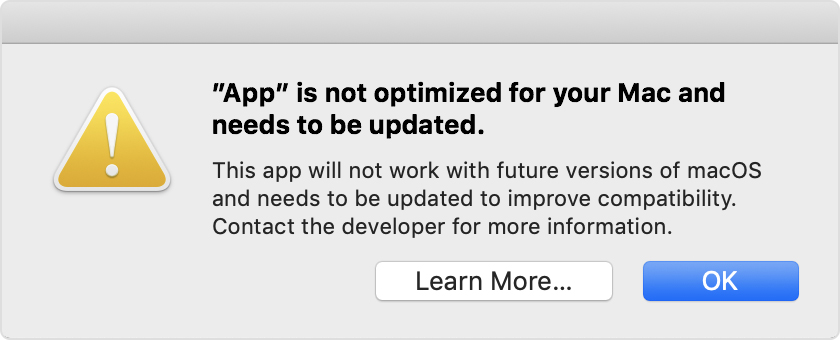
I was asked last week about a message that had appeared on a Lightroom 4 users’ screen with this warning …

… scary eh!?
Well yes it is but if you’ve got a relatively new Mac you do have the choice NOW of making sure you have the latest version of software that will support older versions of Lightroom, and do an upgrade to Mojave (v.10.14) BEFORE Catalina (v.10.15) is released later this year – probably in October. That way you’ll be nearly up-to-date with your version of MacOS and that may be sufficient for you if you don’t feel the need to have the latest version of MacOS.
If you have Lightroom 6 installed (or even 3, 4 or 5), you may be getting the message above EVEN THOUGH it is a 64-bit app. This is because the Installer/Uninstaller and Activation code software is 32-bit. That means the software “should” continue to work, but you won’t be able to re-install it to a MacOS of Catalina (v.10.15), or later.
The only other alternative if you want to stick with Adobe Lightroom is to swallow hard and subscribe at £9.98pm to the Photography Plan of Adobe’s Creative Cloud programme. You do get Photoshop as well as what Adobe call Lightroom Classic, plus their in the cloud version of Lightroom which they (confusingly) call Lightroom!
Adobe detail the changes and implications in this blog post. Another post from Laura Shoe Training gives more information here.
UPDATE: I’ve just read this really useful and interesting article from the magazine MacWorld – I suggest you read it too – and I’ve found out that Microsoft 2011 and Picasa (amongst others on my iMac) will not work with Catalina. Whilst I’m not particularly concerned about losing either of these as there are alternatives I’m already using – such as (in the case of the former) Google Docs, Open Office, Libre Office or Apple’s Pages, Numbers or Keynote applications – it’s better to be prepared and to have made the decision to move before I have to jump! Also in the case of Picasa, that I haven’t got anything in the database that I haven’t catalogued elsewhere – I think that unlikely, but I ought to check!
I’ve also stumbled upon an entry in “About This Mac > System Report …” which you get to from the Apple Icon in the top-left corner of your desktop. Go to Software and if you’re running Mojave there’s an entry called Legacy Software. Look at that and you’ll be able to see quickly what software is unlikely to work in Catalina. If you’re running an earlier version of MacOS go to Software and click on Applications and look for non 64-bit applications (a column to the right of the window).
Other links worth following …
MacOS 64-bit – what it means to you
32-bit app compatibility for Macs with current Mojave operating system


Adding Whats App to a non SIM card Tablet / Pad

Equipment Required: Tablet, £1 Pay As You Go SIM card, Spare Mobile phone.
You probably have a Whats App account associated with your phone.
You may have a tablet and wish to use Whats App on that tablet.  This method gives you a second Whats App account – separate from your original one, – Don`t confuse the two !
1    Obtain a £1 PAYG  SIM card from any store
2    Insert the SIM card into the spare phone, there is no need to make any calls, or send texts & hence no requirement to “Top Up” the SIM card
3    Record this phone number and leave the phone turned on
4   On Your Tablet, Download Whats App from Google Play or Apple Store,Select a name you wish to be known as on this Tablet account (different from your normal Whats App account on your normal phone)
5    When the App requests the Tablet to provide a VERIFICATION phone number, enter the Phone Number of your PAYG SIM card from step 3
6    Whats App will send a verification Text to the phone, Confirm the Text if required
7    You are now up and running and can Whats App to and from the Tablet, you can now switch off and forget about the spare phone as it is no longer required.
Enjoy…..
Paul